August 05, 2016

A Boy Named Queen

Written by Sara Cassidy
Groundwood Books
978-1-55498-905-8
80 pp.
Ages 8-11
August 2016
Reviewed from advance reading copy

Writing a great early reader or middle grade novel is very, very dificult.  The writer has to ensure that there is enough substance–in the story and characters and writing–to support the interest and reading demands of just a sliver of the youthful reading population.  How do you give the reader all that and at an appropriate reading level and in a limited number of pages?  I’m especially flummoxed how author Sara Cassidy, who has written both early readers and hi-lo fiction for teens, could pack so much flavour and sensory lushness into A Boy Named Queen’s mere 80 pages.  While the story is built on  the simple platform of a new friendship, Sara Cassidy has a created a rich landscape of people, places and experiences that heightens the story beyond that humble premise.

The story begins with the last day of summer protocols for Evelyn and her parents as they prepare both girl and house for the beginning of the new school year.  Little does Evelyn realize that her annual shoe-buying trip, normally for the dreaded loafers, would be “the last day of my old life” (p. 18) and herald a new life with sneakers–even if they’re too tight–and a new friend.  Grade 5 with Mr. Zhang becomes ever so much more interesting when the confident and distinctive Queen, a long-haired, brogue-wearing boy, joins them.  He’s like no one she’s ever met.  Even his dog, Patti Smith, who follows Queen to school that first day, is unique, though promptly retrieved by Queen’s pick-up driving rocker of a dad.

The burgeoning friendship between Evelyn and Queen begins with Evelyn trying to be nice to the boy who is obviously used to be ridiculed for his name and sense of style but who is self-possessed enough to withstand it.   He shares with her his strategy of creating an imaginary force field that both protects him from the cruel things that some may say or think as well as points all good things directly to his heart.  

I love Queen for his sensitivity and courage.  
“My name is handy.  I watch how people act when they hear it for the first time.  It shows me what  kind of people they are.” (p. 64)
But I love Evelyn even more for the colour she perceives in life, from her new runners,  that
“bend with her feet.  The soles are like licorice instead of breadboards.” (p 15)
to Queen’s freckles,
“His freckles outnumber even Evelyn’s.  But they’re strong spices–cinnamon, paprika–compared to Evelyn’s weak tea stains.” (p. 20)
and even Brussel sprouts,
“Evelyn doesn’t like Brussel sprouts.  They taste like her fingers taste after she’s held her house key for a while. “ (p. 50)
She is a young girl with eyes and heart wide open to goodness and joy, and Sara Cassidy ensures that Evelyn is receptive to a heartening friendship with A Boy Named Queen. 

August 03, 2016

With Malice

by Eileen Cook
Houghton Mifflin Harcourt
978-0-544-80509-5
316 pp.
Ages 13+
June 2016

Eighteen-year-old Jill Charron just wants the truth.  Waking up in a hospital room without any memories of how she got there and struggling to find words because of a brain injury means that getting at the truth is not going to be easy.  As the byline to the book states, "The truth is how you tell it" and it seems the truths are multitudinous and varied.

Jill's divorced parents seem to want to keep a lot of truths from her, especially the key one that Simone McIvory, Jill’s best friend, was killed in the car being driven by Jill while on a school trip in Italy.  The police, both American and Italian, as well as Evan Stanley, her high-priced lawyer, are badgering her for the truths she can’t remember.  And everybody else, from other students on the trip, to newspaper reports, crime drama series, and subscribers to the “Justice for Simone” blog are more than willing to share their opinions as to the truth.  But what is the truth and is there only one?

While Jill, whisked back to the States by her rich and demanding father, endures rehab and counselling to help heal her body and six weeks of memory loss, the police interview Simone’s parents who portray their daughter as a confident and popular teen with old-fashioned values, and Jill as a less well-liked girl from a broken home and desperate for attention.  Though the strength of their friendship is recognized by many who knew them, different stories arise with regards to the two girls-chilly or friendly, studious or popular, jealous or self-centered–by those who knew them well or just marginally and even by those who’d never met them but nastily weigh in on the news story.
“It doesn’t matter what’s true–what matters is what people believe.” (pg. 102)
Eileen Cook brilliantly layers the multifaceted truths recounted in blog posts, transcripts of police interviews, newspaper articles, yearbooks, and other media as she intricately develops the subplots of With Malice, all with the purpose of revealing what actually happened to Simone and Jill in that car in Italy.  Below the very concrete mess of a mangled car lies a substantial mess of romance, anger, pettiness, jealously, hurt and misplaced affection.  The ultimate truth is both expected and surprising and Eileen Cook reveals it with breath-taking patience, taking YA readers on a suspenseful read all the way to the end before exposing a friendship admittedly more fragile than honest.

August 01, 2016

Pandas on the Eastside

by Gabrielle Prendergast
Orca Book Publishers
978-1-4598-1143-0
192 pp
Ages 9-12
October, 2016
Reviewed from advance reading copy 

Never underestimate the power of goodness to overcome that which others consider weaknesses: youth, poverty, lack of education, dysfunctional families.  Ten-year-old Journey Song doesn’t.  She sees beyond the slummy side of the 1970s Eastside of Vancouver and sees a community of friends, that includes classmates, school staff, street people and local merchants.
Some people call the Eastside a slum.  That’s because they are describing buildings and roads instead of people.  To them, people on the Eastside probably look poor, sad, uneducated, sick and worthless.  But I don’t care what they think.  To me, the people around here are friends. (pg. 1)
And she’s going to need all of them in her mission to help the pandas housed in limbo at a local warehouse while the governments of China and the United States engage in a bureaucratic kerfuffle regarding action during the Vietnam War.

Though Pandas on the Eastside is narrated by the youthfully buoyant voice of Journey, each chapter brings another Eastside community member to the forefront, from homeless Kentucky Jack and mentally ill Contrary Gary, to teacher Miss Bickerstaff and her black boyfriend Ben Wallace, and Officer Pete Baker, and grocer Mr. Huang. Everyone adds to Journey’s story, not the least of which is her father whom she meets for the first time, finally answering some of her questions about her heritage.  But, just like everyone else on the Eastside, it doesn’t matter where you come from but who you are now. For Journey, her now involves helping the pandas and hopefully spreading some happiness in a world filled with war and sadness and conflict.

Gabrielle Prendergast, who made her literary mark with young adult novels in verse Audacious (Orca, 2013) and Capricious (Orca, 2014), demonstrates a formidable skill for writing an intricately-plotted, character-filled middle-grade novel that confronts prejudice without preachiness.  Yet it’s Gabrielle Prendergast's rich setting that truly drives the story, providing the impetus for action and consequently acceptance.  Pandas on the Eastside is an uplifting story from a time long-gone but a place ever-present in heart and geography.


(A version of this review was originally written for and published in Quill & Quire, as noted in the citation below.)

Kubiw, H. (2016, September). [Review of the book Pandas on the Eastside, by Gabrielle Prendergast]. Quill & Quire, 82 (7): 37.

July 26, 2016

Eden Mills Writers' Festival 2016


If you're starting to see ads for back-to-school and despise being reminded of this early but unavoidable proclamation of fall, focus on a great September event that gets children, young adults and adults clamouring for books and CanLit.  On September 18, 2016,  it's the 28th annual Eden Mills Writers' Festival, an outdoor literary event on the banks of the Eramosa River in the village of Eden Mills, Ontario. Amongst the numerous authors, illustrators, poets and musicians attending are these fine youngCanLit writers and artists.  Come for the words!


Young Adult Authors

R. J. Anderson


Lena Coakley


Douglas Davey


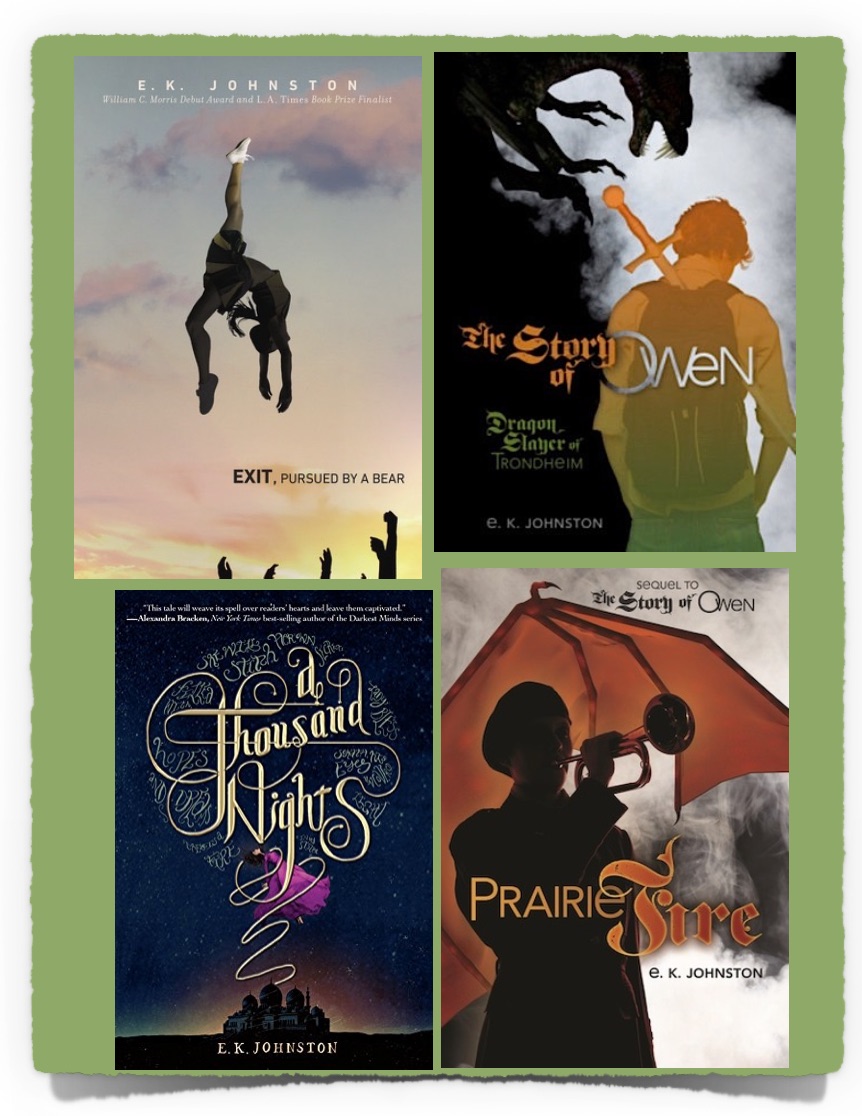
E. K. Johnston


Amanda West Lewis


Sylvia McNicoll


We regret to announce that Lisa Moore is no longer able to join us this year.


Jane Ozkowski


Liane Shaw


Children's Authors and Illustrators

Deborah Hodge


Elly MacKay


Zig Misiak


Jael Richardson


Philip Roy


Joel Sutherland


Eric Walters

It's a glorious day of books and readings and authors' signing books and book sales and magic (really, Ben Caeser the magician comes to the children's venue) and music and poetry slams and new writers showcasing their works and great food and a fabulous setting.  I'll be there.  Will you?


Details about times, tickets, parking, directions and more may be found at https://emwritersfestival.wordpress.com


July 25, 2016

Last Chance Island

by Norma Charles
Ronsdale Press
978-1-55380-458-1
228 pp.
Ages 10+
March 2016

The cover art of Last Chance Island put me in mind of a maritime story that I was sure took place off the coast of Canada on the Atlantic side.  North Atlantic Ocean, perhaps, or the Celtic Sea, but Canada, definitely not.  Last Chance Island, the island of the title, is the journey’s end of  the two protagonists of Last Chance Island,  the book, which is told in the alternating voices of thirteen-year-old Kalu of Nigeria and fifteen-year-old Canadian Lily Spiekeford a.k.a. Spike.

While Kalu and his young cousin Aisha escape an attack on their African village by rebel soldiers, Spike is being sent home from boarding school upon learning  of her father’s death.  As much as both parties would love to stay put, unforeseen circumstances propel them away from their homes.  Kalu, with only a few pebbles and herbs and his bamboo flute as mementoes of home, takes Aisha to a small seaside village, hopeful of getting work on the boats.  Finding nothing, Kalu makes himself available to a less-than-honest fisherman he calls Mister Elliot, squirrelling Aisha away on board.  Meanwhile, the purple-haired, nose-ringed Spike is being sent away by her father’s live-in girlfriend to stay with Maureen Calhoun, a relative of Spike’s dead mother, who is a lighthouse keeper on Last Chance Island off the coast of Ireland, hopeful the girl will find a place “where you’ll belong.” (pg. 17)

Upon learning that the Irish coast guard is checking for illegal migrants and apprehensive about being caught with more than just his smuggled contraband, Mister Elliot drops the kids off at the island, promising to return when it’s safe.  On the other side of the small island, Spike is being delivered by the water taxi of old Seamus who recognizes her as Lela’s daughter and tells her of Lela’s family living on the island, which he calls the “Beginning Place.” (pg. 55)

You know that the two sides are going to meet and it is fortunate for them to do so, even though Kalu is desperate to survive while waiting for Mister Elliot’s return, and Spike is bidding her time until she can escape the island and return to Dublin to join a group of street musicians she’s met.  It’s the meeting of Spike with Kalu and Aisha that brings them all to realize that Last Chance Island has become their new home.

Norma Charles, whose book Run, Marco, Run (Ronsdale Press, 2011) also focuses on a young person escaping to a new home, contrasts the very different lives of Kalu and Spike as beginning places but demonstrates that circumstances can bring unlikely allies together in purpose and acceptance.  The stories of Spike and Kalu may be on different trajectories but these paths are destined to collide at Last Chance Island, which thankfully is more opportunity than just destination terra firma. Norma Charles ensures that Last Chance Island becomes more than just a beacon for marine travellers; it is safe haven for a few lost souls too.

July 15, 2016

Feathered

by Deborah Kerbel
Kids Can Press
978-1-77138-341-7
144 pp.
Ages 9-13
April 2016

Hope can take many forms and be elicited in a myriad of ways.  For Finch Bennett, an eleven-year-old girl in the summer of 1980–a time of Terry Fox’s Marathon of Hope, the hostage crisis in Iran, and the Rubik’s Cube-she needs to find some hope, somewhere, anywhere.  Her father died of cancer less than a year ago, her grieving mother is despondent and oblivious to Finch and her older brother Harrison who is also seemingly indifferent to the young girl, allowing his friend Matt to relentlessly torment her.  For Finch, hope might be found in the tiny scar on her neck from which a single white feather had been removed at age 3.  With that scar, Finch reassures herself that a better life, perhaps one of feathers and flight, might emerge.
“That night, I dream about my feathers.  They’ve grown in all white and fluffy and smooth.  And I’m happpy because it means I’m finally able to fly away. I spread my feathered arms and fly up, up, up to where I think I’ll find heaven…where I know I’ll find Daddy.” (pg. 49)
With the arrival of their new neighbours, Finch sees another opportunity for hope, especially with making a new friend of eleven-year-old Pinky Nanda.  This would  be particularly important once dreaded school starts.  School is where Finch is called slow and lazy. It’s where she has major difficulties with writing. And it’s where she sees her former best friend, Karen, has blossomed into a young woman and hangs out with similarly pubescent girls.  But Pinky and her younger sister Padma are staunchly protected by their parents, who argue about how Punjabi Hindus are treated in Canada and do not permit the girls to interact with others.
“It’s at that moment when I see myself right there in her face.  I see a girl who’s trapped in a mess of grown-up problems.  A girl who’s struggling just to figure it all out.” (pg. 94)
Strangely Finch’s only friend becomes an anonymous writer with whom she communicates on a bathroom stall door. That is, until Finch finds the courage to untether herself and communicate her feelings, good and bad, with those impacting her life.

Deborah Kerbel may have written Feathered as a middle-grade novel but Feathered is much more sophisticated than much pedestrian MG storytelling. The writing is brilliant, demonstrating  much depth of spirit and story, taking Finch and the reader beyond the obvious and into the realm of optimism and possibilities, where even a little girl can see that she has it in her to soar above the commonplace and anticipate greatness of action and virtue.  Just like Terry Fox, Finch learns to recognize that the will to try is within her and she may or may not succeed, but there’s always the promise that comes with dreaming.

July 11, 2016

Door into Faerie: The Shards of Excalibur, Book 5

by Edward Willett
Coteau Books
978-1-550506549
196 pp.
Ages 13+
June 2016

Ariane Forsythe, the heir to the Lady of the Lake, and her  boyfriend Wally Knight, successor of King Arthur, are on their final quest to locate the fifth shard of Excalibur, the hilt, and reforge the legendary sword.  That is, unless computer magnate Rex Major a.k.a. Merlin and Wally’s sister Felicia a.k.a. Flish don’t discover the hilt first, allowing them to claim the whole sword.  With both sides endowed with magic and power and harbouring two shards, it’s anyone’s game in Door into Faerie, the final book in Edward Willett’s pentalogy.
Magical quests are easy; family is hard. (pg. 30)
Having been away for five months from his family, dysfunctional as it is–dad with his girlfriend, mom often off filming and his bullying sister now aiding Merlin–Wally convinces Ariane to transport them to Scotland where his mother is working on her lastest film project at Castle MacPhaiden, named for her side of the family.  Unfortunately, Rex Major and Flish are already there and Wally suspects that, because his mother is researching family legends, Rex Major believes she’ll discover something that will lead them to the hilt.  But Ariane and Wally are the first to realize that the treasure his Great Grandfather Knight had fled to Canada claiming to protect is actually that final piece of Excalibur.  So, the race to the grounds of the historic site Cannington Manor in Saskatchewan and unearthing of the hilt ensues, but not without a little frustration, a whole lot of magic, some familial obstacles, and a climactic battle.

While Edward Willett may not exactly conclude his Shards of Excalibur series with Ariane and Wally fulfilling their quest of retrieving the sword for the Lady of the Lake (you’ll need to read the book to understand that), Door into Faerie closes favorably in more ways than one and Excalibur is not the only entity that is rebuilt at its finale.  This fifth book is as forged with magic, conflict, action and travel, as well as a little history, as the earlier four books–Song of the Sword (Coteau, 2014), Twist of the Blade (Coteau, 2014), The Lake in the Clouds (Coteau, 2015), and Cave Beneath the Sea (Coteau, 2015)–but family, which has always been important, becomes paramount.  Brothers and sisters Merlin and the Lady of the Lake, and Wally and Felicia, as well as mothers Emily Forsythe and Jessica Knight, drive the story, and ultimately help resolve its plotlines, a monumental task in a fantasy based on the Arthurian legends.  Yet Edward Willett accomplishes this easily with his consistent intensity and fluidity of plot progression.  The rebuilding of Excalibur may be the final outcome but it’s the quest that is the journey that regales readers right through the series.