December 21, 2021

The Strangest Thing in the Sea (and Other Curious Creatures of the Deep)


Written by Rachel Poliquin
Illustrated by Byron Eggenschwiler
Kids Can Press
978-1-77138-918-1
32 pp.
Ages 7-10
October 2021

The dynamic duo of Rachel Poliquin and Byron Eggenschwiler who created Beastly Puzzles (2019) have returned with a second non-fiction picture book that doesn't just impart information. Rather, The Strangest Thing in the Sea makes young readers think about the creatures of the ocean, especially the more unusual ones, by looking at their attributes from a different perspective, before revealing who they are.

From the onset of the book, Rachel Poliquin intrigues with her mysterious intro.
The seas are filled with strangeness.

Dancing feathers. Goblin teeth. See-through heads.
Creatures that seem to be made from stardust.
Then the book becomes a series of double-spreads with fold-outs imploring the reader to guess what the creature is before revealing what it is. From the swimming head (ocean sunfish) and the spooky creature with attributes of a witch, a goblin and a ghost (goblin shark) to an alien-like fish with see-through head (barreleye fish), all manner of fish, crustaceans, invertebrates and more are revealed. And revealed is the key word here, because Byron Eggenschwiler first illustrates the creature based on its description before the young reader flips open the fold-out to reveal the true creature of the deep.
I look like a tiptoeing 
rock wearing a wig. 
I even have a bow in 
my hair, sort of.
 
Am I the strangest thing in the sea?
From The Strangest Thing in the Sea by Rachel Poliquin, illus. by Byron Eggenschwiler
For example, this description gives us a rather weird red-haired rock with sneakers and a hair bow before it is revealed to be a hairy frogfish. Speaking in first person, the frogfish explains what it looks like and what it can do, all supported by information boxes that clarify in scientific terms its morphology, habitat, food and behaviour. It's definitely informative but also inventively creative, letting the imagination play in its thinking about the creatures that exist deep in the ocean.
From The Strangest Thing in the Sea by Rachel Poliquin, illus. by Byron Eggenschwiler
By blending scientific information about a diverse assortment of creatures found in the sea with illustrations of strange underwater worlds, Rachel Poliquin and Byron Eggenschwiler bring intrigue with the curiosity and learning. Moreover, by basing the book in the titular question–"Am I the strangest thing in the sea?"–with answers directly from the creatures themselves which are only revealed by spreading open the foldout, author and illustrator make the reading of The Strangest Thing in the Sea an interactive experience.
From The Strangest Thing in the Sea by Rachel Poliquin, illus. by Byron Eggenschwiler
With a riddle of words and a flick of a page turn, The Strangest Thing in the Sea takes non-fiction reading from one of taking in the information to one of connection. Children will hopefully think about the clues as read and seen and try to piece together what each creature could be. They might not know the solution right off or at all but the revelation in text and art will be a valuable surprise and an educational moment. And Rachel Poliquin and Byron Eggenschwiler keep up that atmosphere of the unknown and the odd through their words and illustrations. Rachel Poliquin plays up images of aliens, fighter jets, fanged monsters and walking rainbows while Byron Eggenschwiler, with his dark, weird and wonderful art, emulates it through a mash-up of cut-paper, paint, coloured pencils and digital renderings. 
 
As curious and unpredictable as it is, The Strangest Thing in the Sea is still grounded in a non-fiction tradition of informing through scientific fact, glossary, infographic and more, though there are a few surprises. For example, there is an answer to the question about the strangest thing in the sea. It's not what might be expected but it is surely as unique and astonishing to those that live there as they are to us. Fittingly, it reminds us that perspective is perception and facts can be rendered to change that perspective. So, is it the strangest thing in the sea? You decide after your own reading of The Strangest Thing in the Sea (and Other Curious Creatures of the Deep).

December 14, 2021

I Love You More

Written by Emil Sher
Illustrated by Barbara Reid
North Winds Press (Scholastic Canada)
978-1-4431-7580-7 
32 pp.
Ages 0-8
December 2021/January 2022

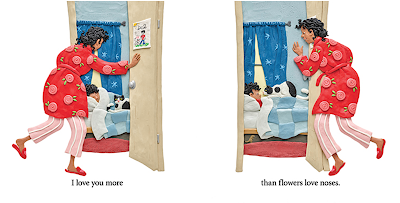
We know that telling someone you love them is special but how to express the measure of that love? In Emil Sher's newest picture book, which could only have been given the depth of emotion that Barbara Reid's textured art could convey, it's a game of whimsical comparisons and heartfelt declarations that demonstrate that there are so many ways to love.
From I Love You More by Emil Sher, illus. by Barbara Reid
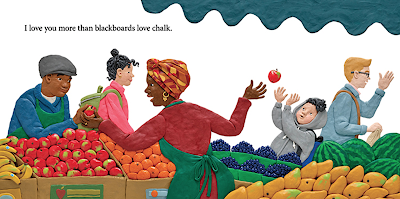
From an early morning greeting–"I love you more than flowers love noses" through breakfast and a walk to school, a mother and child express their love and witness those expressions by others. From the schoolyard to the classroom, and a mom's lunch on a park bench, there are so many vignettes that show connections and affection. Parents and caregivers are there for the children before school–"I love you more than laces love shoes"–and picking them up after school to return home, with everything showing closeness and linkages. ("I love you more than stars love wishes" and "I love you more than pianos love hands" were two of my favourites.) And as the day ends, with mum falling asleep on the couch, a child uses words and actions to express his love.
From I Love You More by Emil Sher, illus. by Barbara Reid
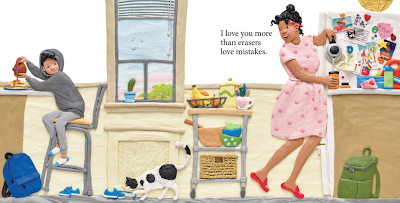
Emil Sher explains the word game that he and his family played comparing affection with a connected pairing like erasers and mistakes, runways and planes and answers and question marks. Not only does I Love You More communicate loads of messages of things that go together, it offers light-hearted word play off of which Barbara Reid's artwork bounces in delight. Using her trademark plasticine in bright colours and detailed settings inside homes, multi-storey buildings, schools and on streets, Barbara Reid gives life to Emil Sher's text. There a calico cat that cuddles, cleans and plays, neighbours that enjoy their balconies and children unique in their own ways. Not only do we see the city in all its glory, we see the life that gives and feels love.
From I Love You More by Emil Sher, illus. by Barbara Reid
The first reading of I Love You More will give young readers some laughs for the playful pairings and affection conveyed as well as the basis for playing their own word game. But subsequent readings–and there will be more readings–will give them opportunities to delve into the illustrations' details and give them food for thought about what it means to be connected.

December 10, 2021

Song for the Snow

Written by Jon-Erik Lappano
Illustrated by Byron Eggenschwiler
Groundwood Books
978-1-77306-268-6
44 pp.
Ages 3-6
September 2021
 
Here in our northern climate of Canada, we can almost always be assured of snow sometime in the winter season. One year may vary from the next in terms of snow load and snow type–fluffy or wet–but we know that in most places in Canada, snow will come. But what if it didn't?
From Song for the Snow by Jon-Erik Lappano, illus. by Byron Eggenschwiler
Freya loves the snow. She dreams of it and anticipates its return come winter. But it has been two years since the weather has been cold enough for the snow to come to her town and her memories of it are beginning to fade. 
Maybe the snow is lost, she thought.
At the market, where everyone is dressed in light jackets and sweaters and definitely no snow boots, Freya hears a tune that draws her to a trinket table with a woman holding a beautiful snow globe. She tells Freya that the song is very old and special, once sung every winter to call the snow home. Then she gifts Freya with the snow globe.
From Song for the Snow by Jon-Erik Lappano, illus. by Byron Eggenschwiler
At home, her mother recalls the tune and sings her the words her grandmother once sang.
"Come home snow," she sang.
"Fall from high...
cover the trees and fill the sky..."
From Song for the Snow by Jon-Erik Lappano, illus. by Byron Eggenschwiler
For days, Freya sings for the snow to come but there is still no snow. She fears it may be too far away or perhaps she isn't singing it right. Then she wonders if more voices are needed and she enlists the help of her classmates to spread the song.
As they sang, distant memories of cozy, snow-filled nights returned to their parents.
And those parents hum the tune as they go about their days, spreading the song into homes and hearts. What happens next is the stuff of legends.

Young readers may anticipate the ending for Song for the Snow but it is no less gratifying, especially for young Freya whose calling it was to bring the snow home. Her connection with snow drew her to the globe and sharing the song, all of which resulted–or did it?–in the return of the snow. Whether it is to be believed by readers or not, it happened, and Jon-Erik Lappano's telling of this fable makes it real. It tells children that it's possible to dream and to wish for things hard enough to make them come true. (I wouldn't be surprised if there are little ones out there who will want to know the tune so they can sing it when they too want the snow to return.) Jon-Erik Lappano tells the story like a recount, a tale passed down, like the song, through generations to remind young readers that they have the capacity to change things. In our tenuous environmental circumstances, Song for the Snow is a lovely push for children to do what they can to make the world the one they want. And it's told so tenderly, never harsh or in your face. Like a blanket of snow, it coats its message of caring action with patience and perseverance and connection.

The artwork by Byron Eggenschwiler gives Song for the Snow a Scandinavian feel from Freya's knitted sweater to the cable-knit feathers of herself as a dream bird. In fact, the art is very reminiscent of Jan Brett's winter tales, perfect for important messages and a cold landscape. Byron Eggenschwiler's digital illustrations are subdued and yet robust in their somberness, infused with a darkness of wishes unfulfilled with only flakes of lightness for the music and snow.

Whether you already have snow on the ground or are only wishing for it, Song for the Snow will give hope that wishing with action can make dreams come true. Freya proved it.

December 08, 2021

My Words Flew Away Like Birds

Written by Debora Pearson
Illustrated by Shrija Jain
Kids Can Press
978-1-5253-0318-0
40 pp.
Ages 4-8
October 2021

There are all kinds of fitting in. But when you're new to a country with a new language, it is especially hard. Not only are you missing your old home with its familiar people and places, you're in a new place where communication is near impossible. For the child in My Words Flew Away Like Birds, she is completely unprepared for the vacuum of language with which she and her parents must endure.
That was my world 
back then.
This little girl remembers the trees, the noisy market, her grandfather's bakery, and her friends. In preparation for their move, her mother teaches her some rudimentary phrases that should help break the ice, like "Hello, how are you?," and "It was nice to meet you.
From My Words Flew Away Like Birds by Debora Pearson, illus. by Shrija Jain
The words felt strange 
and lumpy 
in my mouth.
But, though she is amazed by the things she sees, like snow and a dog in a coat and booties, everyone speaks so fast in her new country and she cannot grasp the words or their meaning. She tries desperately to watch and listen but she feels so lost. 
From My Words Flew Away Like Birds by Debora Pearson, illus. by Shrija Jain
It's not until the next spring when she helps a little girl who falls off a playground swing that she can use one of her learned phrases, experiment with echoing the other child's words, and finally make the connection that makes her feel she belongs.

Many of us know what it's like to travel to new places where different languages are spoken. If we're considerate, we try our best to communicate in their language but appreciate it when the locals help us out by speaking in ours. But for immigrants, immersion in a new culture with a new language is undoubtedly daunting. Not only do they have to navigate bureaucratic and new cultural norms, they often must do so in a new language. For children who are desperate to make connections at school or in their neighbourhoods, how do they do this without words? Fortunately, what the child in My Words Flew Away Like Birds realizes eventually is that kindness and play have no language barriers and learning only happens when mistakes are made. These are both simple and complex messages and Debora Pearson shares them with a convincing text rich in auditory embellishments and striking dialogue, emphasizing what is most important to the young child. She'll remember the sounds she hears and the muffled vocalizations, hand-lettered for emphasis, until they can become words to her, words that don't fly away but instead are ones she can grab hold of.
From My Words Flew Away Like Birds by Debora Pearson, illus. by Shrija Jain
Artist Shrija Jain's pen and ink illustrations, which were coloured digitally, underscore the importance of the words and the connectivity between child and place. Using only pastel shades of blue, rose, purple and orange to offset the vivid black details of hand-lettered words, the immigrant family and those with whom they interact, and sparse landscape elements, Shrija Jain demonstrates what is truly important: connection through communication in all its forms and efforts.

This child may feel like the words of her first language flew away but she does find some new words and is delighted to move forward and recognize that "these words are here to stay." As with much learning, it happens with time and practice, and that includes mistakes, and the making of connections to make that learning worthwhile.

December 03, 2021

I'm Good and Other Lies

Written by Bev Katz Rosenbaum
DCB
978-1-77086-632-4
211 pp.
Ages 13+
September 2021 
 
It doesn't take long for me to start feeling a constant pit of dread in my stomach. The future... (pg. 108) 
 
Seventeen-year-old Kelsey Kendler has every right to be anxious about her life. If the recent past is any indication, things are not heading in the right direction. And the COVID-19 pandemic hasn't even hit yet. There will be lots more to set her off kilter and how she manages is only partly up to her. Parents, friends, school, work and social media will all have a hand in taking her down or bringing her up.

Kelsey and her parents Hannah and Mark have just moved from fashionable and wealthy Rosedale to transitional Parkdale because of Kelsey's celebrity comedian mom's fall from grace. Perennially stoned, drunk or abusing her pain meds, Hannah Kendler, a former participant on "Those Crazy Comics" TV show, is now unemployable and a raging, confused mess. Sadly, Kelsey's dad is less than helpful, either arguing with his wife or avoiding the household altogether. Not surprisingly, Kelsey vows to make some meaningful connections outside of their rat-infested house. There's Molly, a classmate whose perfect family doesn't prepare her for meeting the out-of-control Hannah, and crush Luca, which whom Kelsey begins a textlashionship. But, best of all, Kelsey gets a part-time job at an ice-cream place called Soft Spot. There she meets Chelsea, Veer, Quinn, Ruby, and Lee in addition to Kira, the owner's stoned niece and ineffective manager. Except for the rats in the house, her sleep paralysis that turns her nights into terrors, her warring and oblivious parents, and missing her only friend from before, Makayla, now in LA, things are stable. Then the pandemic hits.

They'd all been hearing about the virus. Makayla's mom, an actress, gets sick, as do others on her film set, and Kelsey worries that her mom's coughing could be it too. But when school is cancelled after spring break and then returns in some mishmash of independent learning and then virtual lessons, and Soft Spot is closed, and she's stuck at home with her worthless parents, Kelsey is left untethered. She may be saying she's fine but dealing with a tenuous support system and mental health during the trauma of a pandemic with lockdowns is just a lie.

We all know how difficult living through this pandemic has been but it's more than just difficult for some. For a teen, when life is in flux as they transition from dependence to independence, it's even more challenging. And for someone like Kelsey, whose home life is painful, she has no respite from the stress. Couple that with sleep paralysis that pervades her nights, this girl has trauma upon trauma with which to deal. I'm surprised she's as sane as she is. Maybe that's the hope that Bev Katz Rosenbaum has written into her story, reassuring her readers that as crappy as things are, there are glimmers of normalcy and even brightness that can help pull you through and out. Whether it's a socially-distanced get-together, texting with a new friend, connecting with a psychologist or being honest about what you're going through, there is hope even while "learning to accept uncertainty" (pg. 182). I'm Good and Other Lies is a powerfully authentic account of a teen living with a multitude of challenges, both before and during the COVID-19 pandemic. Sometimes Kelsey accepts the challenge and puts it down and sometimes she buckles, but it is always real and enlightening. With I'm Good and Other Lies, Bev Katz Rosenbaum has told us a story of not being fine but finding a way to make it so.

• • • • • • •

If you would like to hear author Bev Katz Rosenbaum talk about I'm Good and Other Lies, register for Future Shock (and Future Hope), a webinar with authors Wesley King and Eric Walters.

Date:  Wednesday, December 8, 2021
Time:  11 AM-12 PM, 1-2 PM
Registration costs:  School ($150), Class ($65), Home ($10)

December 01, 2021

Oliver Bounces Back!

Written by Alison Hughes
Illustrated by Charlene Chua
North Winds Press (Scholastic Canada)
978-1-4431-8988-0
32 pp.
Ages 3-7
September 2021
 
Oliver is not having a good day. From struggling with his tangled hair and his favourite shirt being in the wash, his baby sister Annie throwing mushy banana in his face and the burning of his toast, the day doesn't start out well. In fact, it gets worse.
From Oliver Bounces Back! by Alison Hughes, illus. by Charlene Chua
With each new mishap, from breaking a shoelace and Carter taking Oliver's blue spot on the reading-time carpet, Oliver's mood slips from annoyed to irritable and then angry. With each new struggle, Oliver's circumstances are recounted through testimonials from his parents, his classmates, the bus driver and his teacher, attesting to the impact these unexpected troubles have on the little boy.
From Oliver Bounces Back! by Alison Hughes, illus. by Charlene Chua
But, he still is able to hope that the day will get better, and he finds small successes help him through, as does an amazing bouncing apricot that helps him see that he could bounce back too, metaphorically and physically. 

So I tried to make the day get better. I drew a picture. I helped out. I thought of my family and friends, and how nice they were being. I even laughed thinking about my sister chucking that banana at my head! Bullseye!

Resiliency has become a big buzz word in the last decade though teaching someone to become resilient is near impossible. However, what is possible is to share strategies that can improve resiliency and author Alison Hughes notes several of these in a page titled "Learning to Bounce" at the end of the story. Strategies like connecting with others, keeping things in perspective and actual bouncing are all demonstrated somewhere in Oliver Bounces Back! but so discretely that it never reads like a PSA or a directive to a child. Young readers will certainly sympathize and empathize with the boy and will see that he is able to pull himself out of that bad day and make it into something better but they won't feel like they are being schooled. However, they will remember a strategy that might work for them when they too are faced with a day when everything seems to go wrong.
From Oliver Bounces Back! by Alison Hughes, illus. by Charlene Chua
Because key figures in Oliver's day give their takes on what happens and Oliver's reactions to those circumstances–it feels like a reporter asking bystanders what they witnessed before talking to Oliver–Oliver Bounces Back! offers different perspectives on the child's day and shows young readers that they are part of something bigger beyond their own troubles. Oliver is part of several supportive communities, at home and at school, that will help him get through anything, if he asks and listens. Even Charlene Chua's artwork promotes the idea that, though Oliver's troubles may seem insurmountable to him, they are small enough to be manageable and put aside or seen through a different lens, thereby allowing coping and recovery. The brightness of her digital art, the affective faces of the children, and the progression of Oliver's reactions as he struggles and overcomes contribute to the message of childhood troubles survived.
 
Without instructing children how they should become resilient, let Alison Hughes, Charlene Chua and Oliver demonstrate that bad days happen but, with a few tools, it's possible to bounce back from any challenges that need to be faced.
From Oliver Bounces Back! by Alison Hughes, illus. by Charlene Chua

November 29, 2021

Birds on Wishbone Street

Written and illustrated by Suzanne Del Rizzo
Pajama Press
‎ 978-1-77278-219-6
40 pp.
Ages 5-8
November 2021

Wishbone Street is more than just a bunch of houses. It's a multicultural community, welcoming and supportive of all. And when a cardinal is injured, that community brings them all, newcomers and long-time residents, together to do good.
From Birds on Wishbone Street by Suzanne Del Rizzo
Moe loves her street, her neighbours, the parkette and all the things she can do there: bird-watching, tree-climbing, and treasure-finding. There's the elderly Ms. Francesca and her caregiver Ms. Frieda, Mei and her little brother Omari, and Mable, the massive maple tree in their neighbourhood parkette. When Syrian refugees Sami and his family (from Suzanne Del Rizzo's My Beautiful Birds) arrive on the street, Moe drops off a welcome box for the young boy. Moe and Sami realize soon enough that they share a love of birds so when winter's first snowfall comes and they discover a female cardinal stunned in the snow, they and their neighbours spring into action: Sami provides the box, Moe brings a blanket, and Ms. Frieda drives them to the vet.
From Birds on Wishbone Street by Suzanne Del Rizzo
Taking the bird home to recuperate, Sami shares with Moe his story and his treasures, memories from his homeland, and he teaches Moe and her friends to make suet treats and roosting pockets. (Directions are included at the end of the book.) With a happy ending, Moe and Sami and all their friends on Wishbone Street demonstrate that good things happen when we work together and show compassion for everyone.

Suzanne Del Rizzo's polymer clay art has always impressed, giving new textures and colours to already-strong stories. But when she illustrates her own stories, Suzanne Del Rizzo shines. There is a synergy of her words and art that elevates both into something truly extraordinary. In Birds on Wishbone Street, Suzanne Del Rizzo honours her own family and those of all immigrants to Canada, and upholds the idea that communities are based on an appreciation for our differences and acknowledgement of our commonalities. With that sense of community, great things can happen: a newcomer feels at home, a bird is helped, and important learning can happen. And with her magnificent art, created with polymer clay, acrylic glaze and other mixed media, Suzanne Del Rizzo takes us to Wishbone Street, into the parkette and into the snow, to bird-watch with Sami and Moe, to yearn for cannoli and churros shared between neighbours, and to feel those first snowflakes on our faces. We're there on Wishbone Street, watching as a world unfolds and enfolds, making one community out of many.

From Birds on Wishbone Street by Suzanne Del Rizzo

There may be snow in Birds on Wishbone Street and on our streets today but this picture book will serve as inspiration year round to promoting the joys of including everyone in our communities to the benefit of all.