June 09, 2023

ThunderBoom

Written by Jack Briglio
Illustrated by Claudia Dávila 
Kids Can Press
978-1-5253-0496-5
128 pp.
Ages 9-12
May 2023
 
Going to the Santa Claus parade is a tradition that many families enjoy, even if they might worry about safety in the huge crowds. For Logan's family, those fears are far greater because Logan is nonverbal. So when Logan dashes away to see something and gets separated from his family, it is a scary situation for all. Thankfully ThunderBoom is around to help.
From ThunderBoom by Jack Briglio, illus. by Claudia Dávila
As the family prepares for their trip into the city for the parade, it becomes evident that Logan communicates with his parents and older sister Izzy in his own way. He uses hand and body actions, and occasionally speaks the first letter of the words he wants to say, and they get him. He loves playing with his tablet and he loves trains. And he's Mister Social speaking to everyone on the train. But he also is unaware of the dangers that might befall him when he's excited. Logan might understand that he's being told to listen more carefully but that doesn't stop him from bolting from his family when he wants a closer look at the parade.

He soon realizes he's in an uncomfortable situation, faced with a group of clowns. But when faced with a stressful situation, Logan's imagination kicks in to protect him. (Illustrator Claudia Dávila demonstrates this with a white haze that appears and displays Logan's thoughts in yellow boxes.) So Logan envisions himself as ThunderBoom, a superhero who can stomp his way into protection. Still, after getting away from the monstrous clowns, he finds a new dilemma to solve: the little girl he'd met on the train has lost her teddy bear and her parents. ThunderBoom springs into action once again.
From ThunderBoom by Jack Briglio, illus. by Claudia Dávila
After several more heroic adventures, Logan is finally reunited with his family, though he does have some moments of insight that his issues with discerning who is friend or foe, and hence his consequent reactions, may be him misunderstanding situations, just like others misunderstand him.

This may not be Jack Briglio's first book, but I suspect it's his most personal, as his "Author's Note" confirms. But that also means that his character Logan is more real, and Logan's alter ego of ThunderBoom evenmore genuine. Logan, modelled after Jack Briglio's son who has Angelman syndrome, has a great many fears and finds solace in his imagined superhero ThunderBoom for protection. He has found ways to communicate with his family but his ability to connect with others is limited, especially when he's anxious about those interactions. Thankfully his cheerful disposition seems to help him make friends, and also allies, who will help him become more independent and successful when he encounters challenges, whether it's a yappy dog or getting separated from his family.
From ThunderBoom by Jack Briglio, illus. by Claudia Dávila
The message from Jack Briglio is more about Logan's ability to successfully meet those challenges in his own way, whether it's using an imagined superhero or asking for help from others. Everyone is faced with challenges, but we all need to find strategies to confront and overcome those obstacles or hardships. Logan's strategy works for him –I do wonder what really happened to those clowns and baton twirlers he fights off–though he has undoubtedly learned other skills from his family to approach his difficulties with patience and confidence. He's just a kid who is learning, and Claudia Dávila's digital illustrations–appropriately using superhero colours of yellow and red, though subdued, like Logan himself–make him as real as Jack Briglio's characterization and story.

ThunderBoom tackles a lot of important issues, not the least of which is coping with challenges. Giving Logan a voice, both in ThunderBoom the superhero and ThunderBoom the book, Jack Briglio may help other children find their own voices. Moreover, with ThunderBoom  providing us with insight into individuals with Angelman syndrome and the families that love and support them, the story is an act of courage itself, much like that shown by the superhero depicted within.

June 07, 2023

The Halifax Explosion: 6 December 1917, at 9:05 in the Morning

Written by Afua Cooper
Design and illustration by Rebecca Bender 
Plumleaf Press
978-1-7782428-0-9
36 pp.
All ages
For release August 2023
 
On December 6, 1917, two ships collided in Halifax Harbour. The Mont-Blanc was carrying munitions, and the Imo was carrying war supplies. When the two collided, the devastation was extraordinary. Almost 2000 individuals lost their lives, with approximately 9000 injured, and whole communities disappeared. Buildings collapsed, fires erupted, and a tsunami was created. Certain stories from the explosion are memorialized, like Vince Coleman's telegraph message that saved 300 train passengers from certain death. But there are so many stories, and the ones of African Nova Scotians who lived or died in the explosion need to be recognized. So, Dr. Afua Cooper has done just this in her free verse poem.
From The Halifax Explosion: 6 December 1917, at 9:05 in the Morning by Afua Cooper, design and illustration by Rebecca Bender
Her poem begins with naming the two ships and their purposes for being in Halifax Harbour. The text is differentiated with different coloured fonts, bolding of certain words and enlarged text for emphasis. Dr. Afua Cooper's words don't just tell, they emote. The explosion as a result of the collision in monumental.
The sound of
          terror
   The sound of death
Armageddon
The angel blowing the trumpet of destruction (pg. 10-11)
Its destruction is palpable in her words. 
And the City of Halifax gave one long
                           piercing scream
into the bowels of the Earth
           And the Earth moved furiously
                        Belched and vomited
                                         flames (pg. 12)
But then she speaks of the people, and specifically the Black people of Halifax. Some got to work like Clement Ligoure, a Black doctor from Trinidad, though his efforts were not dignified with the support he required. Some were lost and never returned, like Edward Hickey, a dock worker, and little Aldora Andrews. Some survived but with devastating injuries. And many others lived but had everything they'd worked their lives for taken away. Yet, they had greater fights ahead because "Old Jim Crow raised his nasty head". (pg. 19)
From The Halifax Explosion: 6 December 1917, at 9:05 in the Morning by Afua Cooper, design and illustration by Rebecca Bender
The Halifax Explosion was a tragedy. And it was all the more crushing for the racism African Nova Scotians were still subjected to in its aftermath. With The Halifax Explosion: 6 December 1917, at 9:05 in the Morning, Halifax's seventh poet laureate, Dr. Afua Cooper, goes beyond the event and instead goes with the people. She does give the basic facts, including in the "Historical Note" at the end, but her poem does more than just recount the tragedy. With powerful and weighty words, she makes us see and feel for the disaster and how African Nova Scotians were impacted. Her words come from a place beyond the archives. Unlike most picture books in which the illustrations carry much of a story's weight, The Halifax Explosion rests squarely on Dr. Afua Cooper's words. (The poem in its entirety is posted at the conclusion of the book.) Perhaps that's why there is much austerity in the cover and the artwork. The impact of the devastation is well-documented, and key photographs were used to support the details. However, by blending historical photographs with only occasional illustrations by Rebecca Bender, the book goes beyond the reality and extends to the humanity, even if that benevolence was sadly lacking towards African Nova Scotians at the time.
 
There is power in Dr. Afua Cooper's poem of African Nova Scotians whose stories are little known and perhaps less remembered. However, remembered they should be. There are those whose legacies are solid in Canadian history beyond the Halifax explosion, such as Viola Desmond and Dr. Clement Ligoure, but then there are those whose deaths are perhaps not even recorded, or their injuries and losses disavowed. Dr. Afua Cooper tells us their names and about their families. She acknowledges them. The last words of her poem are "Does Halifax remember?" With her poem, they are less lost and truly commemorated.
From The Halifax Explosion: 6 December 1917, at 9:05 in the Morning by Afua Cooper, design and illustration by Rebecca Bender

June 05, 2023

Meet Buffy Sainte-Marie (Scholastic Canada Biography)

Written by Elizabeth MacLeod
Illustrated by Mike Deas
Scholastic Canada
978-1-4431-9612-3
32 pp.
Ages 6–10
May 2023

I can't think of a more accomplished person to highlight during National Indigenous History Month and every month than Buffy Sainte-Marie. Though many know her as a singer-songwriter and young readers may be familiar with her Silver Birch-nominated book Tâpwê and the Magic Hat (2022), this latest illustrated biography from Elizabeth MacLeod and Mike Deas testifies to Buffy Sainte-Marie's varied and good work.
From Meet Buffy Sainte-Marie by Elizabeth MacLeod, illus. by Mike Deas
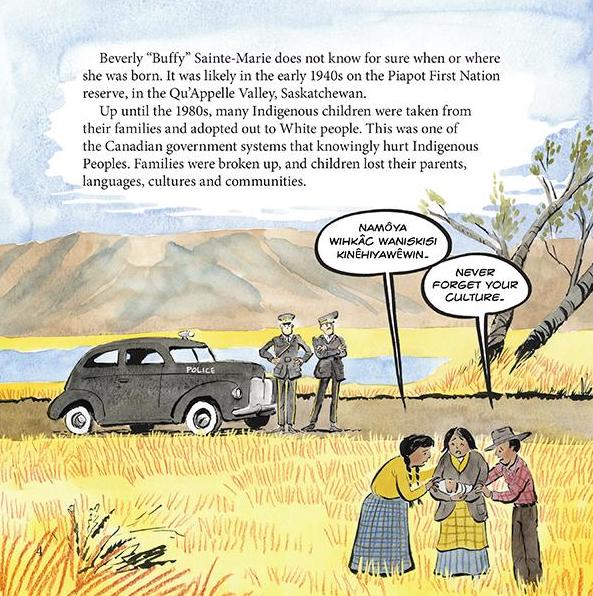
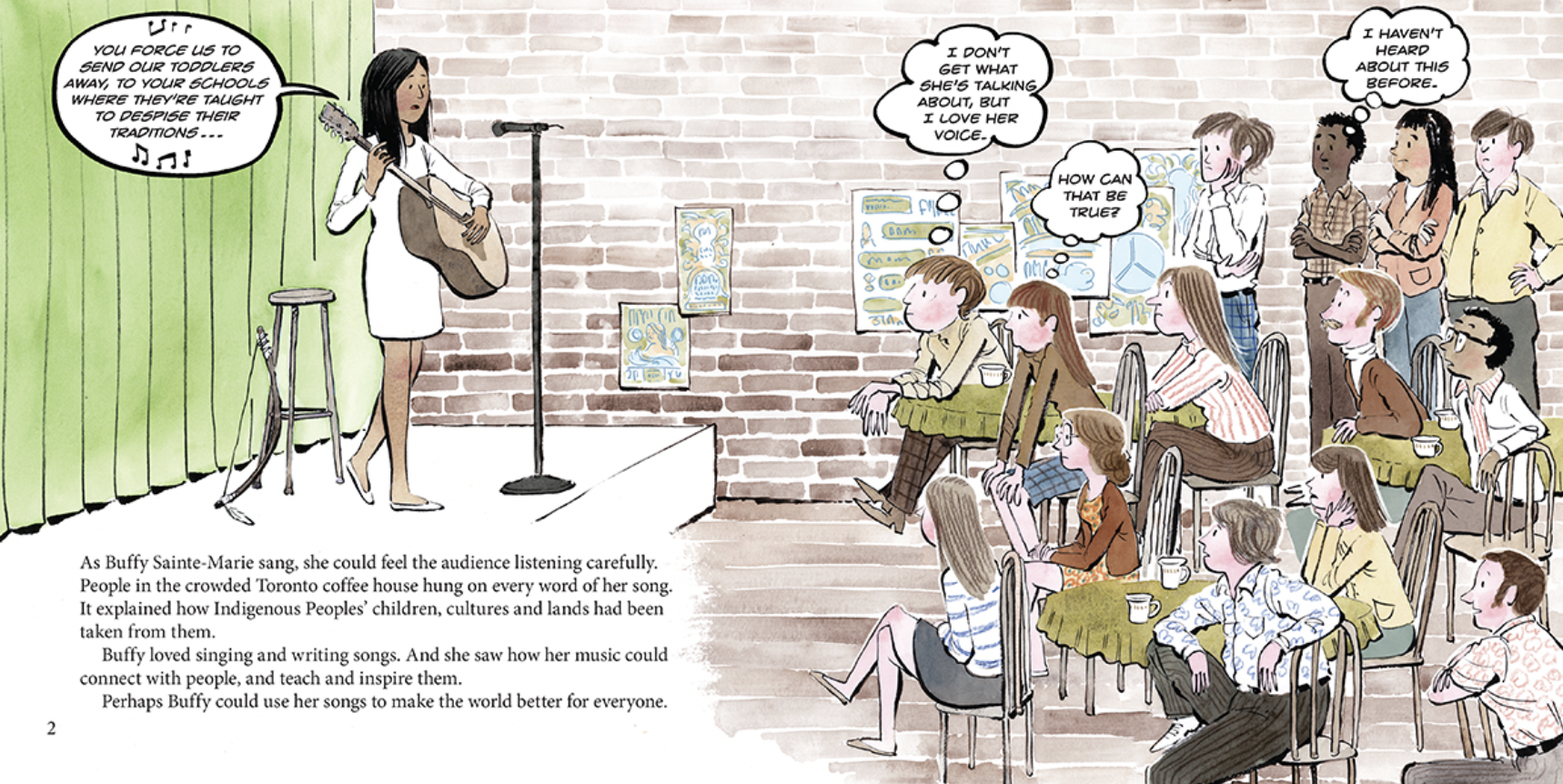
Buffy Sainte-Marie was probably born in the 1940s on the Piapot First National reserve in Saskatchewan but was taken and adopted by the Sainte-Maries of the northeastern U.S.A. Her childhood, often spent alone, was filled with music, with Buffy starting to play the piano at age 3, and learning music by ear. At 16, she taught herself to play guitar, and, while at university, she started playing at small clubs and then larger ones. After graduation, she became a full-time musician.
From Meet Buffy Sainte-Marie by Elizabeth MacLeod, illus. by Mike Deas
As her songs were garnering much attention, from her "Universal Soldier" as a protest song, and "Until It's Time for You to Go" as recorded by countless famous artists, she was noticing how Indigenous roles were depicted on the screen. When she was asked to take a lead rode in an episode of "The Virginian," she maintained the need to hire Indigenous actors for Indigenous roles, leading the action for diversity.
From Meet Buffy Sainte-Marie by Elizabeth MacLeod, illus. by Mike Deas
Her other initiatives included starting the Nihewan Foundation for Native American Education which supported Indigenous teens going to university. She has spoken globally about Indigenous Peoples to further understanding. And even though her music was snubbed in the late 1960s and 1970s by radio stations and more for her political messages, she persevered, continuing to extend her activism to championing the rights of Indigenous Peoples. Along the way she won an Oscar, made several important appearances on "Sesame Street," and used new technology for creating visual art and music. She lent her support to the Idle No More movement and was awarded everything from the Polaris Music Prize to Junos and the Spirit of Americana/Free Speech in Music Award.

With her art fuelling her activism, whether it involved Indigenous Peoples, anti-war protests, missing and murdered Indigenous women, or shelter animals, Buffy Sainte-Marie's story in Meet Buffy Sainte-Marie will provide inspiration to young readers. She defies labelling as she is everything from a singer and a songwriter to a humanitarian, a protester, a teacher, a speaker, an advocate, and more. But by letting her heart and passions lead her, she has accomplished so much and done so much good work
Using the power of positivity, Buffy shares her messages with her songs and through art, education and the organizations she supports. Buffy teaches that we can all work together to help make the world a better place. (p. 29)
Elizabeth MacLeod makes sure that readers will learn about Buffy Sainte-Marie's achievements–a timeline of key events appends the illustrated story–but also about her spirit, and her spirit is great, both broad and deep. Buffy uses it, with her voice in music and art, to educate, to mobilize to action, to inspire, and to give voice. Mike Deas's artwork, which involves gouache and watercolour paints and ink, along with digital tools, supports the story with detailed illustrations from Buffy's personal and professional life, from childhood to the 2020s. He takes her story from being taken from her Cree parents as a baby to performing on stage with a red dress–a symbol of missing and murdered Indigenous women. With that, Mike Deas carries readers through nine decades of Buffy Sainte-Marie living and performing and inspiriting. 

There are many stirring reads of important Indigenous activists and leaders but, as an illustrated biography, Meet Buffy Sainte-Marie gives us a comprehensive and unequivocal depiction of an amazing woman, a woman of talents, of courage, of conviction and of spirit. The story, as the woman, touches, and impresses.
 
• • • • • • 

Scholastic Canada Biography series by Elizabeth MacLeod and Mike Deas:
 
Meet Thérèse Casgrain (2021)
Meet David Suzuki (2021)
Meet Buffy Sainte-Marie (2023)

June 03, 2023

Swept Away: Ruth Mornay and the Unwanted Clues

Written by Natalie Hyde
DCB
978-1-77086-689-8
200 pp.
Ages 8-12
April 2023 
Reviewed from advance reading copy

When 63-year-old Beatrice Payens is swept away in the Teeswater River, her 11-year-old friend and next-door neighbour Ruth Mornay is grief-stricken and perplexed. Why would Bea, head of the Teeswater River Embankment Rehabilitation Society and diligent advocate for signage warning Pinkerton residents about the danger of getting too close to the water's edge, be so negligent? Something doesn't add up for Ruth. 
 
Things get weirder when Hugh Rolls and his young son Saul move in next door, inheriting the house from their Aunt Bea, though Ruth knew Bea had no relatives. Ruth has even more questions. Problem is, all Ruth has are questions. Troubled by weird dreams of drowning and a paltry trio of bequests–a weird water sprinkler head, some old, embroidered gloves and an ugly picture of flowers made from human hair (yech!)– Ruth starts looking for clues and suspects among her fellow residents of Pinkerton (population 134). With Saul as her secret ally, Ruth works at putting the clues together, when she isn't running after her escaped Rhode Island Red hen, Dorcas.
 
The best mysteries are the ones you don't know are mysteries. Ruth suspects something is amiss, but she doesn't really know that Bea didn't just slip into the water accidentally. But, like a puzzle with only a few pieces, Ruth starts slowly. And she thinks and speculates, and she asks questions, and she watches. With Saul, another keen observer and solver of mysteries, Ruth learns there really is much more to Bea's story and her own. That's why Swept Away is so fulfilling as a read. Not only does Ruth figure out what happened to Bea–even putting herself in danger–she learns more about herself and her family in the process. She could never have guessed that pursuing a hunch she had about Bea's disappearance could lead her to a new friend, some family history, and an important discovery about herself. Better yet, writer Natalie Hyde, who has authored outstanding middle-grade novels like Up the Creek (2021), Mine! (2017), and Saving Arm Pit (2015), blends a strong plot with an assortment of unique characters, and a touch of humour. A mystery is always an alluring story but add to it a child with six older brothers and no access to computers, a delinquent but clever hen, a wandering pig, townspeople like the town snoop Mrs. Gorgonzola and Ruth's tedious non-best friend Emily Parsons, and you get a whodunit with twists and turns but also laughter. Natalie Hyde always slips in some subtle humour to add a layer of fun. 
Four years ago at the Fall Fair, Mrs. Parsons–Emily's mom–had to be restrained by committee members when she learned Mrs. Gorgonzola's red pepper jelly had beaten hers. She claimed Mrs. Gorgonzola stole her recipe, which was her grandmother's, and passed it off as her own. Mrs. Gorgonzola said Mrs. Parsons shouldn't flatter herself, that the only thing the Parson red pepper jelly was good for was to oil her furniture. (pg. 81)
Often Ruth's observations about her small town are what give us the most humour, like the red pepper jelly debacle or the purported theft of Mrs. Gorgonzola's ugly green neon lava lamp. It's what's really happening in Pinkerton; it just happens to be funny too.

See if you can figure out this whodunit but, even if it comes as a surprise, especially what it means for Ruth, you'll enjoy visiting Pinkerton, a not-so-sleepy small town, a hot bed of secrets, and a playground for a miscellany of farm animals.

June 01, 2023

The Remembering Stone

Written and illustrated by Carey Sookocheff
Groundwood Books
978-1-77306-589-2
40 pp.
Ages 3-6
March 2023

Sometimes a stone is more than a stone. Sometimes it's a memory, sometimes it's a connection, and sometimes it's an opportunity.

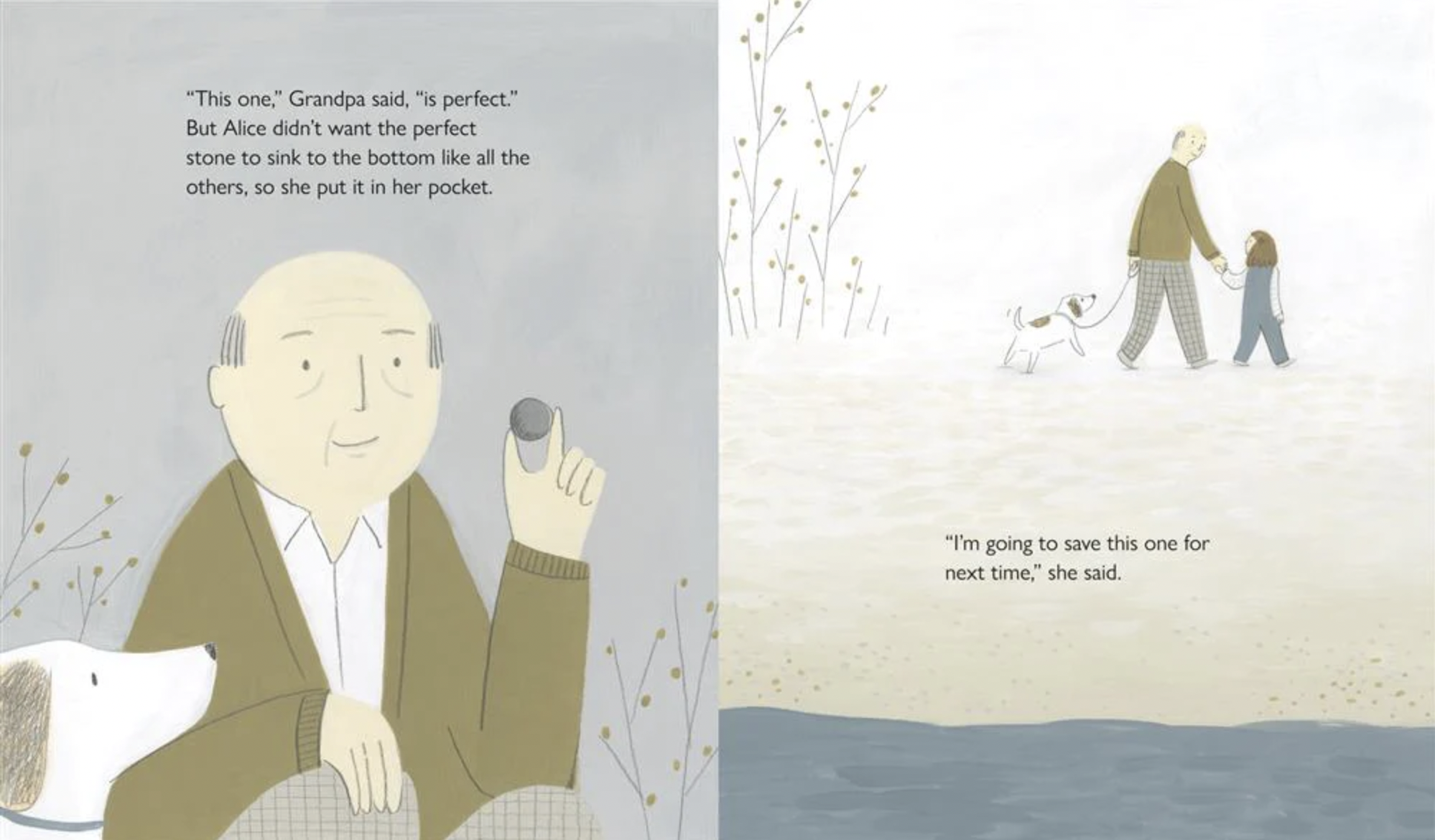
Alice has brought a stone for show-and-tell. Of course, her classmates see it as a stone. A rock. A piece of earth. Though she has lots of stories about using it to trick her dad or as a shape for tracing, it's the memory of skipping stones with her grandpa that is most important. Her grandpa knew how to skip stones and pick out the perfect ones. When he'd found this perfect stone, Alice had kept it in her pocket, probably for their next outing but perhaps because she didn't want to give it up to the water.
From The Remembering Stone by Carey Sookocheff
But when her grandpa got sick and passed away, the stone became something more.
From The Remembering Stone by Carey Sookocheff
The response to her show-and-tell stone may not have been what Alice expected but, when she realizes she's lost her stone on the playground, her classmates understand how important it is to her and they all start looking. They find a lot of stones, though not her special stone. Still, her new stones become something more too.
From The Remembering Stone by Carey Sookocheff
Carey Sookocheff's story is as deceptively simple as her illustrations. It may appear only to be about a girl and a stone which connects her to her grandfather. But Carey Sookocheff uses that stone as a bridge beyond that intergenerational relationship and allows Alice to see that it is both something special and something ordinary. The stone's value is what she places on it. It can remind her of her grandpa or help make new connections with her classmates or it can be just a skipping stone. Regardless of what the stone or stones have been or become, they have meaning, even when they're gone. 

The Remembering Stone truly becomes Carey Sookocheff's story because she illustrates it. Using acrylic gouache and graphite, she embeds the story in reality. Her art is clean and smooth and gives a calmness to being with others. It's the reality of going to school, participating in show-and-tell, spending time with a grandparent, and losing a grandparent. It's all about what a child might experience so it will speak to many children. But, while the story connects with young readers, it will also give them an opportunity to see that there are opportunities beyond the obvious. A skipping stone becomes a memory first but then it transforms both in its presence and in its absence. It's a remembering stone even when it's not.

May 29, 2023

2023 Willow Awards: Winners announced for the Saskatchewan Young Readers' Choice Awards

The winners of the SaskEnergy Willow Awards, Saskatchewan's Young Readers' Choice Awards, were announced last week at Perdue School in Perdue, Saskatchewan.  Readers in Kindergarten to Grade 9 read and then voted on the titles in their award category, and young readers announced the winners. Videos and announcements are detailed at the Willows' website here
 
Congratulations to the  
winners of the three Willow Awards!


The winner of the Shining Willow Award, selected from those books written for youngest readers, those in Kindergarten to Grade 3, is...

The Strangest Thing in the Sea: And Other Curious Creatures of the Deep
Written by Rachel Poliquin
Illustrated by Byron Eggenschwiler
Kids Can Press
Reviewed here


The winner of the Diamond Willow Award, selected from those books written for readers of Grades 4 to 6, is...

Children of the Fox 
 (Thieves of Shadow, Book 1)
Written by Kevin Sands
Puffin Canada


The winner of the Snow Willow Award, selected from those books written for readers in Grades 7 to 9, is ...

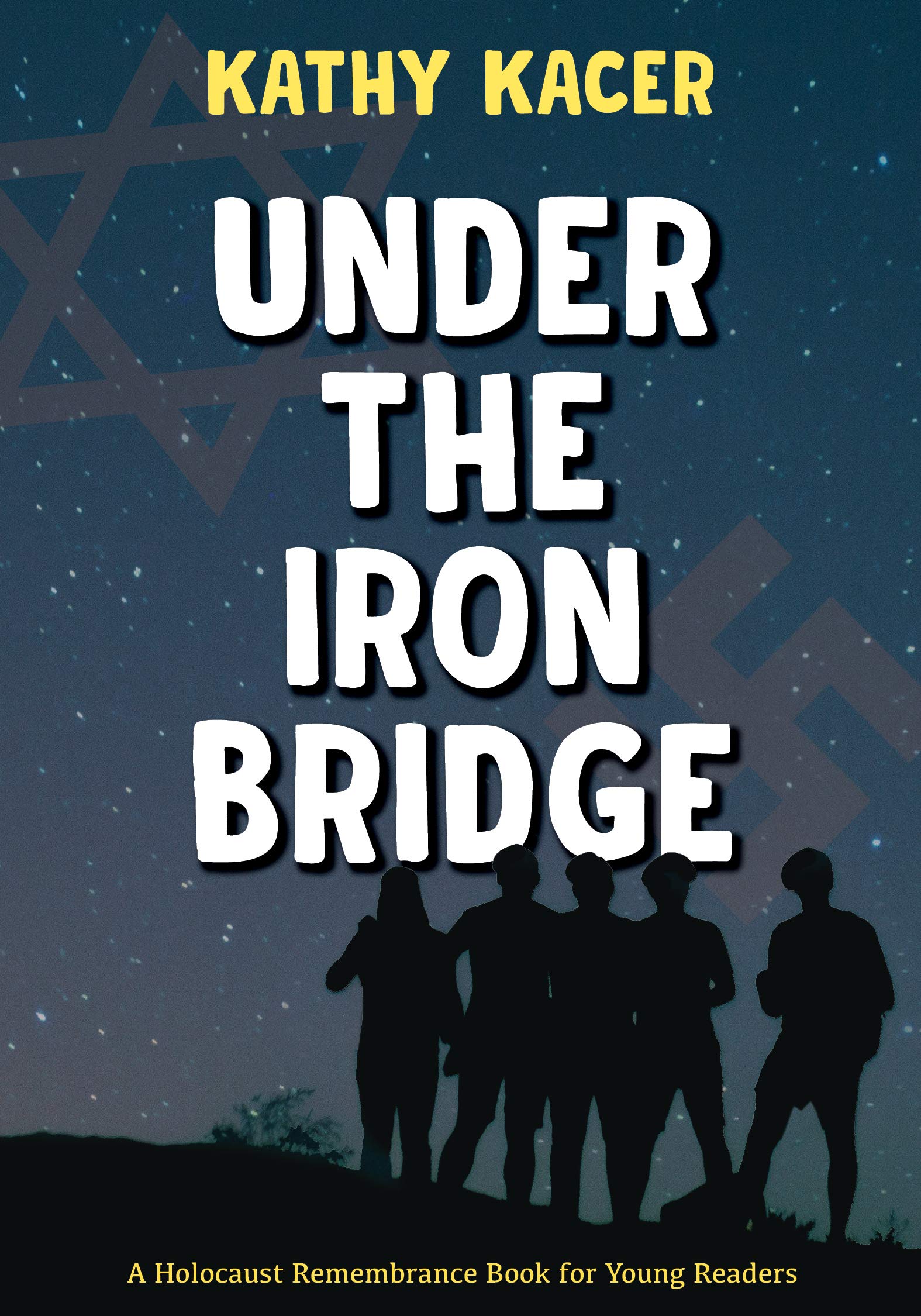
Under the Iron Bridge
Written by Kathy Kacer
Second Story Press


May 28, 2023

2023 Ruth and Sylvia Schwartz Children's Book Awards: Winners announced

On May 26, 2023, the Ontario Arts Council announced the winners of the 2023 Ruth and Sylvia Schwartz Children’s Book Awards as selected by two juries of young readers at Jesse Ketchum Junior and Senior Public School.

A jury of four students in grade 4 selected the recipient of the Children’s Picture Book Award, and a jury of grade 8 students selected the winner of the Young Adult / Middle Reader Award.

Congratulations to both winners and to the juries for their auspicious selections!
 

Winner of the
 Ruth and Sylvia Schwartz 
Children’s Picture Book Award
 
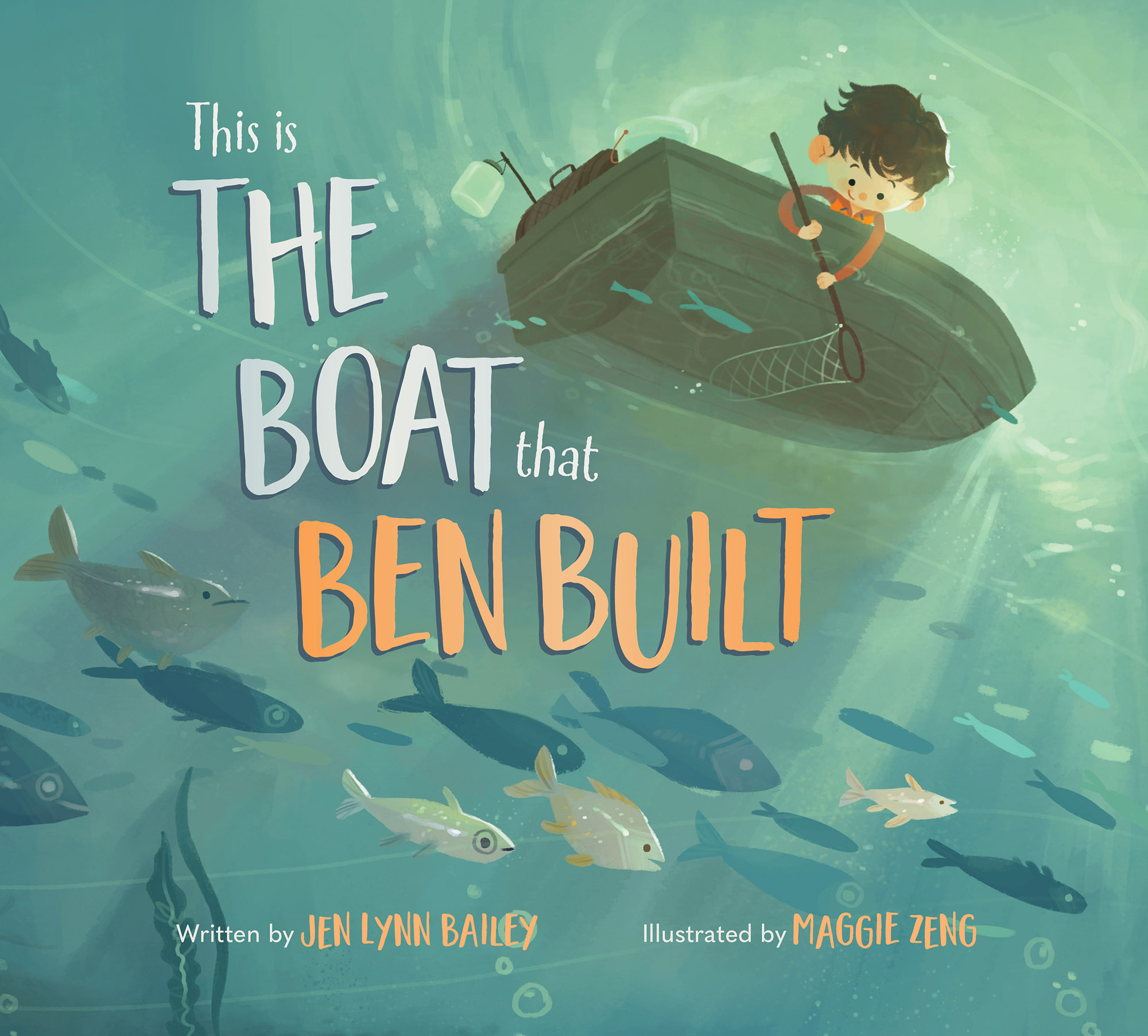
This is the Boat That Ben Built
Written by Jen Lynn Bailey
Illustrated by Maggie Zeng

Pajama Press
978-1-77278-242-4
32 pp.
Ages 5-8
2022 
 
 • • • • • • •
 
Winner of the
 Ruth and Sylvia Schwartz 
Young Adult / Middle Reader Award 
 
Road of the Lost
Written by Nafiza Azad
Margaret K. McElderry Books
978-1-534484993
336 pp.
Ages 14+
2022