July 30, 2025

T Is for Terry: An ABC of Courage

Written by Denise Dias
Illustrated by Noémie Gionet Landry
North Winds Press (Scholastic Canada)
978-1-0397-0679-8
32 pp.
Ages 3–8
July 2025 
 
Terry Fox's story of his cancer and of his Marathon of Hope is one that is firmly established in Canadian history. When he embarked on his cross-country run in 1980 in support of cancer research, he could not have imagined the impact his story and his undertaking would have on the world. For us, he was a champion and a warrior. And now his story is told in such a way that our youngest children, perhaps those who will still be having this book read to them, will understand who he was and what he accomplished. 
From T is for Terry, written by Denise Dias, illustrated by Noémie Gionet Landry
Denise Dias who is involved with the Terry Fox Foundation tells Terry's story using the alphabet as her guide. She begins pre-diagnosis with Terry enjoying play with his siblings and sports. With the letter C, readers learn that Terry became ill and had the courage to face losing part of one leg. (Thank you, Denise Dias, for not making Cc for cancer.) Then there is his treatment and his training, but the text is all about the positives: the dream, the effort, his friends, and his gratitude. 
From T is for Terry, written by Denise Dias, illustrated by Noémie Gionet Landry
With the letter H, Denise Dias begins Terry's Marathon of Hope, still always emphasizing the positives of the kindness people showed him, the pride they felt sharing in his marathon, and the example he was by inspiring people everywhere to carry on his dream. Sure, there were some details about his shoes and how tired he was, but the highlights of T is for Terry is the young man and his worthwhile efforts to help others who were sick through fundraising for cancer research.
From T is for Terry, written by Denise Dias, illustrated by Noémie Gionet Landry
T Is for Terry is a complete illustrated biography for young children, introducing them to this extraordinary young man and his mission in a way that is not scary and very inclusive.  Denise Dias may keep the text inspiring rather than disheartening but she gives everything to his story so it is thorough. What Denise Dias leaves out in the text New Brunswick's Noémie Gionet Landry includes but with care. Her digital artwork blends realism with cheerful illustrations that both inform and amuse. We see Terry and other cancer patients receiving chemo treatment, the solitude of his running through all kinds of weather, and his distinctive running gait. We also see the landscapes of Canada that Terry ran through, from the Atlantic Ocean through forests and neighbourhoods. Noémie Gionet Landry keeps the story but makes it more Terry.
 
I am often wary of themed alphabet books as they can seem contrived, trying to fit a story into the alphabet. T Is for Terry is not forced in its alphabetical storytelling. Terry's story is complete as an illustrated biography in T Is for Terry; it just happens that it is told with the use of the alphabet to organize information. With great honesty and philanthropy, Denise Dias tells how Terry Fox and his Marathon of Hope united a nation and committed us to working to fund cancer research. With all author royalties being donated to the Terry Fox Foundation—in fact, the text and illustrations copyrights are held by the Terry Fox Family—Denise Dias furthers that support now and in perpetuity. By encouraging discussions through T Is for Terry, I hope that teachers and parents will grab this book and further the support for the Terry Fox Foundation and the good work they do, and thus move us all closer to finding all the cures for cancer.

July 28, 2025

Death by Whoopee Cushion

Written by Vicki Grant
Tundra Books
978-1-77488-468-3
256 pp.
Ages 10–14
July 2025 
 
 Having parents who own a joke shop can be torture. (p. 3)
 
For twelve-year-old Manya, who hates the limelight, her parents' joke shop, Pranks-A-Million, is embarrassing. But Ronnie and Stephanie Brown love to laugh and make others laugh. Not only do they sell pranks that explode, smell, stain, and startle, they create new "artisanal pranks" like Barf-In-A-Bag, edible scabs, and the Gravy Blaster, a whoopee cushion filled with sulfur-scented gravy, in their backroom Funcubator lab. Manya likes serious science–she won last year's science fair–and is eager to take an after-school program called "Serious Science for Serious Kids" that is offered at the Museum of Natural History. Along with her best friend and neighbour, Isaac, the only other participants who attend Dr. Michael's course are Jack, another science kid from their school, and Brandon, a kid who wanted to do kickboxing but was forced to attend this instead. Together they learn about acids and bases and do fun experiments.
 
But when things that aren't a laughing matter happen, Manya is concerned, though her parents with their good-natured humour are not. First, they are questioned by police about a trick cigar that caused first-degree burns. Then, more seriously, when her parents are setting up for a presentation at Manya's school, the new custodian is killed by an explosion when handling their materials. Manya's parents are arrested, and Manya and their parrot Toots—who makes farting noises—go to stay with Isaac and his mother Delia next door. Now it's up to Manya and Isaac to put their STEM skills to work and determine who sabotaged her parents' Gravy Blaster that killed a man.
 
Vicki Grant is always known for the humour in her books (e.g., Hold the Pickles36 Questions That Changed My Mind About You, Short for Chameleon) but her stories are always more than cheap laughs. Her plots often look into deeper issues of family relationships or bullying, even loneliness or shame. Vicki Grant reminds us that even when there is much to laugh about, there are serious issues often lightened with humour. Manya may be a girl who has inherited a love of science and experimenting from her parents, but she is quite self-conscious and embarrassed by the silliness, and smells and noises, of the pranks her parents love. But when her parents are arrested, she realizes how much she loves them and how much the joke shop is a part of her. It's this realization, along with the application of some science, that helps her solve the mystery of the exploding Gravy Blaster and connect with those who care about her.
 
I don't want to give away too much—the mystery of the Whoopee Cushion Murder must be solved—but suffice it to say that the laughs will be had courtesy of a fart-noisemaker of a parrot, a poopy baby called Poppy, a plethora of pranks, and a pair of mischief-makers who drive around in a yellow Beetle adorned with googly eyes and a clown nose. But with a little science, a whole lot of fun, and much familial affection, the mystery is solved, along with a few welcome surprises, and only the culprit is left with egg on their face, figuratively of course.

July 25, 2025

Soul Machine

Written and illustrated by Jordana Globerman
Annick Press
978-1-77321-959-2
228 pp.
Ages 12–16
June 2025 
 
In Chloe's world, souls are spun using wheels and the natural plant called breth. She and her family are in the business of soul making, though it's only her and her older sister Lacey since her father Morris left and her mother passed. And though Lacey still has to teach her younger sister all the steps to making souls, from getting the plants to spinning it, trimming it and packing it, Chloe has ambitions of becoming a CEO.
We just spin the threads, Chloe. As long as the mechanics of the soul remain a mystery, soul making stays an act of faith. (p. 8)
From Soul Machine, written and illustrated by Jordana Globerman
But their work has become more challenging. First, MCorp, a corporation led by Maya, a woman all aspire to be like, has been using a synthetic breth called Digibreth to make unlimited souls. Secondly, Lacey suspects that crops of breth are being poisoned by MCorp to force small businesses to become franchises of MCorp and weave Digibreth. Hoping to find a breth black market, Chloe heads to Metropolis, the busy city in which MCorp has its headquarters. There she is almost apprehended by the MCorp police for stealing but she is helped by Persie, one of the Nuspiritualist movement who protests against Maya and MCorp and works with others to heal and protect the natural breth.
From Soul Machine, written and illustrated by Jordana Globerman
Unbeknownst to Chloe, Maya has been watching Chloe and has her police follow her. As Maya and Persie travel towards the breth fields, including a stop at Paradise Found, a Digibreth test site where those test subjects promised spiritual optimization are now ghosts, Chloe becomes unwell. But when they reach their destination, parched and bereft of breth, Persie recognizes Chloe's father, from a photo in a locket, as the man who invented Digibreth.
 
While Persie is arrested, Chloe is taken to Maya. Maya, a cut-throat businesswoman, claims she  wants to help Chloe, asserting that she too needs Morris back as he is the only one who can fix the kinks in Digibreth. While Chloe appreciates the attention Maya pays her, she's starting to think there is much more to Maya's intentions, and she may be putting her family, both their business and their souls, at risk.
 
Soul Machine is Jordana Globerman's debut novel, and she's hit the scene with a powerful book of family and fantasy with a sampling of social commentary on choosing progress and celebrity over tradition and reliability. Chloe grapples with wanting success and fame but is challenged by what she sees in Maya and what she feels for her sister and family. In a society in which appearances are everything and better is best, Chloe is captivated, as many of our world are by popularity and fame. But Jordana Globerman has also given Chloe a soul that, when she must choose and act, she knows where her loyalties and her passions rest. And even though Maya sees the old world as deficient, she sees that as an opportunity for her.
"Your gen is all existential dread. It's a big market. (p. 110)

This new world has its own angst with the merging of state and self. The individual is becoming lost to those upheld as models of the best. Like many today, Maya is just capitalizing on it.

From Soul Machine, written and illustrated by Jordana Globerman
Jordana Globerman moves us through scenes of different atmospheres in Soul Machine with her colour choices, selecting one hue with different tints and shades for each set of circumstances. Metropolis and MCorp are all shown in pinks, perhaps reflecting those who see it all through rose-coloured glasses. The desolation of Paradise Found and the parched breth fields are depicted in a gold-puce-chartreuse. And home for Chloe and Lacey is teal. With her choice of colours and the strength of her illustrations that offer softness and harshness as appropriate, Jordana Globerman makes the reader think about our own society and the choices we make for ourselves and others. While many may not think about the metaphysics reflected in Soul Machine, Jordana Globerman actually presents opportunities to contemplate and discuss self and society, time and space, and reality as a whole—she appends her novel with "Questions with No Wrong Answers"—proving that her graphic novel, like many of other creators, is not "just" a comic book.

July 23, 2025

Miya Wears Orange

Written by Wanda John-Kehewin
Illustrated by Erika Rodriguez Medina
HighWater Press
978-1-77492-125-8
40 pp.
Ages 6–8
August 2025 

Miya loves school and is far removed from experiencing the trauma that too many Indigenous youth had when sent to residential schools. But when her teacher reads a story of one little girl who had such an experience, it all becomes deeply personal for Miya.
 
Miya, the only Indigenous child in her class, is shocked to hear about the child in the book having her hair cut, having her doll taken away, and not being allowed to see her family. 
Miya thinks about how she is the only Indigenous kid in her class, and her chest feels tight.
From Miya Wears Orange, written by Wanda John-Kehewin, illustrated by Erika Rodriguez Medina
The story read by the teacher was an introduction to the upcoming
National Day for Truth and Reconciliation. But Miya cannot focus on the importance of September 30th. Instead, she wonders if she will be sent to residential school because she is Indigenous.
From Miya Wears Orange, written by Wanda John-Kehewin, illustrated by Erika Rodriguez Medina
So begins a discussion between mother and daughter. Miya's mother explains more about the residential schools and that those schools are closed, and Miya would never be taken from her. With her big heart and much compassion, Miya feels so much for the children who were taken, and her mother reassures her that that would never happen to her and that wearing an orange shirt would honour those children. 

Though Erika Rodriguez Medina gives illustrations that are endearing, the story of Miya Wears Orange is a sobering one, and it is one based in the circumstances Wanda John-Kehewin experienced with her own child. This is not a worry a child should ever have. But by answering her questions, reassuring her with her words and her actions—letting her stay home one day and continuing with their daily routines, including picking her up from school—Miya's mom, and probably Wanda John-Kehewin, did everything right. With time and reassurance, Miya will worry less, though I believe she will always think about and feel for those children who suffered. For her, wearing an orange shirt could be for any and every day.
From Miya Wears Orange, written by Wanda John-Kehewin, illustrated by Erika Rodriguez Medina
Just as I have previously reviewed a book by Wanda John-Kehewin (Visions of the Crow, Book 1 of Dreams series), so too have I reviewed those illustrated by Erika Rodriguez Medina. (In fact, the last book I reviewed, The Friendship Blanket, was illustrated by her.) Her ability to keep the warmth of her art no matter the nature of the story speaks to her creativity and skill. In Miya Wears Orange, Erika Rodriguez Medina does not emphasize the horrors of the residential schools, the source of Miya's anxieties. Instead, her focus is on the child and her mother and the good things about school. Her colour palette is limited with much burnt orange and purples and burgundy, and occasional blue or turquoise, keeping the tone of a story about remembrance and empathy. 
From Miya Wears Orange, written by Wanda John-Kehewin, illustrated by Erika Rodriguez Medina
Miya Wears Orange may become an important read for introducing young children to the National Day for Truth and Reconciliation and also why we wear orange on September 30th. But I think it will also open discussions about children sharing their worries so those concerns might be lessened or alleviated. For little children, worries can become magnified very quickly, and for children of Indigenous heritage, for whom generational trauma is a potential, it's incumbent upon parents, teachers and those who care for them to be aware of their responses to texts and news related to residential schools. Those stories are horrific, even when adjusted for a younger audience, and attention and compassion must be applied to ensure an affirmative outcome.

July 21, 2025

The Friendship Blanket

Written by Leonarda Carranza
Illustrated by Erika Rodriguez Medina
North Winds Press
978-1-0397-0346-9
32 pp.
Ages 4–8
July 2025
 
There's a reason blankets show up so often in children's literature. They offer warmth, comfort, and security. They are more than a covering. They are a sanctuary. And for this child, it's also a connection to her former life and that of her future.
From The Friendship Blanket, written by Leonarda Carranza, illustrated by Erika Rodriguez Medina
When the little girl and her Mami move far away from her Abuelita and the home she has known, her grandmother gifts her with a blanket so that she can always have a piece of home with her. Though Mami tries to reassure the child by offering to paint her new room orange and pink like the sunsets at home and by telling her she'll make new friends, the little girl still experiences some trepidation and much longing for her old home.

...I miss Abuelita so much my chest burns.
 
From The Friendship Blanket, written by Leonarda Carranza, illustrated by Erika Rodriguez Medina
When she attends her new school for the first time, she does not feel welcome. Some children laugh and point, and, even when she tries to connect, they don't seem to understand her.  Her mother tries to reassure her as does her family in her dreams. But it's not until the girl notices that "Lonely is everywhere," that she sees a way to connect with a classmate in a meaningful way and use her Abuelita's blanket to bolster that connection.
 
Brampton's Leonarda Carranza was born in El Salvador and has used her experiences to fuel her writing. (Her first book was Abuelita and Me, a Blue Spruce-award nominee.) While The Friendship Blanket has a distinct Latino flavour to it, it is a story of any child who is uprooted from family or from the home they'd always enjoyed. Her Abuelita and her mother do the right stuff to ease the move and transition to a new place but it's a process that is dependent on so many factors, from the school and the kids there, to the opportunity to stay connected with those left behind, and even the understanding of the adults in her life. Leonarda Carranza makes the mother sympathetic and loving but she can only do so much. The little girl has to step up, which she does, by finding a way to facilitate those new connections. Thankfully, she has that blanket from her Abuelita. It's bright and beautiful and it's a wonderful device for sharing with and relating to others.
 
Erika Rodriguez Medina, also of Latina heritage (Mexico), ensures that this is a story of a child from a Spanish-speaking community. From the way the child's hair is braided to the depth of her skin tone, and the bold colours and patterns of her blanket, Erika Rodriguez Medina makes sure that we see this as a child who has moved to a very different community. Most of her classmates, perhaps even her teacher, cannot appreciate her heritage and the richness of her experiences; instead, they make her feel invisible. Erika Rodriguez Medina helps us feel her hurt through her expressive face and body language, but we can also appreciate the power of her family connections. 
From The Friendship Blanket, written by Leonarda Carranza, illustrated by Erika Rodriguez Medina
Most parents and caregivers know the value of a special blanket for a child or a senior, and for everyone in between. It can help provide the comforts of place and people in a way that very few things can. And if you're lucky enough to have blanket that does double-duty as a friendship spark, all the better,

July 18, 2025

A Summer Without Anna

Written by Kate Jenks Landry
Illustrated by Risa Hugo
Kids Can Press
978-1-5253-1025-6
32 pp.
Ages 3–7
June 2025 
 
For children, every summer is different and still the same. There may continuity in activities undertaken or camps attended, in visits with family or in hanging out with friends. But with each year that a child gets older, things will change for them and for their families. Some changes will be welcome and others not. For Junie, this will be a summer without her sister Anna.
From A Summer Without Anna, written by Kate Jenks Landry, illustrated by Risa Hugo
This summer Junie will be visiting her Nan and Pop's house while her parents take care of her hospitalized sister. To help ease Junie into this new set of circumstances, Anna lends her little sister her camera, instructing her to use it if she sees Edmund, a very old turtle. As Junie continues to do many of the activities she and Anna had often done at her Nan and Pop's, such as swimming and catching minnows for bait, Junie takes photos of what she sees, keeping a record of her time away from Anna, and always looking for Edmund.
From A Summer Without Anna, written by Kate Jenks Landry, illustrated by Risa Hugo
But even as she bakes and fishes, swims and relaxes, Junie has a quiet solitude about her. For her, a summer without Anna means so much more than just missing a companion with whom to play and to look for Edmund. Her parents arrange phone calls with Anna so the girls can keep in touch, and Junie takes lots of pictures of everything from the recipes she and Nan use to the water as it ripples with the wind. And when Anna's return home is delayed, Junie is both angry and saddened. 
     I run down to the lake and hurl Anna's tarts into the water.
     The air feels electric. Rain is coming. I tilt the camera straight up to the sky. A fat drop hits the lens and turns the world all wibbly-wobbly.
From A Summer Without Anna, written by Kate Jenks Landry, illustrated by Risa Hugo
When the two sisters are finally reunited, there is much sharing that happens, demonstrating that the two were never far apart in their thoughts and their hearts.
 
This is the first book that I have reviewed of Kate Jenks Landry and Risa Hugo (though both have written or illustrated others). Both take a sensitive perspective to the story, emphasizing Junie's muted experience of a summer without her sister. Though there would be no story without Anna's illness and hospitalization, that all happens outside of Junie's immediate experience. Kate Jenks Landry makes the story all about Junie; in fact, Risa Hugo does not include Anna until the older sister is set to come home and be reunited with Junie. The tenderness of the girls' relationship and the lingering days of summer that Junie experiences are paramount. Without that closeness, there would be no wistfulness or the stillness of play without a playmate. Kate Jenks Landry makes us feel Junie's longing for her sister and the stillness of her summer, even as she is occupied by her grandparents with typical bonding experiences in and outside of their house. 
From A Summer Without Anna, written by Kate Jenks Landry, illustrated by Risa Hugo
The quiet of A Summer Without Anna calms me, even as I feel for a family dealing with an ill child. That quiet, which comes through in both Kate Jenks Landry's words and Risa Hugo's art, is both reassuring and hopeful, and I was left knowing that all would be well in the end. Whether I hear that assurance in Kate Jenks Landry's poetic language ("My belly's full of moth-wing flutters") or in the emotions of her words ("The smile in her voice feels like a promise") or in Risa Hugo's illustrations rendered in gouache, coloured pencils and soft pastel, or in both, I could not speculate. All I know is that, if I had child undergoing medical treatment and wanted to comfort a younger sibling, a reading of A Summer Without Anna would be restorative.

July 15, 2025

The Puzzle of Doom (The Lunch Club, Book 8)

Written and illustrated by Dom Pelletier
Scholastic Canada
978-1-0397-1102-0
136 pp.
Ages 7–10
July 2025 
 
You know there will be laughs to be had if the secret club called the Lunch Club is meeting again. This time Leo and Tia, along with their club advisor Mr. Peabody, are pulled into a ghostly puzzle that comes from England.
From The Puzzle of Doom, written and illustrated by Dom Pelletier
In the prologue to Dom Pelletier's latest volume in his The Lunch Club series, readers are witness to Lord Puzzlegood who, while working outdoors on a puzzle at his club in 1890 London, is killed by lightning. His fellow puzzlers, threatened by his ghostly demands to find the final puzzle piece, lock him away with the puzzle while his earthly possessions are exiled to Canada.
 
In the present day, Leo and Tia, along with Mr. Peabody, are enjoying a local street fair where Madame Celeste (from an earlier adventure) gifts them with a protection amulet and crystal ball respectively. Tia also ends up with a piggy bank left behind by another vendor, Fred, a neighbour of Madame Celeste's.
From The Puzzle of Doom, written and illustrated by Dom Pelletier
At school, they meet new student Dale Picklesworth III who is on exchange from the Puzzle Collector's Club of England, another secret club. Leo is not especially friendly to Dale who is bright and athletic, talented and partnering with Tia. 

Everything becomes a little wackier when Leo and Mr. Peabody open a box hidden in the gym's storage area and Tia gets a message about the piggy bank being haunted. With that, Lord Puzzlegood rears his ghostly head in an effort to complete his final puzzle.
From The Puzzle of Doom, written and illustrated by Dom Pelletier
Dom Pelletier always brings the wacky and the fun with The Lunch Club, and, with The Puzzle of Doom, he introduces a new character and an ongoing story. (The puzzle is going to lead into a new adventure in Book 9 of The Lunch Club.) He gives us the supernatural, school- and friend-based tensions that all children will recognize–except for the ghosts, of course–and laughter through the puns, the clever repartee, and zany panic. I love everything about The Lunch Club, from the characters as they act and as they are drawn (by Dom Pelletier) to the humour of their situations and of their interactions, and to the silliness of the
extraordinary plots. In The Puzzle of Doom, Dom Pelletier makes readers laugh but still think about how we get along with others, about how to work together to find solutions to problems, albeit supernatural ones here, and about what the next adventure might be for the "Philately" Club. And by giving us eye-catching art and nutty cartoon characters, Dom Pelletier continues to hook young readers and keep them returning to the Lunch Club.
 
 • • • • • • •
The Lunch Club series
#1 It Came From the Basement
#2 The Curse of the Scarewolf
#3 The Mutant Mouse from Outer Space
#4 Revenge of the Bigfoot
#5 The Return of the Mummy
#6 The Swamp Thingy
#8 The Puzzle of Doom

July 12, 2025

Vampire Jam Sandwich

Written by Casey Lyall
Illustrated by Nici Gregory
Tundra Books
978-1-774883464
48 pp.
Ages 3–7
July 2025 
 
You know what happens when a vampire takes a bite of a human, right? But what happens when it takes a bite of a delicious strawberry jam sandwich?
From Vampire Jam Sandwich, written by Casey Lyall, illustrated by Nici Gregory

A tale so fearsome that when
 they hear it, folks run to tighten
 the lid of every jam jar . . . 

This might be a legend or just a scary story but don't let that keep you away or worry that it will keep you up at night. It's the story of a jam sandwich, a vampire that may or may not be called Terrence, and a little girl who wants to protect all the jars of strawberry jam. 

Our "legend" begins in the middle of the night when a "vampire" whose scare-factor is all the greater because of the flashlight shining beneath his face (or is it?) makes his way to a kitchen. He takes a bite of a sandwich, perhaps anticipating a different red filling, and is delighted with the taste of the strawberry jam on very tasty bread. But when he is surprised by a little girl in her nightgown, he takes off, leaving a jam sandwich that has been turned into a vampire jam sandwich. And that vampire jam sandwich is craving more, more, more jam! That little girl heeds the advice of the narrator to keep the remaining jars of strawberry jam safe, but will her actions actually do so?
From Vampire Jam Sandwich, written by Casey Lyall, illustrated by Nici Gregory
Readers will know from the book cover that Vampire Jam Sandwich is not a scary story. Casey Lyall's humour is subtle but it's there and children will laugh to think that a sandwich would crave strawberry jam and pursue it relentlessly. 
From Vampire Jam Sandwich, written by Casey Lyall, illustrated by Nici Gregory
But it's the way that Casey Lyall presents the story that pulls the reader in. It's like the classic tale of moving from a dark, dark forest indoors to yet another dark, dark space. Her words may try to convey some scary elements like a vampire but in the context of strawberry jam sandwiches and a narrator who plays with both the reader and the little girl in a mischievous way, Casey Lyall never strays from a tale of humour. 
From Vampire Jam Sandwich, written by Casey Lyall, illustrated by Nici Gregory
England's Nici Gregory also tries to suggest an eeriness to Vampire Jam Sandwich with her sepia tones and blotches of red. But there's no darkness here, just some nighttime endeavours and a whole lot of sweetness. From the humongous eyes on all the characters to the cowlicks on the children and the charming details such as the cat's fish-shaped tag and the strawberry-themed home decorations, Nici Gregory ensures that the balance of humour and potential scariness always leans heavily to the delightful.
  
We're in tail end of strawberry season where I live and there will be much jam-making going on. Hope you can find a way to keep your jam safe from midnight snackers and marauding vampire sandwiches because they'll be sure to be tempted.

July 09, 2025

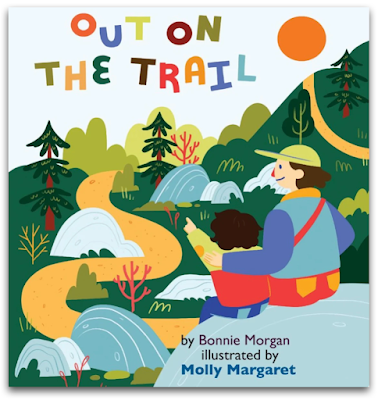
Out on the Trail

Written by Bonnie Morgan
Illustrated by Molly Margaret
Running the Goat, Books & Broadsides Inc.
32 pp.
Ages 0–4
June 2025 
 
 
Out on the trail
Just you and me.
I look to the left
And what do I see?
 
Newfoundlanders Bonnie Morgan and Molly Margaret takes young readers out on the trail to see an ocean, a brook, a cloud, a beach, a rock, and footprints. Those are the words that Bonnie Morgan emphasizes–they are the only bolded and coloured text–in her rhyming text. But Out on the Trail is not just about learning a few simple words from the natural world; it's also about seeing that natural world. 
From Out on the Trail, written by Bonnie Morgan, illustrated by Molly Margaret
As readers are instructed to look up and down and elsewhere, they are treated to amazingly bold and detailed digital artwork by Molly Margaret. We get to walk along a trail to see different forests and ecosystems; to witness the abundance of life and activity on land, in the sea, and in the air; and to think about what they are seeing and compare it to other scenes they've witnessed. While Molly Margaret doesn't always seem to use typical colours in her natural settings, she actually stays true to their essence. That purple ocean could be reflective of the wild waters and those blue stones just edging towards steel grey. But forget the colours and just focus on those vivid shapes that carry the reader along those trails and into those scenes of the spirited environment.
From Out on the Trail, written by Bonnie Morgan, illustrated by Molly Margaret
While Out on the Trail is not a concept book, it could be used effectively as one. Between those simple concepts from nature, there are also the positional words like left and right, up and down, and ahead and behind. Moreover, as that child is out on the trail for a walk with their parent, our very youngest can develop their early observational skills and, as such, their visual literacy skills. That's a lot of story from a picture book with minimal text and basic rhymes.
From Out on the Trail, written by Bonnie Morgan, illustrated by Molly Margaret
Bonnie Morgan and Molly Margaret may be taking readers along trails in Newfoundland and Labrador–the ocean and icebergs are giveaways to the setting–but Out on the Trail offers much more than a guide to local surroundings. It's an opportunity for a child to connect with a parent or guardian, enjoy the outdoor world, even vicariously, and to discover more beyond their own world.

July 07, 2025

Little Shoes

Written by David A. Robertson
Illustrated by Maya McKibbin
Tundra Books
978-1-77488-172-9
48 pp.
Ages 3–7
For release July 29, 2025 

In 2023, David A. Robertson, award-winning author of When We Were Alone and On the Trapline, collaborated with illustrator Maya McKibbin to create The Song That Called Them Home. That partnership of story and art is recreated here with another story based on an intergenerational relationship and based in the experiences of Indigenous Peoples. 
From Little Shoes, written by David A. Robertson, illustrated by Maya McKibbin
James is a kid who thinks big thoughts. His thinking is so big that it keeps him from sleep. What are his thoughts? He thinks about the earth's movements and gravity, about the stars and the constellations. He seeks consolation and wisdom from his mom, and the comfort he finds in her arms helps him sleep. But the next night, his sleeplessness returns. Even remembering the stories his kōkum had told him about the constellations and such, it's James's mother who reassures him.
From Little Shoes, written by David A. Robertson, illustrated by Maya McKibbin
And then James joins his kōkum on a march that ends at a memorial for children who'd attended residential schools and had never come home. There are numerous little shoes, teddy bears, tobacco ties, and flowers. When his grandmother shares with him that her own sister did not return from their residential school, James is overcome. That night when he again cannot sleep, he thinks about all those little shoes.
 
Little Shoes is both a big story about generational trauma of residential schools but a story that focuses on the comfort that comes from family. James's empathy is extraordinary in depth but perhaps not uncommon. Children, especially those who are empathetic, can feel so intensely about others' traumas and other experiences. David A. Robertson's "Author's Note" indicates a familial connection to this story, and I am impressed by the depth of feeling and thinking James, or David A. Robertson's son, demonstrates. I'm also saddened to think about the children in the residential schools and the children like James who empathize with them feeling so much trauma. I'm also thankful for those who are there to reassure, to illuminate, and to love those children through their challenges. 
From Little Shoes, written by David A. Robertson, illustrated by Maya McKibbin
Maya McKibbin, a Two-Spirited multidisciplinary visual artist living on the unceded traditional territories in BC, uses an interesting palette in their digital illustrations. Many of the double spreads are bathed in the dark blues of a night sky that are only lightened with the moonlight and stars. When the story turns to James' walk with his kōkum to the memorial, the colours meaningfully turn to the many hues of oranges, both a reminder that every child matters, and that there is hope for a better future. Beyond their colour palette, Maya McKibbin evokes comfort and discomfort, as well as affection and thoughtfulness, with great sensitivity.
 
Little Shoes, the book, will be a great discussion starter for families and classes about residential schools, about Every Child Matters, and about asking questions. But it will also inspire understanding and empathy for that which has happened so that tragedies like residential schools are not repeated.

July 05, 2025

Big Birthday Wishes

Written by Yolanda T. Marshall
Illustrated by Daria Lavrova
Chalkboard Publishing
978-1-771058957
40 pp.
Ages 4–9
June 2025
 
Ah, if only those wishes made by blowing out a candle on a birthday cake could come true! For seven children celebrating their birthdays all on the same day, it would be an amazing surprise.
From Big Birthday Wishes, written by Yolanda T. Williams, illustrated by Daria Lavrova
When a new baker opens in Fitts Village, his display of BIG birthday cakes and the aromas emanating from within attract many a customer. In fact, the parents of friends Elijah, Noah, Lisha, Mia, Liam, Pierre, and Adeya decide to purchase a unique cake for each child, with Mr. Mayers, the baker, promising them, "Magic in every slice!"
From Big Birthday Wishes, written by Yolanda T. Williams, illustrated by Daria Lavrova
All the kids and their families and friends come together for one big celebration. After the birthday song, each child makes a wish and blows out the candles on their cake. With that, the mayhem begins. Elijah wishes for a colossal cake that drops from the sky and overwhelms the guests and the room. Noah wishes for super leaping powers which land him in the enormous cake. For each child, there's a BIG birthday wish and a POOF! as it comes true.
From Big Birthday Wishes, written by Yolanda T. Williams, illustrated by Daria Lavrova
What do the children wish for? Their wishes are only limited by their imaginations. Some wish for copious amounts of favourite foods, others for things for playful fun, and some go for the fantastical. But with each fulfilled wish, the chaos grows until they have "created a sticky, fiery mess, making everyone frazzled and uncomfortable." Unfortunately, the parents are displeased, and demand Mr. Mayers make restitution. Mr. Mayers finds a way to make things right but reminds them all: "Be careful what you wish for..."
From Big Birthday Wishes, written by Yolanda T. Williams, illustrated by Daria Lavrova
Kids will love the ridiculousness of a story in which birthday wishes come true. They'll recognize all the crazy wishes they might make given the chance. The silliness comes out in the realization that sometimes wishes go awry or aren't exactly what you thought they might be. Just as she did in her earlier books, including What's in the Cookie Tin? and Hot Cross Buns for Everyone!, Yolanda T. Marshall taps into children's imaginations and whims, giving us a story with the spirit of mischievous and creative thinking. That ebullience of spirit shows in the art of Amsterdam's Daria Lavrova. She uses colour and shape as if they were alive, springing from the pages in organized chaos, both joyous and amusing.

I'll be celebrating my own birthday this month and I could only wish for a big birthday cake similar to those in Yolanda T. Marshall's story, courtesy of Daria Lavrova's artistic flair. For a child having a birthday, Big Birthday Wishes will be a treat to read and to spark their imagination for that next big wish. Maybe their caregivers will help them bake a cake–recipe for yogurt-almond cake included–or try one of the other activities Yolanda T. Marshall suggests. Whichever way Big Birthday Wishes is used, it will inspire children to find the magic in their birthday wishes, real or not.