February 15, 2023

Daphne's Bees: Guest review

This review was written by Grade 9 student Bronte L.
 
Written by Catherine Dempsey
Illustrated by Veselina Tomova
Running the Goat, Books & Broadsides
978-1-927917503
48 pp.
Ages 7-11
2022
 
Daphne’s grandmother keeps honeybees, and she often lets Daphne inspect the hives. But on the morning of her 10th birthday, Daphne is treated with her very own hive, bee suit, and equipment. With the help of her dad and grandmother, Daphne builds her hive, and starts a new colony. She has drone bees, worker bees, and most importantly, a queen bee! Grandma teaches her all about their different jobs, how to maintain the hives, and their life cycles.
Daphne was so excited. Now she knew for sure that her queen had hatched, and was laying eggs. She also knew the bees were gathering pollen and nectar. The bits of pollen were the little bright colours and the nectar was the juice from the flowers that would become honey.
From Daphne's Bees by Catherine Dempsey, illus. by Veselina Tomova
Daphne soon discovers that keeping bees isn’t all flowers and honey. Bees are protective of their queen, and, if they think they’re under attack, they aren’t afraid to sting the intruder and die in the process. There are also wasps to worry about. Wasps are like pirates, flying around in search of new or vulnerable hives, looking to steal their honey. However, Daphne is protective of her hive, just like the worker bees, and makes sure that nothing is going to happen to it on her watch.
From Daphne's Bees by Catherine Dempsey, illus. by Veselina Tomova
Daphne’s Bees by Newfoundland author Catherine Dempsey and illustrator Veselina Tomova tells the story of Daphne, her hive, and everything she learns along the way to becoming a beekeeper. The book has loads of information, especially for a picture book, and could be enjoyed by kids from kindergarten to Grade 6. The book includes a glossary, background information, and plenty of puns. It’s a great book to build kids’ appreciation for honeybees.

Daphne’s Bees is an essential book for students learning about nature and the importance of pollinators. It’s informative and fun, and includes a lighthearted story with painted illustrations. The little bees and flowers look realistic, and you can tell that the illustrations are actual paintings, with their pencil outlines, canvas texture, and thick paint strokes.
From Daphne's Bees by Catherine Dempsey, illus. by Veselina Tomova
My grandfather used to keep bees, and I know that if I had read this book several years ago I would’ve immediately wanted to help him take care of his hives!

~ Bronte L., Grade 9

February 13, 2023

A is for Anne

Written by Mo Duffy Cobb
Illustrated by Ellie Arscott
Pownal Street Press
978-1-778124549
24 pp.
Ages 0-3
For release February 28, 2023
 
A is for Anne is a concept book that is ever so Canadian, set in the late 1800s and on Prince Edward Island, and offering an opportunity to learn the alphabet and a historical perspective of our world. From horse-drawn carriages to games and activities, A is for Anne takes us into a different time and place.
From A is for Anne by Mo Duffy Cobb, illus. by Ellie Arscott
Some of the letter designations are simple enough, like A is for Anne, who waits by the train, and B is for Brown, a horse with a mane. Young children will understand and appreciate the I is for ice cream and J is for July but many of the references are far more esoteric, requiring a knowledge of L. M. Montgomery's Anne of Green Gables novel–"M is for Matthew, the real reason we're here" and "N is for natural, a father so dear"– or include sophisticated and dated terms like "decree," and "cordial." This does not take away from the elegance of A is for Anne, but I think it extends its readership to all ages, from the very young who are learning their alphabet to older readers who have already read Anne of Green Gables.
From A is for Anne by Mo Duffy Cobb, illus. by Ellie Arscott
Mo Duffy Cobb, co-founder of PEI's boutique publisher Pownal Street Press, captures all the nuances of Anne's story from the child's arrival in Avonlea to her relationships with Marilla, Matthew, Diana, and Gilbert. She takes readers into Anne's enthusiasm for the island's beauty from its poplar trees by a stream, the blossoming cherry trees, and yellow skies tinged with pink, and her joie de vivre for the potential of her new life. Mo Duffy Cobb shares with us Anne's foibles and her heart. And she does it all in polished rhymes, giving rhythm to her refined text.
From A is for Anne by Mo Duffy Cobb, illus. by Ellie Arscott
Though not from PEI, illustrator Ellie Arscott delivers the reader to Anne's home in place and story. From its landscape and its people and the story of the freckled child looking for a home, Ellie Arscott's watercolours with ink depict a world of softness, of place and people. The pace of life is slower than today and simpler in scope but full in sentiment and connection, as is the original story.

I know that parents and teachers will first see A is for Anne as the alphabet board book that it is, but I hope that others will see it as a tribute to the classic story, giving us both rhyme and art to see Anne and her creator from a different perspective.

February 09, 2023

Smash

Written by Adam Schafer
Illustrated by Noel Tuazon
Red Deer Press
978-0-88995-635-3
32 pp.
Ages 5-8
January 2023
 
This child likes to smash stuff. He smashes his own stuff and other people's stuff. He smashes with a bat, his trike, his hands–anything that can destroy.
From Smash by Adam Schafer, illus. by Noel Tuazon
But it's soon revealed that his smashing has more to do with what he can't do, like read or draw, than what he can do. Still, his frustrations are not making him a lot of friends.
From Smash by Adam Schafer, illus. by Noel Tuazon
Then he realizes that the same hands that destroy can just as easily build. He puts a couple of pieces together here and then a few there and, with simple assembly, he makes himself and others quite happy. 

This child is any toddler who lacks the power to do more complicated things, like reading or writing, and, as a way of coping, takes matters into his own hands, and that means destroying what he can. At first glance, it's simple destruction and upsetting to others. But, unknowingly, he's learning. He's learning how things fit together, how they can be manipulated, and ultimately self-control. I suspect Adam Schafer is a father who has witnessed a toddler being destructive because he sees the normalcy of a very young child trying to take control of his situation in whatever way he can. The child wants to feel good about what he can do–don't we all?–but realizes, after seeing the reactions of others, that destroying things only makes him feel good and only temporarily. When he switches to building, then everyone gets happy as does he with his sense of accomplishment.  
 
Adam Schafer has written a book for very young children about very young children. There are fewer than 100 words in the whole book and most are in sentences of two or three words. (Children will be able to read this book soon enough because of its structure.) Your little ones may be in their destructive phase but Smash will help them see the joy that comes from the building phase too as well as giving them that reading boost when they realize they can read Smash on their own.

From Smash by Adam Schafer, illus. by Noel Tuazon
Noel Tuazon's artwork of ink and watercolour gives the child's actions the power of movement both in his destruction and construction. He makes the child the center of his world, as is the case for toddlers, when he is destroying things but then Noel Tuazon introduces more colour once the child extends himself into his structures, as he builds and creates.

If you have a little one at home who loves to smash, then Adam Schafer's story will be all too familiar. But, Adam Schafer, with the illustrative assistance of Noel Tuazon, demonstrates that the frustration of powerless can be set aside when the energy is put to building whether it be structures, self-actualization or friendships.

February 06, 2023

A Place for Pauline: Guest review

This review was written by student Bronte L.
 
Written by Anouk Mahiout
Illustrated by Marjolaine Perreten
Groundwood Books
978-1-77306-609-7
48 pp.
Ages 3-6
2022 
 
Pauline lives in a busy household. Her rambunctious younger brother is always running around; her baby sister cries and whines; and her mother is busy with another daughter on the way. Being the eldest isn’t as easy as it seems. But Pauline has a secret hiding place where she can daydream in peace. There she flies around the world, rules her very own kingdom, and escapes to France where her grandmother lives. One day, she decides to take action, pack her bags, and make her daydreams reality. 
From A Place for Pauline by Anouk Mahiout, illus. by Marjolaine Perreten
On her way to the ship that will take her to France, she is reminded of all the fun she has had with her family: playing ball hockey, enjoying Dad’s baking, and taking care of her cherished flower bed of the tricolour of impatiens, columbines, and forget-me-nots. But will those memories be enough to keep her and her imagination from escaping off to France?
My house is so full of people, it isn’t easy to find my place - even though I got here first! (pg. 4)
From A Place for Pauline by Anouk Mahiout, illus. by Marjolaine Perreten
A Place for Pauline is written by Montreal's Anouk Mahiout and illustrated by Swiss artist Marjolaine Perreten. It's an ever-so charming story with delightful watercolour illustrations in a comic style. The book does a terrific job of illustrating children’s wild imaginations, how special secret dens and hide outs can be as well as a home filled with comfort and bustle. I’d suggest this book to kids ages 4 to 7; however, finding a place to belong is something most people must go through at some point in their lives and, although Pauline is determined that her place is in France, I also think it’s a relatable book for anyone and everyone.
From A Place for Pauline by Anouk Mahiout, illus. by Marjolaine Perreten

~ Review written by Bronte L., a Gr. 9 student

February 02, 2023

The Grace of Wild Things

Written by Heather Fawcett
Balzer + Bray (HarperCollins)
978-0-06-314262-6
360 pp.
Ages 8-13
February, 2023

Grace Greene, who has been raised in the Rose & Ivy Home for Unwarded Children in Charlottetown since being abandoned by her parents, is determined to find a home with the witch who lives in the woods at Brook-By-the-Sea. The freckled twelve-year-old with a great imagination and love of words and reading is sure the witch will help her develop her own magical gifts. Grace just needs some guidance, especially as she is convinced she is the bad kind of witch because she can make people's see their worst memories. Though the witch, known to her neighbours as Miss Evelyn Puddlestone, is reluctant to have anything to do with Grace, she gives in when Grace shows some skills. She agrees to train Grace if the child can prove her gift is great, casting every spell in the witch's grimoire before the next blooming of an old cherry tree in spring. That leaves the child only nine to ten months to cast one hundred and a half spells or the witch would claim of all Grace's magic for her own.

With her poetry-loving crow Windweaver and the accidental help of a fairy she calls Rum, Grace begins to make herself at home at the witch's cottage. She is befriended by Sareena Khalil who lives at the farm next door with her parents and four-year-old sister invisible-pretending Daisy Bean. With the help of the children, her crow, and the fairy, Grace begins to make her way through the challenging grimoire. 

But, like a famous red-haired orphan of PEI to whom Heather Fawcett pays homage, Grace runs into trouble time and time again. She always intends to do good and behave but her temper sometimes gets the better of her, especially when she is criticized for her looks or behaviour. There's the snarky Mrs. Charity Crumley upon whom she spills ice cream that is now milked from their cow. There's the bully Poppy whom Grace goes after for making younger children cry. And there's the unfortunate brewing of a potion that spills on Sareena and leaves her drunk. 
 
Still, Grace is tenacious about making a home for herself at Brook-By-the-Sea. With her big heart and good intentions like helping heal the ill witch and deal with a woman claiming the witch as a squatter on her land, Grace has much work ahead of her.

For fans of Anne of Green Gables, the story of The Grace of Wild Things is rich with familiar elements of L. M. Montgomery's classic novel of the PEI orphan looking for a true home. She's freckled and imaginative, talkative, passionate, and sensitive. She has altercations with a local busybody, puts her friendship at risk by accident, and makes a friend of a former bully. But The Grace of Wild Things is much more than just an homage to Anne of Green Gables as those unfamiliar with the classic Canadian novel will instantly recognize. Heather Fawcett writes a fantastic story of magic, challenges, friendship, and home. The writing is superb, eloquent in its heart and richness of language.
Do you think one can have too much imagination? It seems to me it's rather like having too much lemon shortbread or too many flowers in your garden. After all, if you have too little imagination, you'd spend your life finding fault with everything, like Mrs. Spencer does, instead of noticing that there are beautiful things in the world alongside the horrible ones. (pg. 17)
Heather Fawcett, the acclaimed author of The Language of Ghosts and Ember and the Ice Dragons, blends fantasy with the mundane and creates a world in which an orphan seeks home and magical guidance. Forget the parallels with Anne of Green Gables and you still have an extraordinary story of courage and friendship, albeit swaddled in magic. With complex characters who are neither good nor bad and whose demeanours speak of human frailties and strengths, Heather Fawcett helps readers see themselves in those characters. Grace's story may be her own–unique from Anne herself–but, like the rest of us, she is looking for connection and purpose. With the help of the witch, her new friends and even an adversary or two, Grace becomes the witch she was always meant to be.

January 30, 2023

Fox and Bear

Written and illustrated by Miriam Körner
Red Deer Press
978-0-889956469
32 pp.
Ages 5-8
January 2023
 
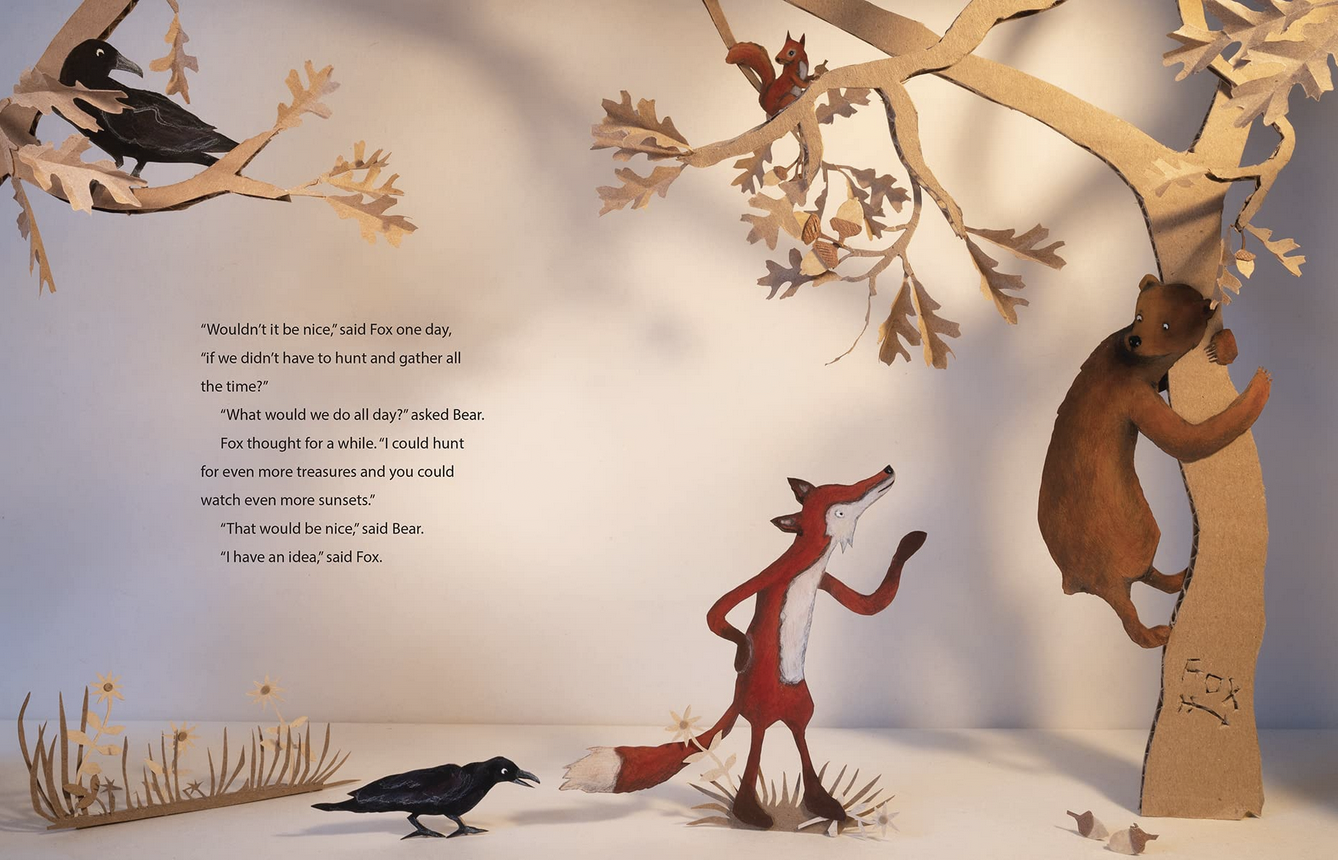
Though life for most animals revolves around the search for food and may seem mundane by human standards, Bear thinks life is pretty good. He loves picking berries while Fox hunts for eggs. And in between the search for food, Bear takes naps and enjoys the daily sunset while Fox searches for treasures and hides them. But then Fox has an idea. What if he could make their food forays more efficient?
From Fox and Bear by Miriam Körner
They start with cages to trap geese and keep them as egg-layers. They also gather more berries and seeds and plant them. Though their aim was to spend less time searching for food, all their chores require more effort, and Fox and Bear rarely have time for the pleasures of naps, treasure hunting and sunsets. So, Fox comes up with another idea.
 
This time, Fox draws up plans for a complex set of machines to gather eggs, feed the birds, water the plants, and pick the berries. Unfortunately, they have to dig up mountains and cut down trees for their contraption. And there were new jobs of gathering wood for the steam engines, filling the bird feeder and building more cages. As their work became more efficient, it became bigger and more involved and time-consuming. Eventually Bear realizes that their new efforts are greater than their past ones and their original daily tasks were the best of all.
From Fox and Bear by Miriam Körner
Fox and Bear could be an updated version of an Aesop's fable. Whether the message is about greed or ensuring that progress is actually an improvement, Fox and Bear remind us that bigger is not always best. A simple life of earnest food-searching and basic pleasures like napping and sunset-watching are not to be dismissed. Our world today is so focused on getting bigger and more that those who adhere to the principles of simple and meaningful are disregarded. It's reassuring to see that, although Bear goes along with Fox's plans, he eventually realizes what is best for him. What Fox decides is up to the reader as Miriam Körner leaves it open as to whether he too will return to his former life or stick with his new busy and overworked lifestyle. (This would be an interesting lesson for students to consider.)

Author-illustrator Miriam Körner lives in Northern Saskatchewan, and I suspect that the very landscape she sees outside her cabin's window is what has given her Fox and Bear's story. The destruction of forests for development must be seen in her northern community, whether for commercial farming, forestry, mining or settlements. Perhaps those behind all that economic planning should be reading Fox and Bear along with young readers.
From Fox and Bear by Miriam Körner
Behind her impactful story is Miriam Körner's artwork which is extraordinary. She has created dioramas from recycled paper and cardboard packaging painted with graphite pencils, soft pastels and acrylic paint. Through a limited palette of browns with red for fox and occasional hints of blue or black, Miriam Körner gives Fox and Bear an organic and very realistic feel to the natural world. Even when she introduces the machinery that Fox implements for efficiency, the cut of the paper and shape of her structures, though of the same colours, shouts of the manufactured and the synthetic. I'm a big fan of textures in picture book illustrations and, by photographing dioramas she has made of the paper and cardboard, Miriam Körner introduces even further textures with shadows and a three-dimensionality to the art. Miriam Körner's artwork presents a story of such quality that readers will be drawn in by the art but will stay for the fable that simple is sometimes actually best.

January 27, 2023

When Sally Met Harry


Written by Paulette Bourgeois
Illustrated by Brooke Kerrigan
North Winds Press (Scholastic Canada)
978-1-4431-7508-1
32 pp.
Ages 2-8
January 2023

Whether you're an adult, a child or a dog, change can be difficult. Even when the status quo is challenging, it's familiar. But when the norm is wonderful, filled with love and attention, adoration and praise, change can be especially effortful, as Sally a goldendoodle learns.
I was a bundle of absolute puppy adorableness.
Sally can do no wrong. She sleeps on their bed, chases squirrels, plays and is cuddled. Even when she does do something inappropriate, like getting into their underwear, chewing it and getting sick, she is consoled with, "Poor baby." And then Sally learns that her people are having a baby. 
From When Sally Met Harry by Paulette Bourgeois, illus. by Brooke Kerrigan
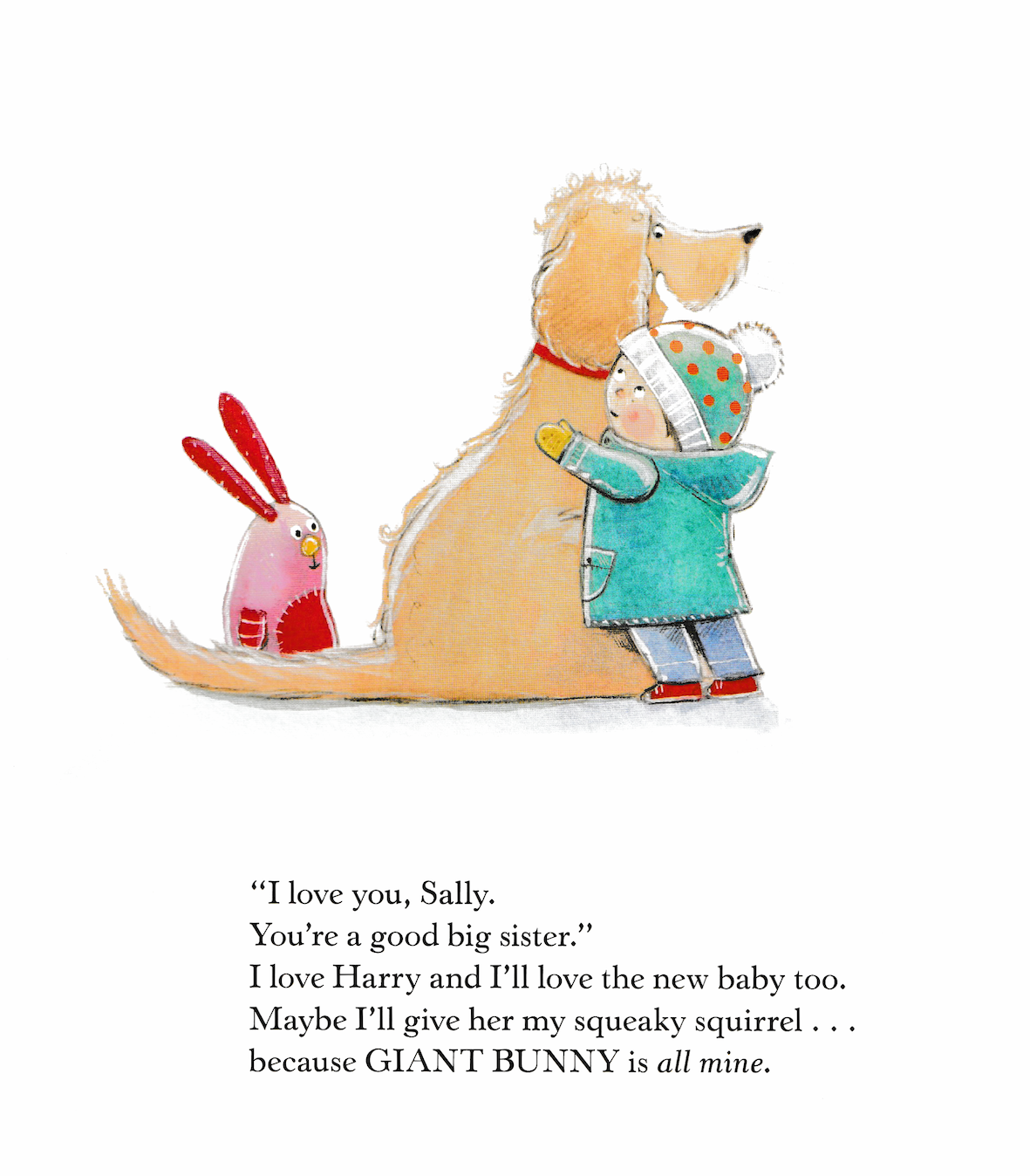
Immediately after Harry arrives, Sally knows things are going to change. She lets herself out when her people are too engrossed with the noisy baby.  Sure, she gets a blanket and a new squeaky squirrel, but Harry gets a giant red bunny! And when Sally tries to show affection for Harry as she would her own pup, they yell at her to get away and she is told, "No." Now Sally has a dog walker, and she sleeps in a basket because Harry sleeps with them. 
From When Sally Met Harry by Paulette Bourgeois, illus. by Brooke Kerrigan
Though Sally tries to think of a way to make her people love her again, she really doesn't have to do anything special. Sally's specialness comes through with the simplest of acts and makes Harry realize that Sally is part of his loving family.
I look deep into Harry's eyes.
I let him know that I love him.
From When Sally Met Harry by Paulette Bourgeois, illus. by Brooke Kerrigan
Many will recognize the name of Paulette Bourgeois as the author of the Franklin the Turtle series but it's obvious she knows more than turtles. She knows babies and children and dogs. She knows the confusion of a new baby in a home with a pet who has been the only "child" and used to getting all the attention and love. But, Paulette Bourgeois, a grandmother herself, also probably knows about finding a way to make all feel appreciated and loved–which will be all the more important when Baby #2 comes along–while bringing seemingly unconnected family members to becoming part of the whole. Telling the story from Sally's perspective, feeling what she does, hearing from others, and seeing for herself, Paulette Bourgeois makes Sally the star of When Sally Met Harry and restores her place of importance when we all know that a helpless baby must become the center of his parents' attention, at least for a time. And then when that baby is a toddler and can be a little brother to big sister Sally, the family circle is complete again.

That sweetness of story and familial bonding comes through in Brooke Kerrigan's illustrations. Rendered in watercolour, pencil crayon and gouache on paper before digitally enhanced, the artwork screams cuteness. From the playful and loving Sally to the cherubic Harry–look at that round head!–and all the little details of toys, squirrels, cats, and other dogs, When Sally Met Harry depicts many a household in which a baby is introduced to a family pet. Still, with Paulette Bourgeois's words and Brooke Kerrigan's illustrations, When Sally Met Harry tells the story of a one-of-a-kind relationship that could earn a cinematic rendering of its own.