January 19, 2022

On Baba's Back


Written and illustrated by Marianne Dubuc
Princeton Architectural Press
978-1-61689-912-7
24 pp.
Ages 1-4
January 2022

In a sweet board book perfect for the very young and their caregivers, Marianne Dubuc charms with a story of family, protection, patience, risk-taking and letting go. And it's all with koalas!
From On Baba's Back by Marianne Dubuc
A young Koko enjoys being carried on Baba's back. But Koko does everything a little koala would do while on Baba's back: eat, play, pee, bathe, and go for walks.
From On Baba's Back by Marianne Dubuc
But sometimes the young want to do something different than what their elders have chosen for them to do. When Koko sees a blue butterfly, a "There!" signals to Baba what Koko wants.
From On Baba's Back by Marianne Dubuc
Still, Baba keeps walking so Koko climbs down to follow the pretty insect. And though taking a risk and leaving the protection of Baba's back might not necessarily be the safest decision, what Koko finds brings joy to both Koko and Baba.
From On Baba's Back by Marianne Dubuc

There will always be a time when a child will take their first steps to independence. It may come with first steps literally or by making choices different than their elders or by leaving the intimate protection of family. For Koko, it is all of these. And though Koko's self-assertion could've been a little scary for both Koko and Baba, there's a satisfaction that comes from taking those independent steps, especially knowing that the safety of family is still there at the end of the day. Though these steps can be milestones, Marianne Dubuc keeps the story very simple, with the text perfect for an early reader or for reading to a baby or toddler who will soon learn the limited phrases. Likewise, Marianne Dubuc doesn't overwhelm her artwork with too much of anything. The stars are Koko and Baba, clearly identifiable as koalas by their ears, with an emphasis on only a few other details like an ice-cream cone, a pee puddle, a ball or a butterfly.

While Baba is a term for father in a number of Asian cultures, it also can refer to a grandmother in eastern Europe. Either way, it is a loving elder who can provide protection for the youngest family members and that's what Koko finds on Baba's back: the security and freedom to learn to become independent.

January 17, 2022

Aggie and Mudgy: The Journey of Two Kaska Dena Childen

 
Written by Wendy Proverbs
Wandering Fox (Heritage House)
978-1-77203-375-5
144 pp.
Ages 8-12
November 2021

They were lost in a void, 
not understanding where they would end up. (pg. 99)

While there are an increasing number of middle-grade books about residential schools, few discuss the journeys that Indigenous children were forced to take from their home to get to those residential schools. Aggie and Mudgy is one such story. But it's also a tale of loss: of family, of names, of culture. And it is as painful as their journey.
 
In contemporary Vancouver, eight-year-old Maddy has found an old photo in her Nan's desk and begs her grandmother to tell her the story of the two little girls. And so Nan does, recounting the story of two young sisters from Daylu, a Kasha Dena community on the BC-Yukon border. As history has shown us, the arrival of those of the Catholic church brought much change, as it did in Daylu, where the First Nations people were first forcibly assimilated by being renamed. 
When we name something, it gives us a kind of ownership, doesn't it? (pg. 96)
Sisters Mac-kinnay and Beep were renamed Agnes and Martha but they called themselves Aggie and Mudgy. Then two years later, the young sisters, only 6 and 8, were taken away by Father Allard to go to school far away. How far away they could not have known.

Though leaving their home would have been frightening, the beginning of their journey starts with some comfort and familiarity as the priest employs two Indigenous brothers to transport them down the Liard River. The landscape, the food and the language are still their own. But after 300 km, their journey after Dease Lake becomes one of newness. As the priest and the girls travel six weeks by mail truck, paddle wheeler boat, steamship and train to the Lejac Residential School at Fraser Lake in central BC, the girls soon realized that their old ways would not be tolerated. Not the language they spoke, not the way they looked, nor the joys they savoured in the outdoors. And if Priest Allard and the nuns who aided them in their journey were not pleased, the children were shamed and beaten.
They couldn't respect different people and cultures, and if the children didn't obey, some priests and nuns could be very cruel. (pg. 47)
The girls' journey with Father Allard was just over 1600 km but it was just the beginning of the inevitable trauma that would be their residency at the Lejac school. Wendy Proverbs could have walked us into that school with Aggie and Mudgy but she knew that the journey of these two Kaska Dena children was important enough to be highlighted. Still, the story is told to enlighten and to acknowledge, not traumatize-it doesn't, though it could have– and by revealing her own personal connection (see "Author's Note" and "Acknowledgements" in Aggie and Mudgy), and giving Nan one as well, Wendy Proverbs has made the sisters' story both restrained and profound. Don't be surprised if a tear is shed.

Because Aggie and Mudgy tells a story within a story, with fiction embracing history, Wendy Proverbs, herself of Kaska Dena descent, has honoured her heritage and her ancestors. In fact, a nod of appreciation should be given to her as she does to others in her acknowledgements for sharing Aggie and Mudgy and purposefully shaking up the universe with truth.
Final appreciation to all of our ancestors who led the way for future generations to speak, dance, create, and indeed disturb the universe. (pg. 130)

January 15, 2022

CanLit for LittleCanadians celebrates 1M views Contest: Winner announced

On Tuesday, January 11, 2021, 

I launched the 

READY TO CELEBRATE 1M VIEWS CONTEST.

And, though we were thousands off, we reached one million views within about 5 hours.

(I had to change the format as it didn't fit in the sidebar. 😧)

As the rules stated the contest would close at 11:59 PM EST the night that the counter turned over one million views (about 3:08 PM EST), the contest closed that night. Thanks to all who submitted comments on the blog and on Twitter about reviews readers had enjoyed on CanLit for LittleCanadians.

Using a random number generator, a winner was selected and it is.....Elizabeth A. who enjoyed the review of Cherie Dimaline's "The Marrow Thieves." 

CONGRATULATIONS!

👏👏👏

Though I can tell you're in a high school library, I have no other information about you, Elizabeth A. So, if you could submit a comment with your details (email, address), I won't post the comment, just grab the information and delete your comment. And anyone who might know a Canadian high school librarian whose first name is Elizabeth and last name starts with an "A," please leave me a comment below with any info (name, email, school) you can provide. (I won't post the comment but I will get the relevant information from it.)

Thank you again to everyone who participated and helped 
get the blog over that milestone of ONE MILLION VIEWS.
 
 
(And 🤞 that we hear from Elizabeth A. within the week. 
Otherwise, I may have to select another winner. 
Thankfully I still have all the participants' names logged for just that possibility. 😥)

January 11, 2022

Ready to celebrate 1M views!: Contest


After just over ten years, CanLit for LittleCanadians is ready to celebrate one million views of posts about books for young people by Canadian authors and illustrators. Want to help me celebrate? Then have I got a contest for you!


What do you have to do?
Leave a comment below (with an identifier so I can contact you somehow) and/or Tweet (tag @HelenKubiw and #1Mviews) about a book that you decided to purchase or read (I'm thrilled to support libraries) after checking out a review here. You've got ten years of reviews from which to choose. Tell me the title of the book and author/illustrator and what grabbed your attention. 
 
Participants will be time-logged in order of submission and a random number generator will select one from all submissions. I will announce the winner here and on Twitter. 

If you submit more than once, only your earliest submission will be logged.

Who can participate?
You must be a resident of Canada in order to participate. (Sorry expats who live outside our country.) Authors and illustrators are welcome to participate.

When?
You have from now until the end of the day (11:59 PM EST) when the blog's view counter hits one million views. (Hint: it will be happening within the next few days.) So if it hits 1,000,000 at lunch on Friday, January 14, you have until almost midnight that night to leave a comment. (I think it will happen sooner.)

Prize?
A box of Canadian books for young people. I will pick the books but it will be a mixed box of at least 10 books.

 
I have been privileged to promote so many wonderful books by so many fabulous authors and illustrators. I've covered picture books, early readers, middle grade novels, graphic novels, non-fiction, young adult books and more. My readers are young people, parents, grandparents, great-grandparents, teachers, school librarians, public librarians, school boards, university faculties of education, organizations like the Ontario Library Association and the Canadian Children's Book Centre, publishers, and more. Thank you to all who have linked to my blog and helped promote it as I promote our Canadian creators.

Though I have wondered whether the 10-year mark (October 2021) or the 1 million view mark would be a milestone for me to reconsider the blog, I don't think I'm quite ready to give it up yet. This is especially true as I think CanLit for LittleCanadians offers an opportunity to celebrate books from everyone from debut authors and small publishers to world-renowned writers and large publishing houses. As long as these creators are Canadian, born or residing, I will champion them, if I like the books. (You might notice that I don't review anything I don't like.)

So here's to CanLit for LittleCanadians 
and it's upcoming ONE MILLION VIEWS. 
 
Thanks you for celebrating with me.

January 10, 2022

Arnold the Super-ish Hero

Written by Heather Tekavec
Illustrated by Guillaume Perreault
Kids Can Press
978-1-5253-0309-8
32 pp.
Ages 4-7
2021

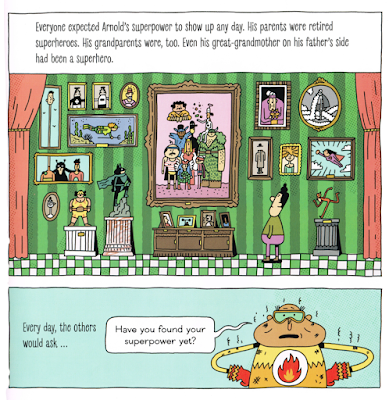
Arnold works in the family business, and that business is one of superheroes. They are superheroes like his super strong cousin and his super fast brother and his super bouncy uncle. But Arnold doesn't have a super power, yet, so, as they all wait for it to show up, Arnold is their phone guy.
From Arnold the Super-ish Hero by Heather Tekavec, illus. by Guillaume Perreault
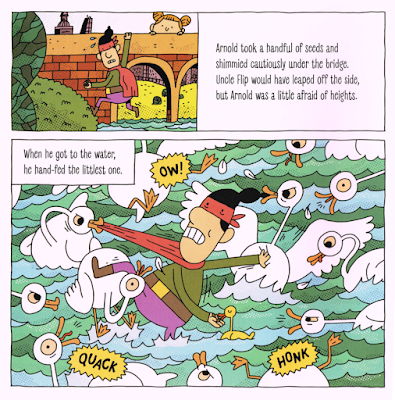
Then a call comes in for a superhero and no one responds when Arnold sounds the alarm. So, determined to follow the family motto of "Stop the bad guy from being a bad guy," Arnold dusts off his great-grandmother's mask and cape to find the crime. But just getting to the crime scene becomes problematic. As he speeds to the scene, as best he can after taking the bus, he comes across situations he misinterprets. A young man yelling at a woman in a wheelchair is actually a grandson trying to tell his grandmother who has lost her hearing aid to keep her hands off the tires so he can push her safely. Arnold's solution of giving the woman a stray kitten to hold works miracles for the grandson, grandmother and even the kitten. He sees a little girl throwing things in the water until she reveals she's trying to feed a baby duck before the more aggressive adults get the food. Arnold comes to the rescue again. 
From Arnold the Super-ish Hero by Heather Tekavec, illus. by Guillaume Perreault
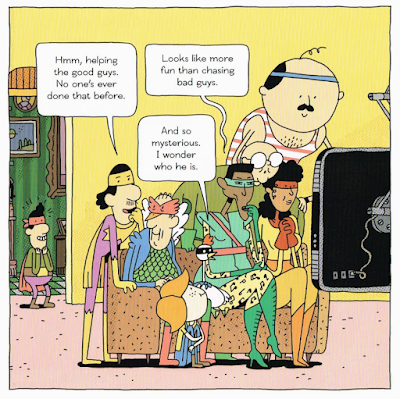
When Arnold finally gets to the called-in crime scene, he realizes that he can use his phone message-taking skills to good use to solve the problem and make two little girls very happy, with one declaring him a super-ish hero. After a few more good deeds, Arnold returns home to witness his efforts lauded on TV, with his family unaware that the Super Nice Guy superhero was their own family member. And that's a secret he's happy to keep to himself. (Oh, look, another superpower: keeping secrets!)

Kids love the idea of superheroes who can do beyond the norm, usually to fight crime and evil. But, if the past two years have shown us anything, it's that heroes come with all kinds of abilities, and goodness and kindness may be the greatest of all of these. As such, BC's Heather Tekavec has given us a humble character in Arnold, one who just wants to emulate his superhero family, but learns unintentionally that kindness is his strength. Even without trying for the spotlight, just stopping to offer assistance wherever help is needed, Arnold has become a hero. He's every guy and, with him, Heather Tekavec has shown us that anyone can be a hero.
From Arnold the Super-ish Hero by Heather Tekavec, illus. by Guillaume Perreault
Quebec illustrator Guillaume Perreault gives Arnold a banal look that works with the common person image. Except for a top-knot, there's not much to distinguish Arnold from anyone, including the reader. He doesn't stand out except when he does something kind. Guillaume Perreault may make Arnold's family members unique in their dress and skills but he makes Arnold stand out for his originality. In fact, Guillaume Perreault gives the whole book an understated feel with his choice of colours-no emphasis on bold primary colours–and blend of picture book illustrations with graphic novel boxes. Unlike most comic books about superheroes that bombard you with flash and action, Arnold the Super-ish Hero has the same restrained and easygoing appearance as does Arnold himself.

With a message that kindness is a superhero talent available to anyone, even Arnold, young readers will cheer for him and anyone who does good, knowing that the goodness comes in the doing, not from the recognition or the celebrity.

January 08, 2022

A Sky-Blue Bench

Written by Bahram Rahman
Illustrated by Peggy Collins
Pajama Press
978-1-77278-222-6
32 pp.
Ages 5-8
 November 2021
 
Bahram Rahman, author of The Library Bus (Pajama Press, 2020), returns the reader to Afghanistan and offers another hopeful tale of resilience and courage, creativity and endeavour.
From A Sky-Blue Bench by Bahram Rahman, illus. by Peggy Collins

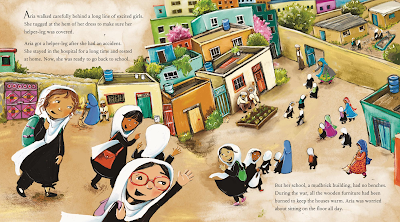
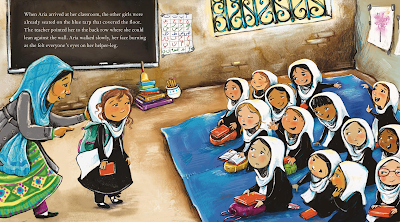
Aria is an Afghan girl with lovely new red shoes and a helper-leg that she got after an accident. (Bahram Rahman's appended notes talk of land mines and unexploded ordinance.) While she is eager to be returning to school after her lengthy hospitalization, Aria is apprehensive, especially as all the wooden school furniture has been destroyed for firewood and the children now sit with bent knees on a floor tarp, something she will be unable to do.

From A Sky-Blue Bench by Bahram Rahman, illus. by Peggy Collins
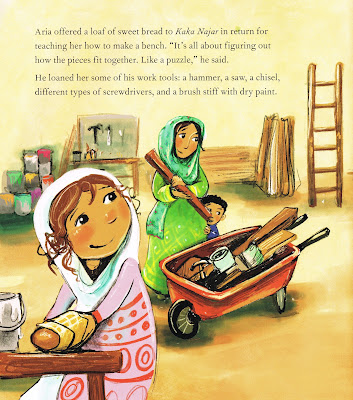
Aria contemplates not returning to school but rejects that idea and instead comes up with the "brave idea" to build herself a bench. Most of the girls laugh at her plan but Aria is determined and she and her lone friend scavenge the city for discarded wooden boards, broken pieces of furniture, and random nails and screws. Then, Aria and her mother visit a carpenter in the old city who, for the gift of a loaf of bread, loans her an assortment of tools and a can of sky-blue paint.
"Sky-blue is the color of courage, peace and," he tapped at his temple, "wisdom."
From A Sky-Blue Bench by Bahram Rahman, illus. by Peggy Collins
And so a bench is created, and with it an opportunity for Aria and the other girls to take control of their own schooling needs.

Though Bahram Rahman makes it clear from his notes about circumstances he and others experienced in his homeland of Afghanistan, he does not dwell on the horrors of land mines or the challenges of living with a civil war. Instead Bahram Rahman speaks to a girl's determination to get an education, be proactive and resourceful, and to challenge herself to meet her own needs. It's a brave commentary on focusing on what you can change, not on what you can't, and Aria demonstrates that the possibilities can be inspiring. 

While there is a brightness and a child-like quality to her art, Peggy Collins (Harley the Hero, 2021) stays firmly in realism, but without immersing her art in the adversity of the situation. Aria's prosthetic leg is barely visible under her black dress and the challenges of the civil war are obscured by the vibrancy of the community in its activity and colour. Peggy Collins takes us into the Afghanistan of Aria's life, not of news reports: her school, her helper-leg, her mother and little brother, and her community. Her sky-blue bench is as assured as she is.

A Sky-Blue Bench may be a story from Afghanistan but its lessons about self-reliance and resourcefulness will speak to all children, especially those facing their own challenges, and encourage them to find solutions. With a desire, some hard work and a little wisdom, Aria was able to build something worthwhile, with wood and with vision.

January 04, 2022

A Long Way Home

Written by Jean Little
Illustrated by Gabrielle Grimard
North Winds Press (Scholastic Canada)
978-1-4431-7091-8
32 pp.
All ages
February 2022
 
No matter how different they are, Maya and Jane become fast friends after Maya moves into the apartment building next to Jane's house. When they learn about animals like whales and polar bears under threat, the two girls vow to do something together.
From A Long Way Home by Jean Little, illus. by Gabrielle Grimard
Jane's grandfather suggests they start close to home and do what they can for the monarch butterflies.
"...wishes don't come true without help..."
Learning of the monarchs' need for milkweed plants, the girls decide to start some plants in Jane's grandfather's community garden. Like good gardeners, they choose their site carefully, plant the seeds and tend to them. The waiting is tough but the girls fill their summer days with cycling and swimming until one day "A bright orange-and-black butterfly was fluttering flower to flower." With new watching and waiting, the girls see an egg become a caterpillar and then a chrysalis.
From A Long Way Home by Jean Little, illus. by Gabrielle Grimard
Though they are anxious for the butterfly to emerge from the chrysalis and Jane considers helping it get out, they have learned that it will appear when it is strong enough to begin its long journey. It is then that Maya reveals that she knows about long journeys. And when the butterfly does emerge and the girls send it off with hearty goodbyes, anticipating its arduous migration to Mexico, Maya bravely discloses that she and her family traveled a long way over many years to escape hardships that threatened their lives. Her own experiences give them hope that their butterflies and others, including those they might save the following year, will arrive safely to their destination just as Maya did.
From A Long Way Home by Jean Little, illus. by Gabrielle Grimard
For many lovers of Canadian children's books, Jean Little is a legend. When she passed in 2020, there was a great sense of loss for her relentless spirit and for any new books, resplendent in their compassion and heart-warming plots. With A Long Way Home, we get Jean Little back for a little while in this story that parallels the plight of the monarch butterfly with that of an immigrant family. While A Long Way Home will be a useful book for teaching STEM with its emphasis on the butterfly's life cycle, it goes beyond the science and evokes compassion for those who must escape troubling worlds and find refuge elsewhere and far away, often after much waiting. But in her inimitable style, Jean Little juxtaposes the story of the butterfly and of Maya's family without being too obvious or deliberate, letting young readers find the connection themselves, so they might understand what both have had to endure.

Gabrielle Grimard's artwork, which has graced many picture books including The Library Bus (2020), Stolen Words (2017), and  Not My Girl (2014), uses a mix of watercolours, gouache and oil to create warm and inviting scenes of children learning, playing and gardening. Her children are very real, with their fly-away hair, joyful camaraderie, and empathetic demeanours, and their efforts to help the monarch butterfly are just as honest. 

A Long Way Home is a triumphant story of a friendship born of acceptance for differences, of a compulsion to learn and help a threatened species, and of journeys taken. Moreover, with A Long Way Home, we are graced once more with a story from Jean Little whose vision is given colour and shape by Gabrielle Grimard. How wonderful for all young readers.