June 27, 2025

Every Leaf on Every Tree

Written and illustrated by Lauren Soloy
Nimbus Publishing
 978-1-77471-423-2
20 pp.
Ages 0–3
June 2025 
 
How great is a parent's love for their child? For this rabbit, that love is vast, mighty, boundless, and endless. For this family, that love is everything.
From Every Leaf on Every Tree, written and illustrated by Lauren Soloy
In a poetic love song to their baby, this rabbit declares the extent of love they feel. Referring to the wonderful elements of their natural world, that love is extolled profusely. 
And every petal 
     on every flower
And every second 
     in every hour 
It's in the grass and the flowers, the ocean and the sand, and in butterflies, birds, and stars. But it's also in the personal touch and tickle. When a parent loves a child, that love is truly reflected in everything.
From Every Leaf on Every Tree, written and illustrated by Lauren Soloy
Every Leaf on Every Tree is a board book and aimed at the very youngest of our children, and so it will be a lovely baby gift for expectant parents. Lauren Soloy, who is best known to me as an illustrator of books such as Kathy Stinson's A Tulip in Winter, has an impressive collection of picture books in her bibliography. But with Every Leaf on Every Tree, she has become an author-illustrator to me, and one that can put words to her art in a heartfelt way. Every Leaf on Every Tree reads like a love song to a child who may or may not be too young to understand the depth of that affection. Regardless, the reading of this book can begin when a child is still a baby and progress to ages one and two and older and even until they are reading it for themselves. And they will always appreciate the comfort of knowing the magnitude of that closeness.
From Every Leaf on Every Tree, written and illustrated by Lauren Soloy
In addition to the text, Lauren Soloy also illustrated Every Leaf on Every Tree. While it's not always possible as a reader to identify the media the illustrator uses, I found that it was especially challenging to identify Lauren Soloy's medium. The art appears to include paint and pencil, perhaps digital rendering, and even cut-paper. Regardless, Lauren Soloy gives us a picture book in which parent and child are part of each other and a larger world of immense beauty and scope. In their own little world, they are everything. In the world at large, they are one.

June 25, 2025

The Witching Hour

Written by Jennifer Harris
Illustrated by Adelina Lirius
Tundra Books
978-1-77488-440-9
32 pp.
Ages 3-7
June, 2025 
 
For those who read fantasy or believe in the supernatural, the witching hour is that time, late at night, when entities like witches make their appearance. But for this family of witches, the witching hour is a little different: that unique hour that slips in between dinner and sleep when their littlest one is set to be put to bed. For them, this time of fussiness is as chaotic and rowdy as any time when other worldly creatures come out to play or cause mayhem. 
From The Witching Hour, written by Jennifer Harris, illustrated by Adelina Lirius
A lovely family of two witches, a small boy and a baby have just finished their meal when the chaos begins. After its bottle spills, the baby begins to cry which turns to caterwauls and then to crescendos. The little boy covers his ears, the black cat is alarmed, and the two witches start to implement an assortment of tricks to calm the baby.
From The Witching Hour, written by Jennifer Harris, illustrated by Adelina Lirius
They take turns, one rocking the child as they perch on a broom before the other takes it for a ride, bouncing on the broom like a pogo stick. The little boy takes the child in hand and does flying loop-de-loops to soothe the baby. When a wand is finally brought out, an owl from a magical parade of toys is just the thing to quieten the baby. For now, at least.
From The Witching Hour, written by Jennifer Harris, illustrated by Adelina Lirius
There are still routines to follow in that witching hour like baths and diaper changes and again the baby is having none of it. So new tricks come out. Snacks, songs, dancing, and even a bat are brought out to the crying child. The baby might not be amused but her big brother is enjoying everything from the music to the pink poodles and tries to help distract and entertain her.
From The Witching Hour, written by Jennifer Harris, illustrated by Adelina Lirius
As every parent and caregiver will know, the baby will eventually tire itself out–hopefully!–and finally, finally succumb to the exhaustion that caused such mayhem and misery.
 
Bedtime must be a special time for Jennifer Harris as her earlier book, The Keeper of Stars, highlights another getting-a-child-to-bed ritual, though with a far gentler story. But, The Witching Hour, as disquieting as it might seem, is actually a very sweet story about family coming together to help the youngest settle down. And though the strategies this family uses may be a little bit different than those your family might use–after all, very few of us have flying broomsticks and magic wands and bring bats to distract a baby–they are creative and diverse, and this family is willing to try anything. Surprisingly, Jennifer Harris never makes the story ridiculous or uproariously funny. She keeps it charming and familial and affectionate. Any parent or older sibling will understand and feel for this family at this witching hour.
 
Illustrations for The Witching Hour were created by Sweden's Adelina Lirius who used gouache, coloured pencils and digital application to  design a magical home of a wonderful witch family. From the spider web play pen to their hanging herbs and lush yard of fairies, frogs and flowers, Adelina Lirius has given Jennifer Harris's words a playground of colour and fascination.
From The Witching Hour, written by Jennifer Harris, illustrated by Adelina Lirius
 
Anything could happen 
in the witching hour.
 
Jennifer Harris is correct that anything can happen in the witching hour whether in a witches' home or that of a human family. But the aim of calming a baby and bridging the time between eating and sleeping is universal, though the approaches taken can be unique. Still a little magic can always help.

June 23, 2025

This is How a Ball Rolls: The Science of Wobbling, Bouncing, Spinning Balls

Written by Heather Tekavec
Illustrated by Suharu Ogawa
Kids Can Press
978-1-5253-0968-7
32 pp.
Ages 5-8
June 2025 
 
Tell most children you're going to be talking about physics, and you'll hear groans. Tell them that they're going to play with balls, and you'll hear the cheers. So, let them play with the balls and they'll learn about the physics painlessly.

This is no ordinary book of nonfiction. Heather Tekavec, who has written both playful picture books (e.g., Arnold the Super-ish Hero) and books of nonfiction (e.g., Same? Different?), always leads with playfulness, and This is How a Ball Rolls has that same whimsy of text, with art by Suharu Ogawa, to lighten the science basis of how different balls work.

From This is How a Ball Rolls, written by Heather Tekavec, illustrated by Suharu Ogawa
For each type of ball, and Heather Tekavec covers everything from a marble to a tennis ball, a bowling ball and a beach ball, she teases readers with a hint to the type of ball she'll be highlighting in the following double-spread. By doing so, she gets young readers interacting with the text, guessing what the ball will be. For example, before her focus on the marble (see illustration above), she writes,
There is a little ball–
A teeny ball–
A glossy, smooth and swirly ball...
The next pages include a five-line poem filled with appropriate verbs and adjectives for that ball–for the marble, words like "clinking,""plinking," and "trading" are used–and then an information box about the type of ball. Information included may deal with how the ball is used in play, the composition of the balls, and even the physics of wind resistance. (Heather Tekavec extends this information in a section called "The Science of (Wobbling, Bouncing, Spinning) Balls" with discussions about the sphere, elasticity, aerodynamics, gravity, trajectory, drag force and speed along with some fun trivia.
From This is How a Ball Rolls, written by Heather Tekavec, illustrated by Suharu Ogawa
This is How a Ball Rolls is anything but boring science. It's playful and colourful and yet informative. It's even more so because of Suharu Ogawa's digital artwork that is as colourful as the balls which she depicts. The brightness of her art is only secondary to the diversity of her characters and the fun that they have in their play. Because she has to represent each type of ball in the scenes in which it would be used, be it a yoga studio, a beach, or a bowling alley, Suharu Ogawa makes every illustration rich in quirky details to draw the young reader's smile and interest. (I'm especially curious about the animated knitted duck head (?) and ball of yarn.)
From This is How a Ball Rolls, written by Heather Tekavec, illustrated by Suharu Ogawa
I know the audience for This is How a Ball Rolls is listed as five to eight years of age so it would work well with Grade 3 students studying forces, but I'd also use it with older students too. They'll appreciate the fun and the interactive nature of the book, but they'll also take away a lot of science that they can apply to new situations.
Moreover, they'll never look at any ball again as just a play thing. It will be recognized as much more, and they'll have a ball sharing what they've learned. (Pun intended.)

June 21, 2025

Yoga Adventures for Little Explorers

Written by Megan McDougall
Illustrated by Hayley Lowe
Pownal Street Press
978-1-998129-23-2 
32 pp.
Ages 3-5
May 2025 
 
There are so many ways that parents and teachers have been getting little ones into mindfulness practices, including yoga, and Megan McDougall's Yoga Adventures for Little Explorers demonstrates that, with some playful imagination, it can be easy.
From Yoga Adventures for Little Explorers, written by Megan McDougall, illustrated by Hayley Lowe
In rhyming verse, Megan McDougall lets us follow a child and his mother to "try something new" though it's obvious that the child is reluctant.
She smiled at me and gave me a nudge.
Weary at first, I did not want to budge.
But everything changes when they enter a space with other children and their parents, and he is given a very special mat that "if you let it, ignites magic in your mind." With that promise, their class begins, starting with breathing and moving into various poses. The poses may not be labelled as Tree Pose or Mountain Pose, but the children are guided to "grow their roots and stand really tall" or "bring both of my feet down to the ground" to find stillness.
From Yoga Adventures for Little Explorers, written by Megan McDougall, illustrated by Hayley Lowe
As the children move through their poses, the yoga studio morphs into a forest or an ocean shore or even a concert venue for a gorilla rock band. And soon the children are dancing with the apes, and doing poses that have them bending and stretching.

From Yoga Adventures for Little Explorers, written by Megan McDougall, illustrated by Hayley Lowe
Finally, when they are home and the child is settling into sleep, those lessons of calm and stillness take him to a dreamland of new adventures.
From Yoga Adventures for Little Explorers, written by Megan McDougall, illustrated by Hayley Lowe
I know that the intention of books such as Yoga Adventures for Little Explorers is to introduce young readers to yoga and other mindfulness practices but, because BC's Megan McDougall takes the perspective of the child, it becomes something different. It isn't children being told what to do. It's what the child experiences, and every child seems to experience it differently, as evident from the variety of their poses. There's an honesty about a story in which a child is dragged to a new place and their trepidation at what they might expect. But then the yoga class becomes an exercise of the imagination as the boy senses places and animals around him. These imaginings add to his experiences and enhance his yoga practice. And any child who reads this book can try these same poses because a double-spread appended to the story displays a great ape doing 15 different stances.
 
Hayley Lowe, an illustrator from BC, uses different media including pencil and digital application to create art that reflects the authenticity of the physical poses but also the fanciful imaginings of a child. Her colours, like her lines and shapes, are soft and cheerful, and any reader would feel welcomed into the yoga studio and the landscapes envisioned.
 
If you're a teacher or a parent who'd like to get your children into yoga, I recommend Yoga Adventures for Little Explorers as a playful introduction and then as an informative guide to the practice. It's a study that little ones, like their adult counterparts, will appreciate for the positive impact on the body and the mind.

June 18, 2025

My Nova Scotia

Written by Lindsay Ruck
Illustrations by Martyna Czub
Nimbus Publishing
978-1-77471-439-3
32 pp.
Ages 3-7
June 2025 
 
Do not think that My Nova Scotia is a travelogue about one of Canada's Atlantic provinces. Instead, read and see about a land and people much loved and spirited and diverse through the words and art of two Nova Scotians, Lindsay Ruck and Martyna Czub.
From My Nova Scotia, written by Lindsay Ruck, illustrated by Martyna Czub
In a lovely, melodic rhyming text, Lindsay Ruck shows us her Nova Scotia. It's a setting of ocean breezes, rustling trees, apples, berries, and a rolling sea. But beyond what is seen in its landscape, it is a place of heritage and people. It is Mi'kma'ki and a land of diverse cultures, from Black Loyalists and refugees and Acadians to those who celebrate the Lunar New Year. They are a people who celebrate with music and dance, food and family. They are a people who have big dreams and share their stories.
 
We work as one and together we rise. 

From My Nova Scotia, written by Lindsay Ruck, illustrated by Martyna Czub
Lindsay Ruck tells of a Nova Scotia of the past and of the present, and honours all that it is with her words.
 
My Nova Scotia honours our past
Our cultures are rich and our heritage vast 

But added to Lindsay Ruck's words is the watercolour artwork of Martyna Czub which transports young readers to an ethereal Nova Scotia of colour and vibrancy, solitude and contemplation. She gives us lively scenes of Lunar New Year celebrations and ceilidhs, large family meals and the gardening and harvesting of food. Martyna Czub also takes us to quiet places of hiking in the woods and travelling on the water. But her depictions of these places and people are so emotive through her choice of colours and strokes of her brushes that Martyna Czub imbues her art with heart and a calming spirit of devotion. Both Martyna Czub and Lindsay Ruck give us a lovely view of Nova Scotia and yet each finds their own way to reveal its charm.
From My Nova Scotia, written by Lindsay Ruck, illustrated by Martyna Czub
I know that some readers may see My Nova Scotia as a regional book that could only be appreciated by locals, but you'd be mistaken. It's been years since I visited Nova Scotia so my appreciation of its beauty and people and all it has to offer a tourist is very limited. But, even if I had never been to this Atlantic province, I would get a true impression of its wonder.  And as I read the text, I was the hearing the melody of "Farewell to Nova Scotia," not because it had a similar tale but because they are both infused with love for a land. My Nova Scotia may be that of Lindsay Ruck and Martyna Czub, but it is an all-embracing admiration for a land unique in place and people that could only be Nova Scotia.
From My Nova Scotia, written by Lindsay Ruck, illustrated by Martyna Czub

June 16, 2025

Steve, a Rare Egg

Written and illustrated by Kelly Collier
Kids Can Press
978-1-5253-1300-4
64 pp.
Ages 6-9
June 2025 
 
Steve the Horse, being the pretty exceptional horse that he is (Steve, a Pretty Exceptional Horse), has starred in a number of picture books but now is being introduced to young readers in an early graphic novel series, of which Steve, a Rare Egg is the second. It's just another way for author-illustrator Kelly Collier to shine a light on this remarkable and unique and singular character. Steve is not just a horse. He's a headliner.
From Steve, a Rare Egg, written and illustrated by Kelly Collier
Steve is just trotting along, singing as he does, when he spots some remnants of a party in a trash can. There's cake and a party hat, and then he's distracted by an errant red balloon trapped beneath a stick. It's red and intriguing and Steve calls it fabulous, though his friends Gopher and Bob the Raccoon warn him to be careful. But it's Steve and his argument that it's a law that nothing fabulous is dangerous overrides all. Soon the friends are trying to name it, study its form and figure out what it is. And Steve is taking control and ownership of a red balloon he decides is an egg. In fact, it's a very rare Thingamabob Horse Egg and its parents must be found.
From Steve, a Rare Egg, written and illustrated by Kelly Collier
But until the parents are found, they must babysit this rare egg. That includes putting it down for a nap before Steve's "snuggum-wuggums becomes a cranky-panky." (p. 29) Young readers will know it's a balloon but will laugh as Steve decides that his rare egg is about to hatch and he's going to help nurture it, even incubate it, like a "mama horse-chicken." (p. 48) It's not until the inevitable happens that Steve accepts that the red thingamabob was not egg. But will Steve accept that his scientific process of observations and hypotheses and conclusions might not be the strongest?
From Steve, a Rare Egg, written and illustrated by Kelly Collier
Kelly Collier makes a simple discovery of an unknown object into an informal science experiment with a wild result. Steve and his friends make observations, hypothesize about the red thing's nature and even give it a name, and, based on those premises, Steve concludes what is needed to happen. Unfortunately, he is mistaken–something Steve rarely accepts–but turns it around to see himself in an ever-positive light. Surprisingly, it's Steve's antics that make Bob the best comedic foil, getting laughs with his composure and his insight. Steve's egocentricity–he always knows best–bring on the laughs but, with Bob and Gopher's as counterpoint, the story of Steve, a Rare Egg is hysterical. Steve is gullible and self-interested, but his pals show more insight and guide him to see different perspectives on the same circumstances. Steve may race ahead with all his ideas, but they rein him in as much as they can to keep him safe emotionally and physically.
 
The story of Steve, a Rare Egg is a funny one and it's all the better with Kelly Collier's digital artwork. She keeps her illustrations uncluttered so that Steve and his friends and the balloon, with only a few key embellishments, like a nest, a blanket and some lost posters, are the focus. That red balloon and the trio tasked to monitor it are everything. Even her choice of colours draw the eye to the white horse and the red balloon, the protagonists (?) of the story.  
 
Through her illustrations and dialogue, Kelly Collier gives young readers a story of colour and humour, and so many laughs, and even a bit of the scientific method. With a horse and a balloon, it's a rare combination but it's one that is successful in its silliness.
 
• • • • • • •
If you want to read more about Steve the Horse and his antics, both in picture book or in early graphic novel, or pre-order his upcoming story, here is a bit about the books in the series:
 
Picture books: 
 
Early graphic novels:
Steve, a Rare Egg (2025)
Steve, Born to Run (coming Sept. 2025)
 

June 11, 2025

Meet Frederick Banting (Scholastic Canada Biography)

Written by Elizabeth MacLeod
Illustrated by Mike Deas
Scholastic Canada
978-1-0397-0785-6
32 pp.
Ages 6-10
June 2025 

I get excited with the release of each new addition to the Scholastic Canada Biography, and this is just so with Meet Frederick Banting, which came out last week. Elizabeth MacLeod and Mike Deas collaborate so well that I know that young readers will come away having learned and be inspired by another great Canadian.
 
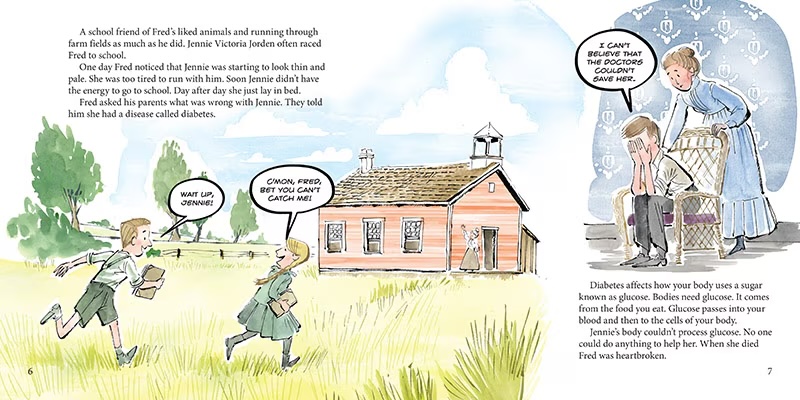
While many will know the names Banting and Best for their discovery of insulin, the full story of Frederick Grant Banting, born on an Ontario farm in 1891, will be less well known to many. Banting's story, beyond a Heritage Minute of Historica Canada, is far less familiar, though, within his childhood, education, and work beyond the discovery of insulin, he is a man of great accomplishment, humanity, and charity.
From Meet Frederick Banting, written by Elizabeth MacLeod, illustrated by Mike Deas
Living on a farm at the turn of the twentieth century would have been fairly typical though Fred was encouraged early on to really study the animals to help determine why they were sick and how to help them get better. However, it was his friendship with Jennie Victoria Jorden, a young diabetic, that probably was most critical to compelling him to consider why diabetics got sick and died and how he might help them.
From Meet Frederick Banting, written by Elizabeth MacLeod, illustrated by Mike Deas
At university, Fred studied medicine and, after working as a doctor in Britain and France during World War 1, he returned to Canada and started a family practice in London, Ontario. He also taught at the nearby university, and it was during his prep for an upcoming lecture on the pancreas, which was known to be involved with diabetes, Fred had an important realization. He took his idea to a professor at the University of Toronto who provided him with a lab and assistant, Charles Herbert Best. Their research into isletin which was renamed to insulin is well established, and the accolades he received, along with others, are firmly rooted in the history books.
From Meet Frederick Banting, written by Elizabeth MacLeod, illustrated by Mike Deas
But Elizabeth MacLeod tells us more about the man and his nature beyond his discovery. He didn't want to make money from his discovery and sold the rights to make the medicine for a single dollar. When he won the Nobel Prize in 1923, he split his prize money with Charley Best. And he continued to work for others, opening a diabetic clinic and helping the Canadian government by conducting research during World War 2. This extraordinary man lived a life of service and Elizabeth MacLeod makes sure to tell his story more completely. (She includes a timeline of his life at the conclusion of her story.)
 
The reason I love the Scholastic Canada Biography books is because I always learn something new. Elizabeth MacLeod goes beyond the obvious or the known and gives us a fuller picture of the individual. Here, Frederick Banting becomes a humanitarian and a researcher, more than just a Nobel Prize laureate or a celebrity to be lauded on a Walk of Fame, though he is both of those. And she tells his story with passion and directness, probably not unlike the man. This is his story and his life, and Elizabeth MacLeod tells it effectively for her audience.
 
That simplicity of message comes through in Mike Deas's illustrations that look like they were effortlessly created, but they are far more than just sketches. In a complex process of creating sketches digitally, with a Wacom tablet and Photoshop, Mike Deas traces them onto watercolour paper and then applies gouache and watercolour paints before using black ink to finish the illustration. But with that process, Mike Deas creates art that is both direct and detailed, has heart and authenticity, and is perfect for a story of a selfless man who worked to help others and not enrich his own life with money or accolades. 
 
Meet Frederick Banting may take longer than a single minute of recounting history, but Frederick Banting deserves more, and Elizabeth MacLeod and Mike Deas have given his legacy that which he is due. They have relayed to young readers that he was a great man and that all his work justifiably earned him the recognition as a great Canadian.
 
• • • • • • •

I know that readers always like to check out more of these books so here is a smattering of volumes from the Scholastic Canada Biography series:
 
Meet Viola Desmond (2018)
Meet Chris Hadfield (2018)
Meet Tom Longboat (2019)
Meet Elsie MacGill (2019)
Meet Willie O'Ree (2020)
Meet Terry Fox (2020)
Meet Thérèse Casgrain (2021)
Meet David Suzuki (2021)
Meet Mary Ann Shadd (2022)
Meet J. Armand Bombardier (2022)
Meet Buffy Sainte-Marie (2023)
Meet Jim Egan (2024) 
Meet Frederick Banting (2025)

June 09, 2025

Jane and the Blue Willow Princess

Written by Catherine Little
Illustrated by Sae Kimura
Plumleaf Press
978-1-069093523
40 pp.
Ages 6-10
June 2025 
 
The name of Jane Austen is forever linked with her Regency novels of Sense and Sensibility, Pride and Prejudice, Mansfield Park, and more, though she wasn't credited with their authorship during her lifetime. But how Jane Austen became the writer she did is purported to have its origins in her family and childhood, and Jane and the Blue Willow Princess is but one story of how she might have drawn inspiration from that place and time.
From Jane and the Blue Willow Princess, written by Catherine Little, illustrated by Sae Kimura
Catherine Little's story of little Jane takes readers to a family home in the late 1700s England where children entertained themselves and would take tea outdoors on Blue Willow fine china. In this story, Jane talks with her older sister Cassandra whom she calls Cassy about her many ideas for her writing. Though young readers might not recognize key scenes from her books, like a young lady on a horse getting caught in the rain or a family with many daughters who walk the countryside and confide in each other, these are the basis of Jane's ideas. But on this day, she is considering what to write as a birthday gift for her father.
 
While enjoying their tea, Jane is fascinated by the scenes depicted on the plate. She sees a fleeing young woman on a bridge, an attentive man on a boat, a wealthy or important man looking agitated, and lush outdoor scenes. Within the chinoiserie design of the plate, even after it gets broken by a stray ball, Jane finds inspiration.
From Jane and the Blue Willow Princess, written by Catherine Little, illustrated by Sae Kimura
With that plate in mind, Jane creates a play about a Blue Willow Princess who chooses not to marry her prince. Jane and her siblings perform her play for her father's birthday and takes a step forward in launching her writing career.
From Jane and the Blue Willow Princess, written by Catherine Little, illustrated by Sae Kimura
This year marks the 250th anniversary of Jane Austen's birth and there will undoubtedly be many events and commemorations to celebrate the author. As with many historical figures, some information is known but there are always gaps that offer opportunities for fictionalized accounts and Jane and the Blue Willow Princess is one such imaginative story. Catherine Little, whose earlier books include Anne of the Library-on-the-Hill, Dragon's Dilemma, and Twelve in a Race, gives us a lovely story about a child who finds inspiration in a plate. And anyone who writes will understand that creativity can find a germ of an idea anywhere, whether in personal experiences with others, in local happenings, or in a plate. For Jane Austen, she found her ideas very close to home.
 
Sae Kimura, who illustrated all of Catherine Little's earlier picture books, has a style that is very well matched to a historical picture book. There's a lightness of line and colour that transports us hundreds of years ago to a time when girls wore simple empire silhouettes and boys wore breeches and waistcoats. But she also gets the whimsy in there with Jane's  imagination as her writing takes her on flights of fancy.
From Jane and the Blue Willow Princess, written by Catherine Little, illustrated by Sae Kimura
A foreword comment to Jane and the Blue Willow Princess from Caroline Jane Knight, the fifth great niece of Jane Austen, submits that Jane's storytelling with her family was important in helping her to write the novels that she would complete later in life. With everything around her providing her with fodder for her writing, even a Blue Willow Princess, Jane Austen took her readers and her audiences to the places of her imagination and delighted them with her fancy.

June 05, 2025

Inspired: A Roy Henry Vickers Colouring Book

 
Art by Roy Henry Vickers
Harbour Publishing
978-1-998526-33-8
88 pp.
All ages
Releases June 17, 2025 

Roy Henry Vickers, an Indigenous artist of rich Tsimshian, Haida, Heiltsuk, and English ancestry, has inspired many a child through his First West Coast Books with Robert "Lucky" Budd, and art lovers with his carvings, paintings, and prints, and even music lovers through his Grammy-nominated artwork for the Grateful Dead's 2018 boxed set. With this new publication, Roy Henry Vickers shares his art with those who may be inspired to create beauty through the colouring process.

From Inspired by Roy Henry Vickers
First, I must apologize for the poor reproductions of the gorgeous pages of Inspired. As line drawings, I could not share them properly to display the beauty of their shapes and line. That is my failing, not that of the book. Once you have your own copy of Inspired, you'll see the true depth of charm and style depicted in each spread. Roy Henry Vickers does not disappoint, though my scanned images do.
From Inspired by Roy Henry Vickers
Inspired is a collection of 42 pages for the reader to colour. The perforated pages are blank on one side, allowing the reader or colourist to remove the pages easily for display. Some of the titles of Roy Henry Vickers's colouring pages, some derived from actual art pieces, include Two Salmon, Bear Claw, Frog Drum, Snowy Owl, and Skeena Northern Lights. They cover a wide variety of Pacific Coast animals, people, and places. How the reader or colourist decides to give embellishment to the art, whether with pencil crayons, markers or watercolour paint, is up to them.
From Inspired by Roy Henry Vickers
Roy Henry Vickers's style is evident in each illustration with flowing lines creating elegant abstractions. His images, even as line drawings, are powerful and magnificent, recreating familiar scenes and natural elements in wonderfully stylized Northwest Coastal art. Roy Henry Vickers, who lives in BC, blends his natural surroundings with his heritage and designs creations that are both unreal and recognizable. They are beautiful.

From Inspired by Roy Henry Vickers
Though I would be tempted to colour these images myself, I think Inspired would be a lovely gift to someone who needs to see beauty and have a hand in gracing it with colour. Roy Henry Vickers's artwork needs no embellishment; it is perfection. But, by creating a colouring book of his images, Roy Henry Vickers allows the reader, nay colourist, to be part of a process by giving them license to impart their own vision onto his outlines. It's a subtle collaboration that empowers and soothes.

• • • • • • • 

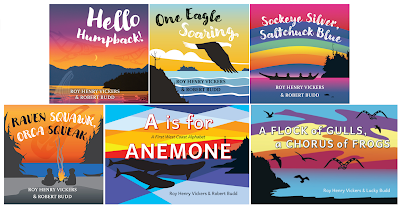
To further appreciate the art of Roy Henry Vickers, check out the First West Coast book series he created with Robert Budd.

June 03, 2025

Mr. Beagle and the Quidi Vidi Caper

Written and illustrated by Lori Doody
Running the Goat, Books & Broadsides, Inc.
978-1-998802234
44 pp.
Ages 4-8
June 2025 
 
If it's a picture book by Lori Doody, you know it's time for another visit to Newfoundland and Labrador. In fact, Lori Doody invites us to revisit her character Mr. Beagle, whose nose for mystery helped him solve the local cases in Mr. Beagle Goes to Rabbittown, Mr. Beagle and the Georgestown Mystery, and Mr. Beagle Climbs Signal Hill.  This time, Mr. Beagle heads to the charming neighbourhood of Quidi Vidi in St. John's, Newfoundland and discovers a new mystery to solve.
From Mr. Beagle and the Quidi Vidi Caper, written and illustrated by Lori Doody
While making a delivery from his store, Mr. Beagle's Convenience, he notices that folks in the neighbourhood are looking a little sad and seem to be having a hard day. He learns that their stuffed teddy bears have gone missing. "It was unbearable!"
From Mr. Beagle and the Quidi Vidi Caper, written and illustrated by Lori Doody
He walks through the neighbourhood, talking to people and visiting the fish and chips stand and the one selling pupsicles before heading to the wharf. As the locals and tourists, all donning colourful sweaters and hats, scarves and bottoms, meander the wharf, shopping, taking boat rides, fishing, watching artists and more, Mr. Beagle has his beagle eyes open and his sniffer on the scent. With observation and insight, he catches the culprit whose plight compelled him to theft.
From Mr. Beagle and the Quidi Vidi Caper, written and illustrated by Lori Doody
But identifying the thief is just part of Mr. Beagle's talent. As in his earlier stories, Mr. Beagle finds a way to help the offender and in turn enrich the community in a novel way. And for Quidi Vidi, there's going to be a new attraction.
 
With a plethora of pun and subtle charm, Lori Doody has Mr. Beagle solving a mystery and helping the neighbourhood of Quidi Vidi. The mystery he tasks himself to solve may not be a heist of incalculable wealth, but it is a grab at the most precious and comforting of possessions for many: a beloved teddy bear. So, he takes his task seriously and just apprehending the culprit is not enough. Mr. Beagle needs to know why the theft took place and what could be done to resolve this for both thief and victims. In doing so, he institutes a form of restorative justice whereby both victim and perpetrator can find healing.
 
That's a big message for a little story about a dog who solves the mystery of the disappearing teddy bears, but St. John's printmaker Lori Doody keeps the lightness and brightness of the story in her art. From the bold colours of the sea, sky and land to the myriad of characters that populate the community, Lori Doody takes us to a neighbourhood that is unique and rich in spirit. And with another mystery solved, Mr. Beagle has strengthened another Newfoundland community and revitalized its residents through humanity.
 
Mr. Beagle Climbs Signal Hill (2022)
Mr. Beagle and the Quidi Vidi Caper (2025)