November 11, 2024

Pick Me!

Written by Annika Dunklee
Illustrated by Lori Joy Smith
Bread & Butter Books
978-1-0689189-0-2
32 pp.
Ages 3-8
October 2024
 
Annie, Lillemor and Lilianne are good friends who do everything together. But what happens when they can't?
From Pick Me!, written by Annika Dunklee, illustrated by Lori Joy Smith
The three friends who first shared a story in Annika Dunklee and Lori Joy Smith's Me, Too! and then in its sequel Me, Me, Me, continue to bond over their shared interests and spend all their time together. Especially cute is their teaching each other their own language as Lilianne speaks French, Lillemor speaks Swedish, and Annie speaks her imaginative language of Oinky Boinky. But on a field trip to the museum, their teacher insists that Lillemor pick only one girl with whom to partner. This becomes an onerous task as she attempts three different ways to choose. Finally the teacher chooses, and Annie is left to partner with Meilin. 
From Pick Me!, written by Annika Dunklee, illustrated by Lori Joy Smith
Annie is less than gracious about being with her new partner, leaving her behind and repeatedly returning to her two friends. But she soon learns that Meilin too had another partner in mind and was equally upset with being paired with Annie. Now it's up to Annie to try to make a connection with Meilin and through a couple of ice breakers, the two become fast friends too.
From Pick Me!, written by Annika Dunklee, illustrated by Lori Joy Smith
Annika Dunklee certainly gets into the heads of little girls for whom friends can be the most important thing in their lives. In each book in this series, the girls are challenged with making friends, staying friends, and dealing with friends. Having a friend offers stability but when you can't be with your friends of choice–and this will always happen at school in group work and partnering up for games and activities–it can be monumental. It's not surprising that Annie would disregard her teacher's instructions and do what she chooses just to feel the security of her established friends. Her annoyance is palpable. But her friendships have given her the skills to be friendly to others, when she chooses to, and to make new friends. Pick Me! are words that reverberate in many schools every day but, with strategies to make decisions and choices as well as approaches to connecting with new people, Annika Dunklee's story also becomes a resource for navigating friendships, particularly at school.
From Pick Me!, written by Annika Dunklee, illustrated by Lori Joy Smith
PEI's Lori Joy Smith brings the joy of friendship to life in her bright illustrations. There is a simplicity to her art, focusing on the kids and their expressions of satisfaction and their connection, but also in their distress and frustration, all the emotions that come with becoming, being and holding onto friends. Annika Dunklee has made her characters diverse in their languages, but Lori Joy Smith has made them real in the diversity of their backgrounds, physical features, personalities and more. She's made their story one that is universal for all friends.

For a great kindergarten lesson, or for kids in Grades 1-2 who still need help in making and keeping friends, Annika Dunklee and Lori Joy Smith's trio of books featuring Annie, Lillemor and Lilianne will be invaluable. Moreover, Pick Me!, like the earlier two books, will offer young children a different perspective on friendships that they might find difficult to understand. When they're very young, it's difficult to see that others are may be struggling too. For Annie to realize that Meilin was also disappointed in not being with her friends was a big step to making a new friend and seeing beyond herself and ultimately getting something that made her happy: a new friend.
 
• • • • • • •

 Me, Too! (2015)
Me, Me, Me (2017)
Pick Me! (2024)

November 09, 2024

2024 Prix TD de littérature canadienne pour l'enfance et la jeuness: Winner announced

On October 16, 2024, the Canadian Children's Book Centre and Communication-Jeunesse announced the five finalists for the $50,000 prize for le Prix TD de littérature canadienne pour l'enfance et la jeunesse.  This past Monday, November 6, the winner of this French-language book award was announced.

Congratulations & Félicitations!

 • • • • •


WINNER / LAURÉAT
 Le Prix TD de littérature pour l'enfance et la jeunesse canadienne
 
 
Les saumons de la Mitis
Écrit par Christine Beaulieu
Illustré par Caroline Laverge
Éditions de la Bagnole


November 08, 2024

Lemming's First Christmas

Written by Jamesie Fournier
Illustrated by Tim Mack
Inhabit Media
978-1-77227-543-8
28 pp.
Ages 0-5
October 2024
 
Avinngaq (lemming in Inuktitut) lives under a house and hears children singing, "Santa Claus is coming to town." When she asks Qimmiq (a sled dog), he tells her that Santa Claus puts presents under the tree. That just leads to more questions because Avinngaq doesn't know what a tree is. And so begins Avinngaq's quest to ensure Santa Claus visits her.
From Lemming's First Christmas, written by Jamesie Fournier, illustrated by Tim Mack
Qimmiq has a simple explanation about a tree–"It grows out of the ground, and you decorate it"–and he goes with Avinngaq to find one. The other Arctic animals bring forth what they suggest might be a tree. From Natsiq (a ringed seal) who brings some seaweed, and Tuktu (a caribou) who brings a purple saxifrage, Qimmiq can only tell what is not a tree. Other animals include Tiriganiaq (an Arctic fox) and Ukaliq (an Arctic hare) but it's not until Avinngaq rests on a piece of driftwood that Qimmiq confirms she's found a tree.
From Lemming's First Christmas, written by Jamesie Fournier, illustrated by Tim Mack
So, the friends decorate the driftwood with the seaweed, the purple saxifrage, arctic willow, and berries, sing, "Santa Claus is coming to town" and are delighted to find presents under the tree the next morning.
From Lemming's First Christmas, written by Jamesie Fournier, illustrated by Tim Mack
For our very youngest children, Lemming's First Christmas would be a bright beginning to the holiday season. Of course, they'll start singing the song too and it could get tiresome for the next seven weeks but maybe you could break that up with a reading or two of Lemming's First Christmas and some discussions about Arctic animals and plants, about cultural traditions, and even the magic of the holiday season. Jamesie Fournier, a writer in Iqaluit, keeps the story positive and simple, which is perfect for an early picture book–it has thicker pages and a reinforced cover–while introducing them to the Arctic and its plant and animal species, and teaching them a few words of Inuktitut. (A double-spread at the back posts the Inuktitut names and their pronunciations along with illustrations of the animals depicted.) It's very sweet and all the more so for Tim Mack's illustrations. I've reviewed several books which Tim Mack has illustrated (It's Time For Bed and What's My Superpower?) and his cartoon style of digital art will resonate with very young readers. His characters are cute and recognizable, and even if unfamiliar with an Arctic environment, children will recognize the play of shadows at night, the magic of snow and stars, and the quest for answers from those we know.
From Lemming's First Christmas, written by Jamesie Fournier, illustrated by Tim Mack
Get into the holiday season in a gentle way with Lemming's First Christmas. It's an easy introduction for those who may become overwhelmed with the customs of the holiday and let them see it from the perspective of a group of animals who interpret a tradition in their own way and make it a very sweet first Arctic Christmas.


November 06, 2024

Two Tales of Twenty-Six: Liam and the Letters, Walter and the World

Written by Stephanie Simpson McLellan
Illustrated by Mike Deas
Red Deer Press
978-0-88995-746-6
64 pp.
Ages 6–8
November 2024
 
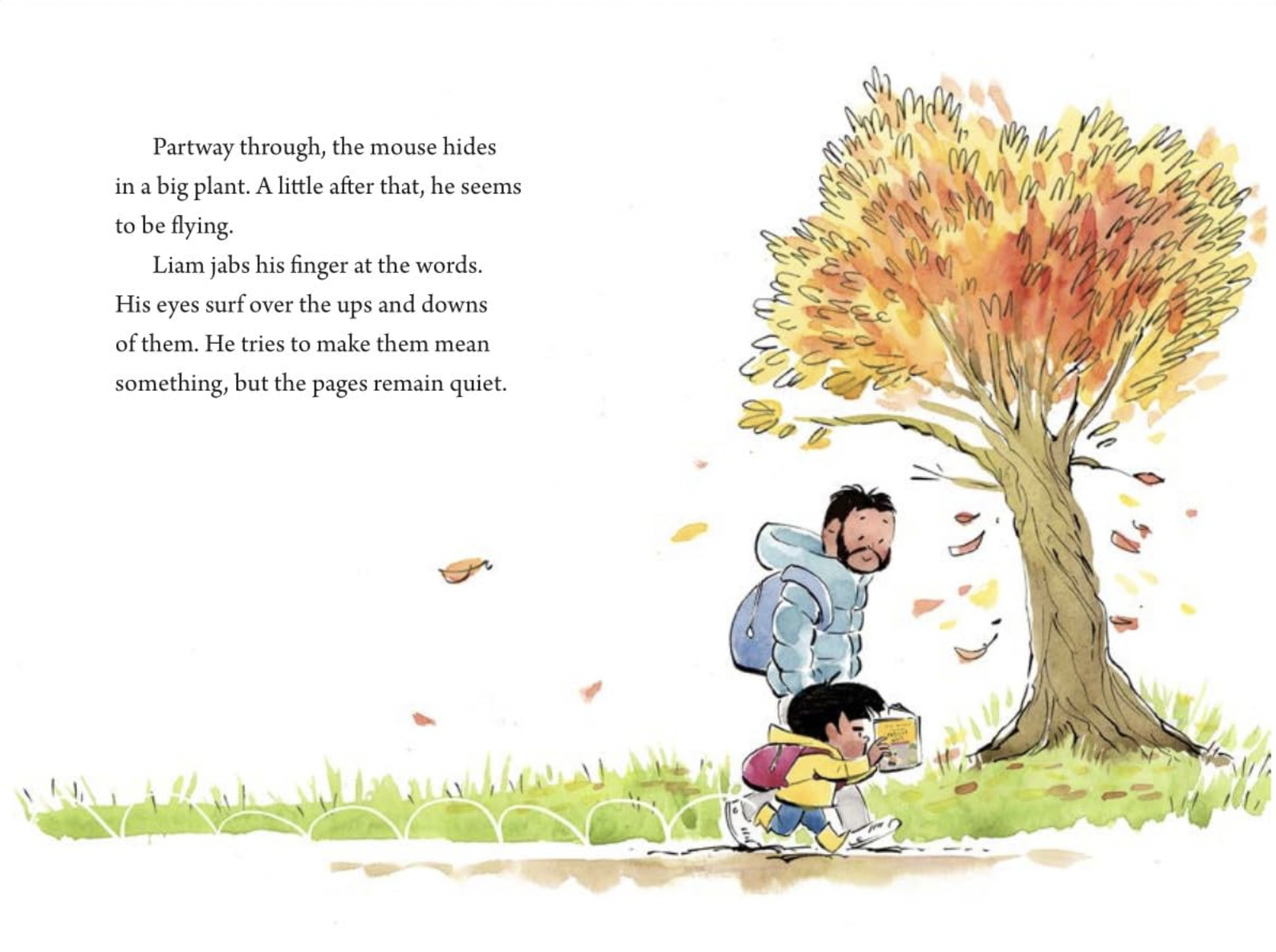
Like all skills, literacy develops at its own pace for the learner. For some children, the step between seeing shapes and deciphering into letters and then words comes earlier. For others, whether because of readiness or learning disability or even opportunity, the ability to read may come later. For Liam, it's not coming fast enough, especially when he has a charming book about a mouse and a bunch of cats–his family has cats!– and he wants to know what's happening.
From Two Tales of Twenty-Six: Liam and the Letters, written by Stephanie Simpson McLellan, illustrated by Mike Deas
In Liam and the Letters, a little boy is charmed by a book about a mouse and a lot of cats. He gets a lot of information from the illustrations, but he wants to know what's actually happening "but the random lines and loops of the letters stretch across the page like fences." (Liam and the Letters, p. 5) In fact, a sample of letters look a lot like those almost indecipherable text-based captchas and spell out "You Can't Come In" and could refer to the mouse and the outside world to which he is eager to visit or to Liam and his reading.
From Two Tales of Twenty-Six: Liam and the Letters, written by Stephanie Simpson McLellan, illustrated by Mike Deas
Liam is getting frustrated as fall turns to winter and he even throws his book away into the snow. But he retrieves it and makes a plan. After all, twenty-six letters is a lot. One letter at a time is manageable. 
One letter at a time could turn impossible into possible. (Liam and the Letters, p. 15)
From Two Tales of Twenty-Six: Liam and the Letters, written by Stephanie Simpson McLellan, illustrated by Mike Deas
So, he starts with the L and the A, letters from his name and ones that he recalls learning about at school. He's frustrated but with time he picks up on the W in the "Walk" sign on his way to school and the R on a cereal box. By spring, he's learned the letters and the weird-looking letters become readable.
 
Now, he can read the story that the reader can also read, simply by turning the book over. Walter and the World is the story of the mouse and the cats that Liam could not read. Walter the mouse has his own issues, with twenty-six cats whom he must evade if he's going to explore the outside world. Both Liam and Walter have twenty-six entities standing between them and what they crave, whether reading or an opportunity for exploration. Their stories may be different, but they are connected and ultimately even linked.
From Two Tales of Twenty-Six: Walter and the World, written by Stephanie Simpson McLellan, illustrated by Mike Deas
A tête-bêche book, which is also a flip book, has two stories in one book which you access by flipping it over. But Stephanie Simpson McLellan's book is not just two different stories. They are two linked stories with a child trying to read the other story. I don't think it matters which story is read first. If they read Liam's story first, they will get a perspective of what it means to look at a book and be frustrated at being unable to read it. But they will also get the satisfaction, as Liam gets, when he can put letters together into words and make sense of the story the reader can now read too. On the other hand, if they read Walter's story first, they'll be charmed by a cat-and-mouse story like no other and feel like they know a secret about the book that Liam cannot read when they read the second story. The order of the reading of the flip book does not matter here; it's the connection that matters.
 
Flip books can be problematic for libraries, particularly for cataloguing, but Two Tales of Twenty-Six will not be so. It will just be a fuller story, told from two different layers, that of a story character and that of a reader. For each, Stephanie Simpson McLellan who is a star of storytelling–my particular faves are The Christmas Wind and The Sorry Life of Timothy Shmoe–gives us a character who is faced with a challenge of twenty-six and tackles it with strategy and perseverance and ultimately success. It's two feel-good stories in one package.
 
To make it even more enticing for early readers–other than giving them a story with which they will be familiar–Two Tales of Twenty-Six is illustrated by Mike Deas, giving these young readers the graphic support to help them read and understand their reading. Mike Deas's art uses a blend of gouache, watercolour, ink, and digital tools to both support and enhance the stories, giving Liam the reader a starting point for his reading, and the reader of Two Tales of Twenty-Six the colour and the magic to make understanding possible and worthwhile.
 
I'm usually not enamoured with tête-bêche books but Two Tales of Twenty-Six is more than the sum of its parts and that's why it's extraordinary. It's a book that is geared to its audience perfectly, encouraging our youngest children in their reading, especially if they are frustrated, and allowing them to see themselves in a story while taking a step up in their reading from picture books.
• • • • • • •
 
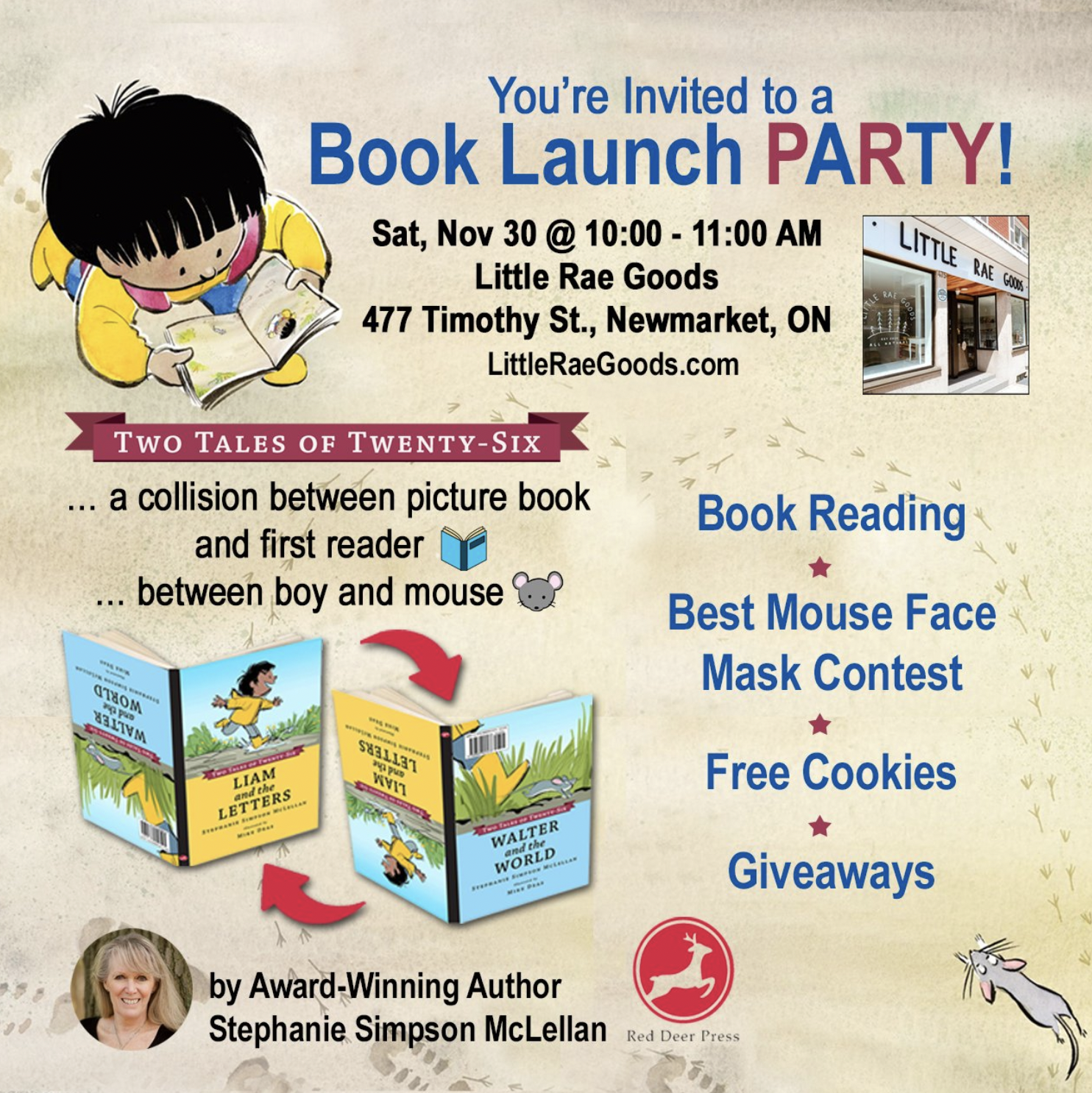
I'm very pleased to tell you about the book launch party for Two Tales of Twenty-Six
 
that will be held on

Saturday, November 30, 2024
 
from 10–11 a.m.
 
at

Little Rae Goode
477 Timothy St.
Newmarket, ON
 
 
This book launch will include:
 
• a book reading
 
• a contest for best mouse face mask

• free cookies

• giveaways

and

• book signing by the author Stephanie McLellan


November 04, 2024

Unsinkable Cayenne

Written by Jessica Vitalis
Greenwillow Books (HarperCollins)
978-0-06-331445-0
304 pp.
Ages 8-12
October 2024
 
 
But in middle school
there are two choices:
fit in
or
stand out. (p. 69) 
 
It's 1985 and Cayenne has always lived a nomadic life with her Mom and Dad and now six-month-old sibs Sossity and Bear. They've travelled throughout the U.S. in their van, living off Dad's small disability check from the VA, with Mom homeschooling Cayenne. Cayenne knows that some people may look down on them for being poor and living a hippie lifestyle, but she feels a closeness with her family, especially when she plays her harmonica and Dad plays his guitar and Mom dances, even though Mom has been distracted with the babies. Still Dad decides to settle them down in a Montana town where he's gotten a job at the sawmill, and Cayenne feels like it's where they finally belong and maybe she can feel normal, even if Mom isn't necessarily happy. 
I agreed to this move.
I did not agree 
to sell my soul. (p. 31) 
Still Cayenne is all in. At Sandstone Middle School, Cayenne is determined to make friends. She's keen on the popular girls who play flute in band but she's not quite up to their skills and she is separated from them while she learns the instrument. And though she isn't eager to attach herself to a "loser," she is befriended by Dawn, an awkward girl who is always reading, wearing outfits that reflect her reading, and who plays drums. She also meets Tiff, a popular chatterbox of a girl from art class, who lives on the wealthy side of town. And then there's Beau, a new boy whom Cayenne met while walking their dog, George. Cayenne is smitten and when others suggest that Beau likes her, Cayenne is sent into a tizzy of how to act and what to say. So, as Cayenne desperately tries to fit in, choosing with whom to associate and hide the reality of her family's circumstances, things become even more tenuous. Fitting in becomes even harder when you don't feel like you have the means to belong, whether the money, the family, the clothes, the opportunities, anything. 

Jessica Vitalis, whose earlier middle-grade books The Rabbit's Gift, The Wolf's Curse, and Coyote Queen made quite a splash, doesn't just give us a novel about pre-teen angst. She gives us a story enfolded in many layers of storytelling which add context and insight into Cayenne's own life. From their Titanic-themed social studies unit in which they learn of the disparities between first- and third-class passengers, particularly with respect to their survival, and Cayenne's love of birds and her knowledge of their behaviours, Unsinkable Cayenne goes beyond a kid trying to fit in with her new classmates. She's trying to fit in to her life, her new one and the one she has always had with her family, and she sees it through multiple lenses. She is the new kid but also a poor kid and a kid whose family is atypical in their circumstances. They might not have money to replace her holey shoes and the electricity might have to be turned off to save for rent money, but they also don't have a phone or a TV. Cayenne doesn't complain or see it as a problem; it's just different. Her perspective is both insightful and revealing, and Jessica Vitalis does not sugar-coat their poverty with a happy ending or lottery winning or change in financial circumstances. She makes and keeps it real.
 
The writing is exceptional. Unsinkable Cayenne, told in free verse, flows through Cayenne's days at school and her thinking about her life with vigour and subtlety.
I don't understand why the amount of money
someone has determines how much they are worth. (p. 182)
Jessica Vitalis tells a story for middle-grade readers but with sophistication and lyricism. She's given us a real kid who not only exemplifies the famous Unsinkable Molly Brown of Titanic fame in her tenacity and humble beginnings but also in seeing others beyond class and wealth.

October 31, 2024

Author Event: Writing Adventures with Gordon Korman (Milton, ON)

Middle grade readers LOVE author Gordon Korman's books. His books range from the silly to the dramatic, to adventures and fantasy. There are suspenseful reads, and humourous ones, standalones and multiple series. There's something for every middle-grade reader out there, and the opportunity to hear from this award-winning author is a unique opportunity. So, whether you're a teacher or a parent, a school librarian or an administer, I encourage you to get your Gr. 2-8 students registered for one of two presentations Gordon Korman will be making with the Milton Public Library in the early new year. Details follow.
 
• • • • • • •
 
Gordon Korman 
 
will be presenting
 
WRITING ADVENTURES WITH 
GORDON KORMAN
 
on
 
Thursday, January 30, 2025
 
 
at
Mattamy Theatre
 FirstOntario Arts Centre Milton
1010 Main Street E
Milton, ON
 
• • • • • • • 
 
Two sessions will be held at
 
10:30 AM for Grades 2-4
and
12:30 PM for Grades 5-8
 
Each session will last between 45 and 60 minutes 
and  
will be followed by a Q & A.

• • • • • • •

Special price for schools: $15 per ticket 
(note: all attendees must purchase a ticket)
 
Links to register schools and purchase tickets may be found at 
 
 • • • • • • •
 
Author visits are always a treat and catching a youngCanLit star like Gordon Korman is a one-of-a-kind event. Don't miss your opportunity to be inspired and learn more about his writing and his books.

October 30, 2024

2024 Le prix TD de littérature canadienne pour l'enfance et la jeuness: Finalists announced

On October 16, the CCBC and Communication-Jeunesse (CJ) announced the finalists for the 2024 prix TD de littérature canadienne pour l’enfance et la jeunesse.  The winning French-language title, which will be announced on November 6, 2024, will receive $50,000, with additional awards to the publisher and the four remaining finalists.


Alerte : culottes meurtrières
Écrit et illustré par Elise Gravel
Éditions Scholastic
 

La couleur de ma différence
Écrit par Mc Knoell Alexis
Héritage jeunesse
 

Le Cumulus Machinus
Écrit par Ugo Monticone
Illustré par Orbie
la courte échelle
 

Les saumons de la Mitis
Écrit par Christine Beaulieu
Illustré par Caroline Lavergne
Éditions de la Bagnole


Taches d’huile
Écrit par Jonathan Bécotte
Illustré par Enzo
Éditions Québec Amérique


 Félicitations et Bonne chance à tous!