February 24, 2023

The Pancake Problem: Weenie Featuring Frank and Beans #2

Written by Maureen Fergus
Illustrated by Alexandra Bye
Tundra Books
978-0-7352-6794-7
48 pp.
Ages 6-9
January 2023
 
In this second Weenie Featuring Frank and Beans story from Maureen Fergus, a dachshund named Weenie, a cat named Frank and a guinea pig named Beans navigate a typical day but one in which their person, Bob, is more interested in sleeping than feeding the ever-hungry Weenie. But what will they do when Bob's #1 Rule is to "Never, ever, ever wake Bob up early on the weekend" and #2 is "Always follow Bob's number one rule." Certainly, it's certainly a dilemma for the trio.
From The Pancake Problem by Maureen Fergus, illus. by Alexandra Bye
Though Frank and Beans offer Weenie sage advice when Weenie contemplates breaking the rules, Weenie's enthusiasm for his breakfast supplants all wisdom. Eventually, Weenie realizing that Bob will not get up–and yes, he tries to encourage him to do so–Weenie brings out his Supersonic Pancake Maker, intent on making his own breakfast.
From The Pancake Problem by Maureen Fergus, illus. by Alexandra Bye
But, Weenie's very slick invention, using a multitude of Bob's things from his underwear and lightbulb to his car's steering wheel, doesn't exactly work as it might. Instead of pancakes, the invention pops out Brussels sprouts and a wagonload of them. Now, the ever-resourceful Weenie must come up with a plan to get rid of the Brussels sprouts. But one bad idea leads to another and another, though the Brussel sprouts eventually find a grateful recipient and Weenie and friends get their pancakes.
From The Pancake Problem by Maureen Fergus, illus. by Alexandra Bye
For a little dog, Weenie has big ideas, and he has no problem implementing them, whether it's inventing a machine to make pancakes, holding a yard sale, or passing off Brussels sprouts as art. He's a little over the top but Maureen Fergus makes him so lovable in his logic and attitude that readers will smile at his antics and wonder what he'll try next. Thankfully Maureen Fergus gives him the wisdom of his friends as Frank and Beans can see through much of his naivete though they never stop him from implementing his wacky plans. They do, however, question him and make pointed comments that suggest they always know better.

New Hampshire's Alexandra Bye brings the lightness and fun of an early reader graphic novel. Her animals are simple but quirky, and she keeps the backgrounds uncluttered, only including what is necessary to carry the story. That doesn't mean her illustrations are austere. No, she includes little details like a calendar which includes a haircut for the almost bald Bob, a mug for Frank that reads "Coffee Right Meow" and a pink and purple monster apparently hiding beneath Bob's bed covers.

The Pancake Problem is not meant to teach any lesson or send a message about following rules or eating in excess. It's just a fun read about a wiener dog who must deal with a typical problem–waiting to get fed–but who finds an atypical solution that causes more problems. Even with his sidekicks offering an opportunity for banter and insight, Weenie's problem is solved by a fluke, and he happily gets his pancakes in the end. Hopefully his machine will be fixed or redesigned as I suspect that, since The Pancake Problem is a sequel to Mad about Meatloaf, there will be more food calamities in Weenie's future, with Frank and Beans always there to offer their loyalty.

Weenie Featuring Frank and Beans series
#1 Mad about Meatloaf (2021)
#2 The Pancake Problem (2023)

February 21, 2023

A Blanket of Butterflies: The Spirit of Denendeh, Volume 1

Written by Richard Van Camp
Illustrated by Scott B. Henderson
Colours by Donovan Yaciuk
HighWater Press
978-1-77492-040-4
56 pp.
Ages 12 +
2022 
 
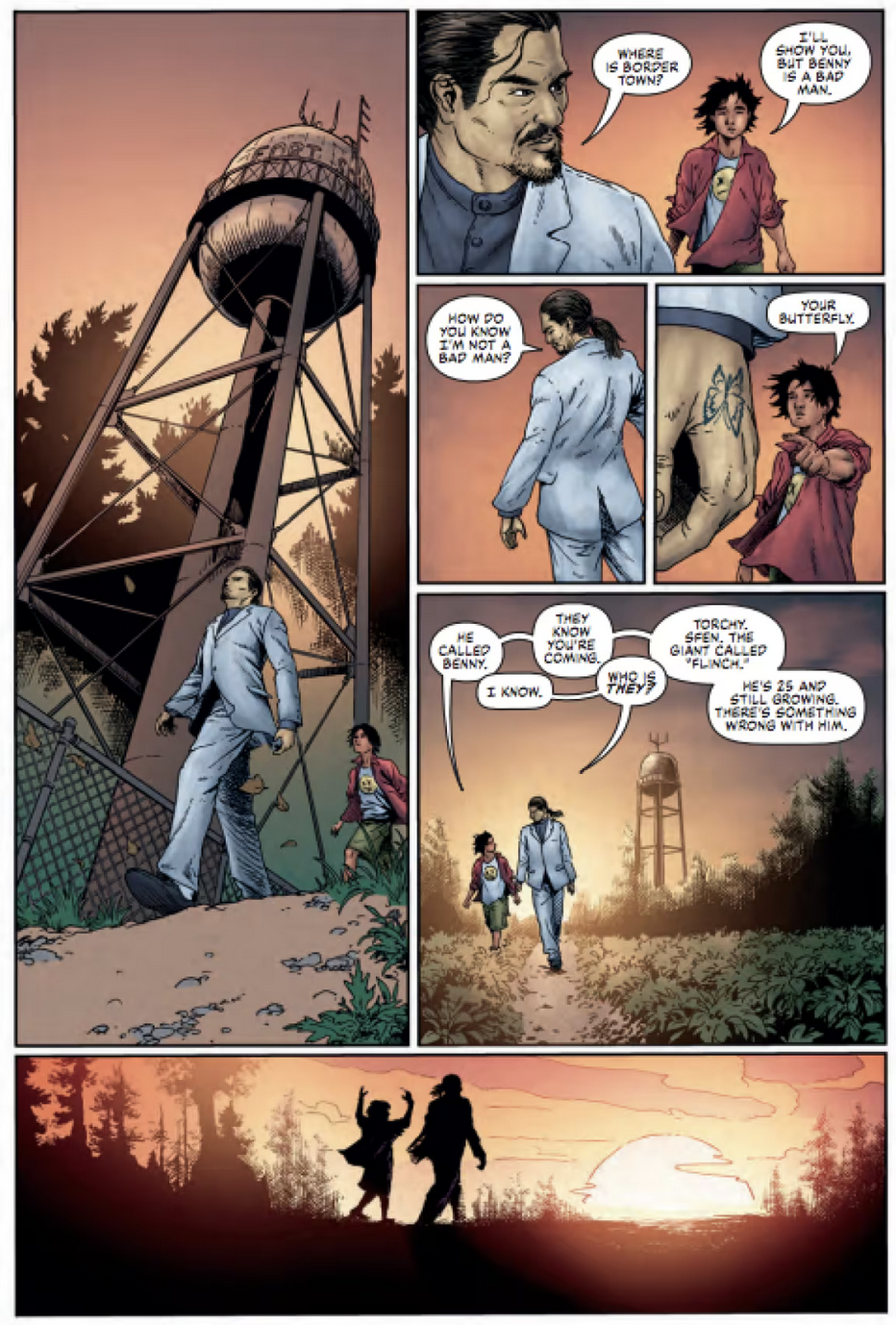
When Shinobu arrives in the Northwest Territories to reclaim his family's samurai armour housed at the Fort Smith museum, he learns that the sword has gone AWOL after Benny, the last museum manager, gambled it away. Sonny, a Tłı̨chǫ Dene boy who was at the museum, offers to take Shinobu to Benny's residence, though Sonny warns that the man will undoubtedly be supported by a trio of thugs named Torchy, Sfen and Flinch. 
From A Blanket of Butterflies by Richard Van Camp, illus. by Scott B. Henderson, coloured by Donovan Yaciuk
Not surprising Shinobu is attacked and, though he valiantly defends himself, he is left almost dead. Sonny and some friends take the man to Sonny's grandmother's house. Though Shinobu's extensive tattoos  frighten Sonny's Ehtsi, she tends to his wounds. With Sonny's support for "the butterfly man"–because of his butterfly tats–and a visitation from the spirit of Sonny's sister, Sonny's grandmother wants to know more. Shinobu tells her he is from Nagasaki, Japan and she realizes the connection their people have with the Japanese linked to the atomic bombing of 1945. She relates this in terms of a powerful bird being fed black eggs and "a fire so bright it left only their shadows on what was left of their homes" (pg. 24).
From A Blanket of Butterflies by Richard Van Camp, illus. by Scott B. Henderson, coloured by Donovan Yaciuk
Shinobu tells them the story of the creation of the sword by his 2 times great grandfather and his need to reclaim it before the August full moon. Because that full moon was that very night, the three head out together to Benny's. Again they are set upon but Sonny's grandmother is a formidable woman whose words stop the thugs. And with words and memories, as well as a blanket for Benny, Sonny's Ehtsi finds a connection between the men and the opportunity for benevolence.
From A Blanket of Butterflies by Richard Van Camp, illus. by Scott B. Henderson, coloured by Donovan Yaciuk
Originally published in 2015, A Blanket of Butterflies has been reissued with full colour, additional background information and cultural context. Still the story is fresh as an intersection of two cultures, one Indigenous and the other Japanese, and how they connect both on a historical and a more personal level. Richard Van Camp, Tłı̨chǫ Dene from Fort Smith NWT, has borrowed from his youth a story of an unlikely suit of samurai armour but he has developed it into a far greater story by asking a series of What If? questions. Sadly, how that suit was lost from a Japanese family is undoubtedly tied to the theft and seizure of the possessions of those interned. Still, Richard Van Camp doesn't emphasize that part of the story but rather the connections that both the Indigenous and Japanese communities have experienced through a history of loss and the substance of family. 

There is a darkness to this story because of that history and that loss. And that darkness comes through in Scott B. Henderson's illustrations, expertly coloured by Donovan Yaciuk. The artwork plays up the conflict that converts remarkably to connection both in its action, expression and colour.

The Spirit of Denendeh tells stories of the People of that land and A Blanket of Butterflies gives us glimpses into the natural and supernatural elements of those lives. I suspect that when Volume 2,  As I Enfold You in Petals, releases in April of this year, there will be another story from Denendeh, the Land of the People, again rooted in reality and upholding a legacy of kinship.

February 17, 2023

Arthur Who Wrote Sherlock

Written by Linda Bailey
Illustrated by Isabelle Follath
Tundra Books
978-0-7352-6925-5
56 pp.
Ages 5-9
2022

Many young readers will know the name Sherlock Holmes, probably from TV or movies, though perhaps more rarely from the books in which he stars, and I suspect fewer will know his creator, Sir Arthur Conan Doyle. Linda Bailey is sure to remedy that with her latest illustrated creative biography in Tundra's Who Wrote Classics series by shining a spotlight on the author and how Sherlock came to be.
From Arthur Who Wrote Sherlock by Linda Bailey, illus. by Isabelle Follath
From listening to stories told by his mother, learning to read and becoming a voracious reader, and then writing his first story at age 6, Arthur had a history of love for words and the magic they could create. That love of words would certainly help sustain him as his family dealt with poverty and a mentally ill father who turned to alcohol. When sent away to boarding school by his rich uncles, Arthur struggled with new challenges but could always rely on his storytelling to help him through. 
From Arthur Who Wrote Sherlock by Linda Bailey, illus. by Isabelle Follath
At 17, Arthur went to medical school where he became the assistant to the amazing Dr. Joseph Bell from whom he learned much about observation to aid in diagnosis. Throughout his studies he took on a variety of jobs to earn money. But these jobs, which included being a ship's medical officer, provided him with the adventures and anecdotes that would later feature in his stories. These would be important because, as Arthur struggled to establish a medical practice, he wrote. And, among all his writing endeavours, he created a detective based on his brilliant teacher, Dr. Bell. Though getting published was laborious, Arthur tweaked onto the idea of serializing Sherlock's stories and publishing them regularly in the same magazine to get readers excited and hooked. With that endeavour, Sherlock became a hit. 
From Arthur Who Wrote Sherlock by Linda Bailey, illus. by Isabelle Follath
Surprisingly, Sherlock was such a hit that readers were convinced he was real, and Arthur was left with no time for anything except Sherlock. Even when he resolved to kill off his detective, he was drawn back in by fans, and found a way to resurrect Sherlock and control what he chose to write, always with the aim of ensuring justice and fairness prevailed, whether in real life or in his stories.
 
Linda Bailey wanted to make Arthur the star of his story. Everyone knew and knows Sherlock Holmes, dubbed "the world's most famous man who never was" but Arthur Conan Doyle is a lesser character in his own story. Linda Bailey, though, makes him the lead in Arthur Who Wrote Sherlock, just as she did for Mary Shelley in her earlier book Mary Who Wrote Frankenstein (2018). Arthur is no longer the man behind the man. He is Arthur Conan Doyle and Sherlock comes from him; this is what Swiss illustrator Isabelle Follath depicts in the book's cover. But beyond highlighting the author of Sherlock, Linda Bailey tells us the story of Arthur Conan Doyle both around and beyond Sherlock. This is an illustrated biography and Linda Bailey makes sure to tell us everything of Conan Doyle's beginnings and trajectory to famous author. His story is full and what she doesn't tell us in the text she includes in an extensive "Author's Note" with references at the end of the book. There's lots to learn about the man and the writer and Linda Bailey makes sure that we know who wrote the stories of Sherlock Holmes.

Isabelle Follath's artwork, primarily in watercolour and pencil, play up the realism of a biography, though her depictions of the fancy of Conan Doyle's imagination allow for some whimsy and dramatic abandon from the tangible of a life of poverty, challenges, and work.

Young readers may learn a little bit more about Sherlock Holmes, but they will most definitely learn loads about Arthur Conan Doyle and understand better how he became the man who wrote Sherlock.

February 15, 2023

Daphne's Bees: Guest review

This review was written by Grade 9 student Bronte L.
 
Written by Catherine Dempsey
Illustrated by Veselina Tomova
Running the Goat, Books & Broadsides
978-1-927917503
48 pp.
Ages 7-11
2022
 
Daphne’s grandmother keeps honeybees, and she often lets Daphne inspect the hives. But on the morning of her 10th birthday, Daphne is treated with her very own hive, bee suit, and equipment. With the help of her dad and grandmother, Daphne builds her hive, and starts a new colony. She has drone bees, worker bees, and most importantly, a queen bee! Grandma teaches her all about their different jobs, how to maintain the hives, and their life cycles.
Daphne was so excited. Now she knew for sure that her queen had hatched, and was laying eggs. She also knew the bees were gathering pollen and nectar. The bits of pollen were the little bright colours and the nectar was the juice from the flowers that would become honey.
From Daphne's Bees by Catherine Dempsey, illus. by Veselina Tomova
Daphne soon discovers that keeping bees isn’t all flowers and honey. Bees are protective of their queen, and, if they think they’re under attack, they aren’t afraid to sting the intruder and die in the process. There are also wasps to worry about. Wasps are like pirates, flying around in search of new or vulnerable hives, looking to steal their honey. However, Daphne is protective of her hive, just like the worker bees, and makes sure that nothing is going to happen to it on her watch.
From Daphne's Bees by Catherine Dempsey, illus. by Veselina Tomova
Daphne’s Bees by Newfoundland author Catherine Dempsey and illustrator Veselina Tomova tells the story of Daphne, her hive, and everything she learns along the way to becoming a beekeeper. The book has loads of information, especially for a picture book, and could be enjoyed by kids from kindergarten to Grade 6. The book includes a glossary, background information, and plenty of puns. It’s a great book to build kids’ appreciation for honeybees.

Daphne’s Bees is an essential book for students learning about nature and the importance of pollinators. It’s informative and fun, and includes a lighthearted story with painted illustrations. The little bees and flowers look realistic, and you can tell that the illustrations are actual paintings, with their pencil outlines, canvas texture, and thick paint strokes.
From Daphne's Bees by Catherine Dempsey, illus. by Veselina Tomova
My grandfather used to keep bees, and I know that if I had read this book several years ago I would’ve immediately wanted to help him take care of his hives!

~ Bronte L., Grade 9

February 13, 2023

A is for Anne

Written by Mo Duffy Cobb
Illustrated by Ellie Arscott
Pownal Street Press
978-1-778124549
24 pp.
Ages 0-3
For release February 28, 2023
 
A is for Anne is a concept book that is ever so Canadian, set in the late 1800s and on Prince Edward Island, and offering an opportunity to learn the alphabet and a historical perspective of our world. From horse-drawn carriages to games and activities, A is for Anne takes us into a different time and place.
From A is for Anne by Mo Duffy Cobb, illus. by Ellie Arscott
Some of the letter designations are simple enough, like A is for Anne, who waits by the train, and B is for Brown, a horse with a mane. Young children will understand and appreciate the I is for ice cream and J is for July but many of the references are far more esoteric, requiring a knowledge of L. M. Montgomery's Anne of Green Gables novel–"M is for Matthew, the real reason we're here" and "N is for natural, a father so dear"– or include sophisticated and dated terms like "decree," and "cordial." This does not take away from the elegance of A is for Anne, but I think it extends its readership to all ages, from the very young who are learning their alphabet to older readers who have already read Anne of Green Gables.
From A is for Anne by Mo Duffy Cobb, illus. by Ellie Arscott
Mo Duffy Cobb, co-founder of PEI's boutique publisher Pownal Street Press, captures all the nuances of Anne's story from the child's arrival in Avonlea to her relationships with Marilla, Matthew, Diana, and Gilbert. She takes readers into Anne's enthusiasm for the island's beauty from its poplar trees by a stream, the blossoming cherry trees, and yellow skies tinged with pink, and her joie de vivre for the potential of her new life. Mo Duffy Cobb shares with us Anne's foibles and her heart. And she does it all in polished rhymes, giving rhythm to her refined text.
From A is for Anne by Mo Duffy Cobb, illus. by Ellie Arscott
Though not from PEI, illustrator Ellie Arscott delivers the reader to Anne's home in place and story. From its landscape and its people and the story of the freckled child looking for a home, Ellie Arscott's watercolours with ink depict a world of softness, of place and people. The pace of life is slower than today and simpler in scope but full in sentiment and connection, as is the original story.

I know that parents and teachers will first see A is for Anne as the alphabet board book that it is, but I hope that others will see it as a tribute to the classic story, giving us both rhyme and art to see Anne and her creator from a different perspective.

February 09, 2023

Smash

Written by Adam Schafer
Illustrated by Noel Tuazon
Red Deer Press
978-0-88995-635-3
32 pp.
Ages 5-8
January 2023
 
This child likes to smash stuff. He smashes his own stuff and other people's stuff. He smashes with a bat, his trike, his hands–anything that can destroy.
From Smash by Adam Schafer, illus. by Noel Tuazon
But it's soon revealed that his smashing has more to do with what he can't do, like read or draw, than what he can do. Still, his frustrations are not making him a lot of friends.
From Smash by Adam Schafer, illus. by Noel Tuazon
Then he realizes that the same hands that destroy can just as easily build. He puts a couple of pieces together here and then a few there and, with simple assembly, he makes himself and others quite happy. 

This child is any toddler who lacks the power to do more complicated things, like reading or writing, and, as a way of coping, takes matters into his own hands, and that means destroying what he can. At first glance, it's simple destruction and upsetting to others. But, unknowingly, he's learning. He's learning how things fit together, how they can be manipulated, and ultimately self-control. I suspect Adam Schafer is a father who has witnessed a toddler being destructive because he sees the normalcy of a very young child trying to take control of his situation in whatever way he can. The child wants to feel good about what he can do–don't we all?–but realizes, after seeing the reactions of others, that destroying things only makes him feel good and only temporarily. When he switches to building, then everyone gets happy as does he with his sense of accomplishment.  
 
Adam Schafer has written a book for very young children about very young children. There are fewer than 100 words in the whole book and most are in sentences of two or three words. (Children will be able to read this book soon enough because of its structure.) Your little ones may be in their destructive phase but Smash will help them see the joy that comes from the building phase too as well as giving them that reading boost when they realize they can read Smash on their own.

From Smash by Adam Schafer, illus. by Noel Tuazon
Noel Tuazon's artwork of ink and watercolour gives the child's actions the power of movement both in his destruction and construction. He makes the child the center of his world, as is the case for toddlers, when he is destroying things but then Noel Tuazon introduces more colour once the child extends himself into his structures, as he builds and creates.

If you have a little one at home who loves to smash, then Adam Schafer's story will be all too familiar. But, Adam Schafer, with the illustrative assistance of Noel Tuazon, demonstrates that the frustration of powerless can be set aside when the energy is put to building whether it be structures, self-actualization or friendships.

February 06, 2023

A Place for Pauline: Guest review

This review was written by student Bronte L.
 
Written by Anouk Mahiout
Illustrated by Marjolaine Perreten
Groundwood Books
978-1-77306-609-7
48 pp.
Ages 3-6
2022 
 
Pauline lives in a busy household. Her rambunctious younger brother is always running around; her baby sister cries and whines; and her mother is busy with another daughter on the way. Being the eldest isn’t as easy as it seems. But Pauline has a secret hiding place where she can daydream in peace. There she flies around the world, rules her very own kingdom, and escapes to France where her grandmother lives. One day, she decides to take action, pack her bags, and make her daydreams reality. 
From A Place for Pauline by Anouk Mahiout, illus. by Marjolaine Perreten
On her way to the ship that will take her to France, she is reminded of all the fun she has had with her family: playing ball hockey, enjoying Dad’s baking, and taking care of her cherished flower bed of the tricolour of impatiens, columbines, and forget-me-nots. But will those memories be enough to keep her and her imagination from escaping off to France?
My house is so full of people, it isn’t easy to find my place - even though I got here first! (pg. 4)
From A Place for Pauline by Anouk Mahiout, illus. by Marjolaine Perreten
A Place for Pauline is written by Montreal's Anouk Mahiout and illustrated by Swiss artist Marjolaine Perreten. It's an ever-so charming story with delightful watercolour illustrations in a comic style. The book does a terrific job of illustrating children’s wild imaginations, how special secret dens and hide outs can be as well as a home filled with comfort and bustle. I’d suggest this book to kids ages 4 to 7; however, finding a place to belong is something most people must go through at some point in their lives and, although Pauline is determined that her place is in France, I also think it’s a relatable book for anyone and everyone.
From A Place for Pauline by Anouk Mahiout, illus. by Marjolaine Perreten

~ Review written by Bronte L., a Gr. 9 student