November 20, 2019

King of the Mole People (Book 1)

Written and illustrated by Paul Gilligan
Henry Holt & Co.
978-1-25017-134-4
272 pp.
Ages 8-12
August 2019

...I was never aiming for popular. All I wanted was to somehow claw my way up the ladder to a comfortable middle rung. (pg. 116)

Doug accepts that he's weird but he hates it, especially when bullies like Ed and Ted and popular girl Becky and her Binkettes call him so. But what makes him weird?  He lives in Dreadsville Manor adjacent to a graveyard. His father's prime cooking ingredient is eels. And he's been crowned King of the Mole People after King Zog (there are actually 16 O's in his name) disappears. It's no wonder he craves normalcy. So he makes a plan to participate in school activities, crush on a girl, get a friend, learn to tell jokes and even just eat regular sandwiches for lunch. Unfortunately his good efforts continue to be thwarted.
From King of the Mole People by Paul Gilligan
His friend Simon is becoming less friendly. His efforts at school participation at the rocket club, the school play and at soccer club are epic fails. And he keeps getting summoned to the underworld of the Mole People–crowns etched in the dirt or with mud–where the Royal Advisor, Croogoolooth, both manipulates and disrespects Doug. Fortunately his Royal Guard, a trio of Mole People, support his efforts and continue with the last king's positive attitude about the Up-worlders.
From King of the Mole People by Paul Gilligan
But things above ground and below are getting more weird. Kids are disappearing into holes, at least temporarily, and Doug is welcomed into groups that had rejected him earlier. Below ground, the Mole People have been helping themselves to Up-stuff and clogging their world below with everything from bicycles to fencing, stage lights and water jugs. Keeping his two worlds separate becomes harder and harder, especially with classmate Magda spying on him and with the Underworld in danger of attack by Mega-worms. Worse still, Doug is compelled to help those who trusted him, even if he has to negotiate with the Slug People, the Mushroom Folk, and the Stone Goons to achieve cooperation.
From King of the Mole People by Paul Gilligan
With the right blend of humour, irreverence and weird fantasy, Paul Gilligan will get middle-graders rolling on the floor with belly laughs for his story and his illustrations. His characters are goofy, their circumstances bizarre and his plot lines both ludicrous and entertaining. It's impossible not to laugh at a dad who makes eel pudding or a society where O's in your name denote status or where a king's throne is a painfully pointy rock. Yet in all this absurdity there is an ordinary that most children will understand. Most children just want to fit in. So with a message of self-acceptance, whether it be for a human or a Mole Person, King of the Mole People speaks to many children who will understand when Doug is eventually pleased to return to his "regular level of unpopularity" and accept his differences as normal.

November 15, 2019

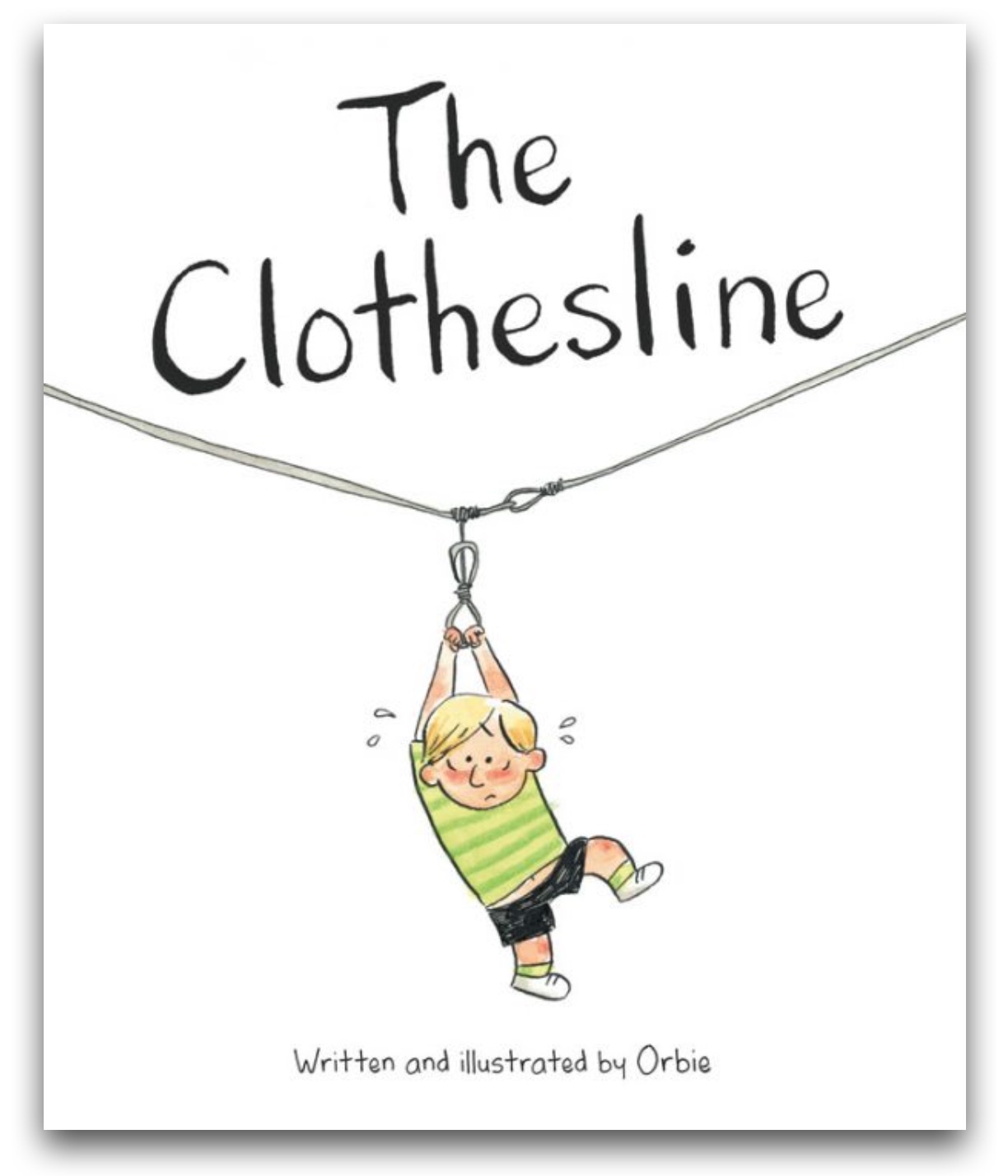
The Clothesline

Written and illustrated by Orbie
Translated by Karen Li
Owlkids Books
978-1-77147-390-3
64 pp.
Ages 5-8
October 2019

From The Clothesline by Orbie
Reggie is five and lives in an apartment above a corner store. When he gets his allowance for doing chores, he races down the outside stairs heading to the store, always yanking on a knot that hangs from the adjacent clothesline.  The sound it makes–ftoiiing–is something he enjoys.

From The Clothesline by Orbie
But one day, coins in hand destined for a candy purchase, Reggie races down faster than ever, yanks at that knot but loses his footing and, grabbing at the knot, is propelled halfway across the clothesline. And there he hangs.
My name is Reggie.
I'm five years old.
And I'm stuck in the
middle of a clothesline.
From The Clothesline by Orbie
He knows this is a dilemma. He cannot use his right hand since it grasps his coins. His left hand is hurting and he knows he cannot hold his weight indefinitely. He's scared that he will fall. So Reggie hangs from the clothesline, looking down, up, across and wonders what to do. Of course he shouts for help but his mother does not hear. He tries to move himself along so he might climb down the pole but to no avail. So he waits. Only the cat comes, though it's focused on washing itself.

In the end, Reggie gets down by accident, and with a few scrapes and tears, and learns to avoid getting himself in trouble again while still enjoying the "ftoiiing" he'd always loved.

Originally published in French as La corde à ligne by Quebec illustrator Orbie, The Clothesline translates easily into English. The story is universal after all in that all children "try" things that look like fun but may get them into a spot of trouble. And though he tries to find a solution to his dilemma, thinking through the possibilities and the consequences, thereby giving children an opportunity to see how problem-solving can happen, Reggie must finally accept his fate. Thankfully he is not badly injured and Orbie's lightness of illustration with pen and ink and watercolour conveys that same impression. Ultimately Reggie finds a way to learn and compromise his need for daring with safety, all courtesy of an old-fashioned clothesline.

November 13, 2019

What Cats Think

Art by Mies van Hout
Text by John Spray
Pajama Press
978-1-77278-087-1
44 pp.
Ages 6-10
October 2019

Dutch illustrator Mies van Hout has created a series of cat drawings to which author John Spray has matched what a cat might be thinking or feeling or doing or wishing. Each cat may be unique in its colour–rarely the grey, black, orange, brown and white cats of our world– but their expressions and their motives will be very familiar to cat-lovers while letting us into their minds and hearts to learn What Cats Think.
From What Cats Think, art by Mies van Hout, text by John Spray
In brilliant colours of lime green and red, turquoise and purple, Mies van Hout's art, created with acrylics, oil and gouache, startle and comfort the reader with an array of cats. They are skinny and scared, obese and wise, and playful and sneaky. They are no one's cat and they are everyone's cat. 

For each one, John Spray imagines what the cat feels and is experiencing (e.g., vexed, teased, worried, spooked, angry, flustered, panic, joy), what it needs to do (e.g., charm, capture, pout, dream, wash), how it acts (e.g., curious, sneaky) and who they are (e.g., grandmother, princess, clever Tom). It is in the creation of scenarios that John Spray illustrates with words what Mies van Hout's cats say in her art.
Worry
I saw him getting out the cage.
Now it's off to the kitty vet.
Needles and that thermometerOUCH!
There'd better be treats later!
Shiver...
From What Cats Think, art by Mies van Hout, text by John Spray
The original Dutch book, Dag Poes!, had a handful of Dutch writers provide poetry about cats to accompany Mies van Hout's illustrations. John Spray's text, however, is personal and a true reflection of the thoughts of each cat as it ponders its circumstances. As a cat person, I appreciate every sentiment expressed. We probably already knew that they hate seeing the cat carrier, don't think they were wrong to sneak on the kitchen counter for a bit of turkey, or delight in a catnip toy, though I'm sad to think that my kitty chirps at birds because it's feeling teased and feels threatened by the neighbour's dogs.
Panic
Two big dogs just moved next door!
Slobbery, slathering kitty-eaters!
Maybe I'll hide behind the furnace.
My man says they're only poodles.
Gulp!
From What Cats Think, art by Mies van Hout, text by John Spray
Every cat-lover and -parent knows that cats have a lot going on in their minds and hearts. We may only hear a handful of vocalizations–and most of us can recognize their basics of demands for food, expressions of annoyance, yearnings to play, cravings for solitude–but there is so much more than to understand. With What Cats Think, Mies van Hout and John Spray have given us the context for cats' looks and sounds that will remind us of the depth of feline reasoning and expression. It's not surprising to many that cats have been celebrated and worshipped throughout history and it's best we not forget this.
Grandmother from What Cats Think, art by Mies van Hout, text by John Spray
🐈🐈🐈🐈🐈🐈🐈

Get this in your calendar as

 John Spray and his publisher Pajama Press 

are launching 

What Cats Think

on

Saturday, December 7, 2019

6 - 8 p.m.

at

Queen Books
914 Queen St. E.
Toronto, ON

Though there will be hors d'oeuvres and drinks, I think the best reason to show up and purchase an autographed copy is that the author's royalties are being donated to Toronto Cat Rescue.

November 11, 2019

Boxitects

Written and illustrated by Kim Smith
HarperCollins Canada
978-1-44345-611-1
40 pp.
Ages 4-7
September 2019

Whether cats or kids, boxes are a source of endless fascination and play.  Now, with the proliferation of makerspaces in libraries and play-based learning in kindergarten, building with materials such as boxes is all the rage, as it is for Meg, an architect whose medium is boxes.
From Boxitects by Kim Smith
Meg's mother, supportive of her child's creative endeavours, sends her to Maker School where there are "blanketeers, spaghetti-tects, tin-foilers, and egg-cartoneers" but, as a boxitect, Meg is a unique. There she learns about making structures useful, strong and beautiful.
From Boxitects by Kim Smith
Then a new kid arrives and she is an amazing boxitect too. But Simone does not hold back her advice to Meg, directing her how to improve her structures. So Meg reciprocates. The two little makers are obviously more interested in showing who is the better boxitect than working together, and this poses a problem when the annual Maker Match is announced and the children must work in teams. Unfortunately Meg wants to build a tree house and Simone is determined to construct a ship so the two children begin to create their own structures, each continuing to amend their own to be taller and more impressive. It's not until a catastrophe befalls the structure that Meg and Simone learn some valuable lessons about working with others to create.
From Boxitects by Kim Smith
Kim Smith, who illustrated the Ice Chips series by Roy MacGregor and Kerry MacGregor (HarperCollins Canada), adds the whimsy to her art through her use of colour and shape. There is no mistaking the boldness of Meg and Simone's creative work in the Calgary artist's illustrations produced digitally with Photoshop. Through edges straight, scalloped and round, doorways and flags of various shapes, and bright tints and patterns, Meg and Simone's maker structures reach the stars, fly off the pages, and spill out of the makerspace. They show the impact of exploration and imagination and encourage thinking outside the box. With her own originality of thought and art, Kim Smith demonstrates to little ones that looking at problem-solving from a different perspective or discovering new ways of expression is a win-win for makers big and small.
From Boxitects by Kim Smith

November 08, 2019

The Munchy Munchy Cookbook for Kids: Essential Skills and Recipes Every Young Chef Should Know

Written by Pierre A. Lamielle
Familius
978-1-64170-156-3
170 pp.
Ages 8-13
September 2019

As a teacher-librarian, I loved purchasing cookbooks for the school library. Kids love looking at photos of great food, dreaming about sweet desserts and baked goods, and emboldening them to try their hand at some kitchen magic. With Chef Pierre A. Lamielle's newest cookbook, this one for children specifically, they'll get a good start on developing their culinary skills and creating some tasty treats.

More than a recipe book, The Munchy Munchy Cookbook for Kids covers important lessons, all told via quirky illustrations and a group of distinct characters called the Munchy Munchy Bunch which includes Sal, Pepper, Ragu, Ziti, Sage, Rose, and Bean. The first lessons focus on avoiding dangers that involve sharp objects, fire and hot items or sources of germs. From learning how to slice, hinge and saw with a knife, to dealing with burns and fires and avoiding Salmonella, Cyclospora and E. coli, Pierre A. Lamielle's "Safety Pages" are an excellent beginning to this cookbook.
From The Munchy Munchy Cookbook for Kids by Pierre A. Lamielle
While introducing the Munchy Munchy Bunch, Pierre A. Lamielle also presents the basic tastes of salty, bitter, sour, sweet and umami, and makes a case for ketchup–with recipe included–being a balance of all five tastes. (Who knew?)

From The Munchy Munchy Cookbook for Kids by Pierre A. Lamielle
The remaining sections–Breakfast, Lunch, Dinner and Sweets–focus on basic recipes but always offer up more. From cooking eggs six ways to making jam for breakfast, or preparing soup, salad, or sandwiches for lunch, and serving up schnitzel, butter chicken or pizza with homemade dough, each meal becomes an exploration of ingredients, techniques, history, and culture. The photographs, most of which are double-spreads that extend across the hardy hidden wire o binding (making scanning of the images near impossible for me), are appealing and never unsophisticated. The recipes are for restaurant quality food from the pumpkin pie soup to the soy delicious lettuce wraps, veggie chili with mini cornbread muffins and browneapolitan dessert. For vegetarian to meat-eaters, and those who prefer savoury to sweet or vice versa, everyone's tastes are covered within the recipes of The Munchy Munchy Cookbook for Kids,
From The Munchy Munchy Cookbook for Kids by Pierre A. Lamielle
Calgary's Chef Pierre A. Lamielle, who has appeared on Top Chef Canada and Chopped Canada, has his spoon in a lot of creative bowls from cooking and writing, to illustrating and teaching, all related to art and food. By mixing both here in The Munchy Munchy Cookbook for Kids, Pierre A. Lamielle has found a way to teach and entertain young readers with the promise of developing their culinary skills, of feeding themselves and others, and of making tasty food a source of sustenance and joy.

November 07, 2019

2019 CCBC Canadian Children's Book Awards: French-language Winners announced


Tonight, the winners of French-language Canadian Children's Book Centre Book Awards were announced at a gala in Montreal at L’Astral.  (The English-language awards were presented on October 15 in Toronto and are posted here.)

Le Prix TD de littérature pour l'enfance et la jeunesse canadienne: Winner
Anatole qui ne séchait jamais
Written by Stéphanie Boulay
Illustrated by Agathe Bray-Bourret
Éditions Fonfon
80 pp.
Ages 10+
2018


Le Choix du Public Littérature Jeunesse: Winner
Anatole qui ne séchait jamais
Written by Stéphanie Boulay
Illustrated by Agathe Bray-Bourret
Éditions Fonfon
80 pp.
Ages 10+
2018


Prix Harry Black de l'album jeunesse: Winner

Mémé à la plage
Written by Rhéa Dufresne
Illustrated by Aurélie Grand
Éditions Les 400 coups
32 pp.
Ages 5+
2018


Toutes nos félicitations!

November 06, 2019

Larkin on the Shore

Written by Jean Mills
Red Deer Press
978-0-88995-577-6
310 pp.
Ages 13+
October 2019
"...her words have stayed with me, just like Jonah's. Words do that. Words spoken and words in books. Words you write. They start to breathe and live and just take over. And right now, I've been taken over by the words of other people–people talking–and I can't find myself or my own words." (pg. 221)
After she is traumatized by something that happened with a boy, Jonah, and ejected from a moving car, sixteen-year-old Larkin Day is sent from her home in Toronto to stay with her grandmother Granne in Tuttle Harbour, Nova Scotia for the summer.  Larkin had managed to finish her Grade 10 exams but the gossip and social media about what happened have left her feeling isolated and unsafe and contemplating the relief of suicide. Her dad decides his mother, a retired principal, would be the best bet for his daughter while he heads to Vancouver to deal with Larkin's mom, a woman addicted to painkillers and bouncing between the unsafe streets and rehab. 

But for Larkin, Granne and Tuttle Harbour are unfamiliar and she must learn to assess every person she meets for sincerity and safety. That includes neighbour Will Greenfield who is helping his dad Billy renovate an old house for Granne into the Tuttle Harbour Café and Reading Room. As Larkin helps Granne with the book donations for the reading room, she deals with her anxiety which tempers her interactions with others, even with nice-guy Will. But when Will takes her to a local campfire with his peers, Larkin meets the gregarious Casey Henwood, his girlfriend Beth and others, and overdoes the drink when "...it tastes so good and goes down easily." (pg. 70). Could she be putting herself in harm's way?

When a fire destroys the back of the café, Casey and Beth and others are quick to point fingers at Will's dad, a recovering alcoholic, who'd apparently once burned down a shed he was building at the Henwood's farm. Hearing the gossip about Billy as well as about Will from Beth, and reflecting on the talk that went on about her after she was injured, Larkin is perplexed about whom to believe or to trust. What's worse is the news coming from her dad about her mother's health situation.  Walking out into the water until the darkness envelopes her or trying to swim out to Prince Edward Island, knowing she'd never make it, continue to overshadow her regular visits to the shore until she starts to live beyond others' words.

Jean Mills, who wrote the Red Maple-nominated Skating Over Thin Ice (Red Deer Press, 2018), knows how to tell a story about dealing with expectations from family, school and self. She gets what it's like to trust and not trust your own feelings and to be confused about how those you care about conduct themselves around you. From an addicted mother to an unfamiliar grandmother and peers that are both charming and deceptive, Larkin must look at every interaction as a potential disaster and possibly harmful. Sadly this is probably not unusual for teens who are trying to understand a world in which they are expected and allowed to take on greater responsibilities but may be unsure whether they have the strength or understanding to meet them. For Larkin, it may not always be evident which is the safe world or the dangerous one, not unlike a shore that borders land and water, but she is developing the courage to choose her heading and a solid intuition about good people that will guide her.