July 17, 2017

Polly MacCauley's Finest Divinest Woolliest Gift of All

Written by Sheree Fitch
Illustrated by Darka Erdelji
Running the Goat, Books & Broadsides
978-1-927917-10-7
68 pp.
Ages 5-8
June 2017

Before Sheree Fitch even begins to tell her story, she invites "Listeners Young and Old" to enjoy her yarn.

Tales are for telling and the truth may be tall,
My yarn is for spinning as the earth spins for all. 


This is a yarn for
   a windy night
      or a rainy day
         or any old time
            or a circle of souls
               or a broken lonely heart– 

so hunker down by a crackling fire and read aloud just to yourself
or share my yarn with those you love.
(pg. 5)

Her yarn begins with the joyful first "Baa" bleated by a very special lamb born in the village of River John. It's a sound that

"...wrapped round that village 
like a ribbon of joy 
     a warm woolly scarf 
          or a magical spell from a long ago fairy tale" (pg. 8)

Meanwhile in the small countship of Woodland, the greedy Count Woolliam and his sister Woolamina, the Countess of Fleece and Fluff, are ruminating over the status of their flock and whether there will be sufficient wool for all their woolly needs: robes, sweaters, hats, socks, blankets, rugs, tissues and more.  They too hear that first "Baa" and head out in search of that special lamb, determined to take it for their own.

From Polly MacCauley's Finest Divinest Woolliest Gift of All 
by Sheree Fitch 
illus. by Darka Erdelji
Polly MacCauley, a woman rarely seen and about whom the grownups often whisper and the children wonder, who did "extra-ordinary, wild and wondrous things with W-O-O-L" (pg. 18), hears that same "Baa" and is thrilled to realized that she would soon be able to knit her "finest, most divinest, woolliest gift of all." (pg. 23)

But, after the lamb's mother dies and her mournful cries are heard around the world, Star–as she is named by Farmer John's family–feels disconnected and good for nothing.  That is until Polly, venturing out for the first time in ages, visits Farmer John's farm.  Though there is a potential conflict when the Count and Countess demand the lamb, they are moved by the love that the village of River John feels for Star (it's a woolly Grinch moment: "Something, some hole in his greedy brittle heart, stitched together."; pg. 53) and Star goes home with her new mama, Polly.

The magic is just beginning, though, because Star grows a very thick coat of fleece daily which Polly shears and uses to work on her masterpiece, as well as the plethora of wool projects Polly and her new knitting group undertake for the newborns, children and fishermen of River John and the people of the world. "Like love, there is always enough wool to go around." (pg. 57)

From Polly MacCauley's Finest Divinest Woolliest Gift of All 
by Sheree Fitch 
illus. by Darka Erdelji
And, though there is finally great purpose and much happiness with some sorrow still to come in Star's life, it is Polly MacCauley's gift to Mother Earth that will become the true star of the story, there "wherever and whenever someone needs a bit of wool or a bit of warmth or maybe the piecing together of a sad and lonely heart" (pg. 65).

Polly MacCauley's Finest Divinest Woolliest Gift of All is an atypical picture book.  Though the illustrations by Slovenian artist and former St. John's resident Darka Erdelji add the whimsy and ethereal fiber to Sheree Fitch's story, this tale is lengthy and text extensive and not a quick read before bedtime.  It is, however, a read-aloud story of story-telling breadth, deep and involved and rich with the essence of life.  It has love, sadness, grief, death, conflict, compassion and hope, so much hope.  There will be cheers and tears and bleats of appreciation for a story of history and connectedness, generosity and inspiration.  Sheree Fitch, whose poetry I have long admired, can turn a phrase with such adeptness that readers will feel the tugs on their own heart yarns and the weaving of a blanket of comfort and contentment.  And though Polly MacCauley's Finest Divinest Woolliest Gift of All is firmly rooted in the Maritimes of her home, Sheree Fitch has woven a story for the world in both context and spirit.
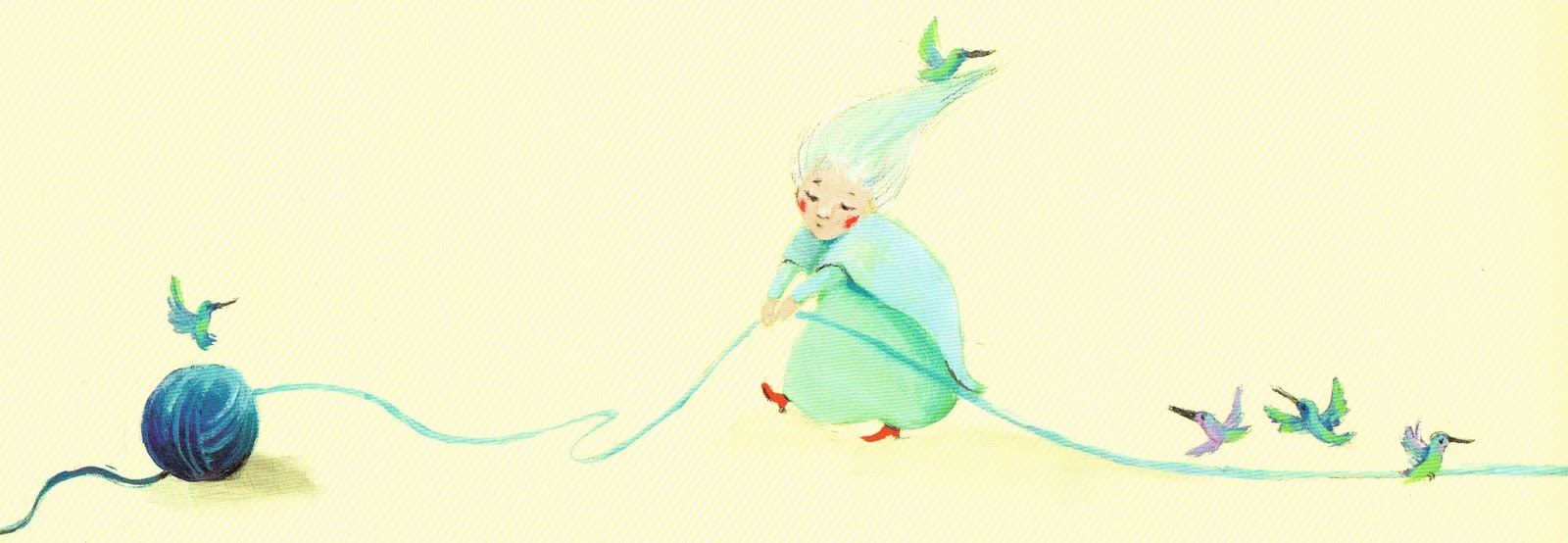
From Polly MacCauley's Finest Divinest Woolliest Gift of All 
by Sheree Fitch 
illus. by Darka Erdelji

🌎🌎🌎🌎🌎🌎


If you're fortunate enough to live near or be visiting the Maritimes, consider stopping it at Mabel Murple's Book Shoppe and Dreamery in River John, Nova Scotia, a specialty bookstore just opened this month by Sheree Fitch and featuring Atlantic Canadian books in all genres as well as Canadian children's books.

July 12, 2017

#Tundra50 Tote Bag Auction


Tundra Books
an imprint of Penguin Random House Canada

is celebrating its 50th anniversary 

with a wonderful online auction in support of

a non-profit organization committed to bringing books and children together. 

Tundra Books asked the following 34 youngCanLit illustrators 

Cale Atkinson
Raphaëlle Barbanègre
Ben Clanton
Genviève Côté
The Fan Brothers
Eugenie Fernandes
Rebecca Green
Janet Hill
Matt James
Marthe Jocelyn
Madeline Kloepper
Julie Kraulis
Ron Lightburn
Julie Morstad
Olivia Chin Mueller
Vicki Nerino
Maxwell Newhouse
Kenard Pak
Gina Perry
Dušan Petričič
Kass Reich
Esmé Shapiro
Zoe Si
Lori Joy Smith
Sydney Smith
Bill Slavin
Mika Song
Ashley Spires
Carey Sookocheff
Chihiro Takeuchi
Frank Viva
Phoebe Wahl
Mélanie Watt
Cybèle Young

to decorate one side of the limited edition Tundra50 canvas tote bags


and these bags are being auctioned off 
between June 23 and July 28, 2017.

That gives you just over two weeks to place your bid
at

Minimum bid is $10 and all bids must be made in $5 increments. 


Details about the Tundra50 Tote Bag Auction can be read here The actual auction and images of the tote bags (both front and back) as well as current bids are listed here.

July 11, 2017

Stealth of the Ninja

Written by Philip Roy
Ronsdale Press
978-1-55380-490-0
225 pp.
Ages 10+
March 2017

When Alfred Pynsent set out in his twenty-foot, diesel-electric submarine three years ago, he was an explorer. He's navigated the Maritimes near his home in Newfoundland, the St. Lawrence River, the Atlantic, Arctic, Indian and Pacific Oceans, South Africa, India and saw more in a few short years, both travel-wise and experientially, than most people do in their whole lives.  And he's just on the cusp of turning seventeen.  But, Al has turned from explorer to eco-warrior having seen the desecration of the oceans first hand.
I know that the sea is dying.  I mean, the water will always be there, of course, but the life in it won't.  And even though there are still days when whales breach in front of my sub, and dolphins race playfully past, and flying fish soar over my head with the funny whispering of their fins, there are much longer stretches  when I see nothing on the water but garbage and torn nets with rotting sea animals, as if the sea were nothing but one humongous human garbage patch. (pg. 2)
Heading to Japan, Al is apprehensive, as months earlier (Eco Warrior, 2015) he had helped the Sea Shepherd Society prevent a tanker from refuelling Japanese whaling ships and he was accused of sabotaging a Japanese tanker in Australia (he didn't).  But, when he discovers an old barnacle-laden freighter, seemingly abandoned, six hundred miles southeast of Japan, it's the beginning of a new adventure for Al that has him learning the ways of ninjutsu, being tossed around in his sub by a tsunami, robbing a new acquaintance's home, and saving a life.

Aboard the rusty freighter, Alfred meets Sensei, a 100-year-old Japanese man, a ninja, who has made the ship his home, growing a garden and collecting the plastic detritus of the oceans within the holds.
His face was gentle, kind and wise.  It was cut with laugh wrinkles, which meant he had probably spent most of his life laughing.  And yet there was something about him that was sad, as if he carried happiness on the outside, but sadness on the inside. (pg. 11)
Sensei teaches Alfred the ways of the ninja– jumping, stealth, stick fighting–and instills in him the disciplines of meditation and exercise, though the perseverance and determination Alfred demonstrates are all his.  When they witness a tsunami encroaching, Alfred and his canine first-mate, Hollie, seek the shelter of the sub but cannot convince Sensei to join them.  Except for a few cuts and bumps on the sub explorers, the submarine survives but the old freighter has flipped and is sitting between 130 and 140 feet below the surface.  Alfred is convinced the plastics have buoyed the ship and that Sensei is still alive.  Heading to the port of Choshi for help, Alfred finds the streets almost deserted because, he soon learns, of the tsunami's impact, most notably on the Fukushima nuclear reactor.  How will he get the help he needs to save Sensei without putting his own life in jeopardy, without getting caught by the authorities looking for him, and without breaking an agreement he made with Ziegfried, his friend and engineer of the submarine?

Stealth of the Ninja is the eighth book (!) in the Submarine Outlaw series and it is as riveting and fresh as any book in the series.  Still amazing is that, although I encourage you to read the whole series because it is so engrossing, Stealth of the Ninja and all its predecessors can stand alone as adventure novels, rife with action and extraordinary characters.  And those characters are truly extraordinary.  From Alfred and his first-mates Hollie and Seaweed to Sensei (whose name we never learn or even need to know) and the Japanese men Yoshi and Hitoshi whom he meets, the characters are so real that I could imagine finding photos of them online and recognizing them instantly.  Moreover, Philip Roy always bathes his stories in such distinctive settings that they are virtual characters.  From the submarine and Sensei's ship to the ocean and the streets of Choshi and Okinawa, Philip Roy creates worlds to which readers can travel in their minds to experience Alfred's  ventures and vicariously face dangers beyond the norm.  Still, though they are wonderful adventure stories, Philip Roy has much to tell us about the oceans and the world and the impact we have on them.  Alfred may seem disheartened at times–though he finds some hope at the conclusion of Stealth of the Ninja–but I think Alfred himself is a source of hope that there are amazing young people out there who care about this world and, recognizing its problems, see themselves as part of the solution. They may not all do it as stealthily as Sensei and Alfred but there's still hope that it's getting done.  By telling the stories of the Submarine Outlaw, Philip Roy gives us all hope as well.

Submarine Outlaw series by Philip Roy

July 10, 2017

Fatima and the Clementine Thieves

Written by Mireille Messier
Illustrated by Gabrielle Grimard
Red Deer Press
978-0-88995-529-5
32 pp.
Ages 5-8
July 2017

In 2012, Fatima et les voleurs de clémentines was published by Éditions de la Bagnole and it promptly won the 2012 Prix jeunesse de l’Alliance française and was nominated for the 2013 Forest of Reading Tamarac Express award.  Now, five years later, English readers can share in this heartwarming story based on an African proverb that says “When spider webs unite, they can stop elephants.”  It’s a story of a defeat by the small and insignificant of the large and strong and ominous.  It’s a Moroccan spider vs elephant tale and the winners are Fatima and her grandfather and their clementine orchard.
From Fatima and the Clementine Thieves 
by Mireille Messier 
illus. by Gabrielle Grimard
Fatima helps her grandfather in their clementine orchard.  They are looking forward to having enough to take to market so that they can buy fish and pistachios and olives and perhaps a treat of almond paste.  And with her friends, the spiders, keeping the bugs from the trees–she treats them to clementines peeled into flower shapes as a thank-you– Fatima's anticipation is great.

From Fatima and the Clementine Thieves 
by Mireille Messier 
illus. by Gabrielle Grimard 
But the young girl and her grandfather awake to broken branches, trampled fruit and even uprooted trees. A nighttime vigil reveals a mother and two baby elephants are the culprits, surprising Fatima's grandfather who declares elephants have not been seen in the area for centuries.  Though they try to scare the animals off with noise and water and even throwing pistachios at them, the elephants continue to do their damage.

Grandfather in his traditional djellaba and turban and belgha slippers seeks out the advice of others in the market, finally relenting to the purchase of a rifle.  But Fatima is sure there has to be a better way to save their clementines.

Fatima enlists the help of her seemingly insignificant spiders–she actually asks them and they agree–to spin a thick wall of spider webs, thwarting the elephants whose way is blocked.
"You have saved the orchard!"
"AND we saved the elephants," adds Fatima, proudly.
"You may be small, but what you have done is very big."
(pg. 29)
The message in Mireille Messier's text is very clear: even the smallest, most insignificant creature can achieve astounding success when united in purpose and working with determination.  By setting the story in a land of clementines and elephants, she has honoured a very African saying and acknowledged the moral without leaving the continent from which it arises.  Fatima and the Clementine Thieves celebrates a culture of which many Canadian children will be unfamiliar but about which they will appreciate learning, especially since they are undoubtedly familiar with daunting tasks.  Learning a new math skill or studying for a test or dealing with family dramas may not be the same as an elephant destroying your clementine orchard but they are all predicaments or stresses one must handle.  As such, children will be able to empathize with the plight of Gabrielle Grimard's Fatima and Grandfather who appear kindly and sympathetic because of her soft artwork that always emotes beyond the page. (Previous reviews of her artwork include When I Was EightNot My Girl, and The Fabulous World of Mr. Fred.)

Fatima and the Clementine Thieves is a feel-good story about problem-solving and triumph and purposeful work. Thank you to Mireille Messier and Gabrielle Grimard for giving all readers a wonderful back story for every clementine we might enjoy in future and for a new illustrated lesson on achieving success with little but determination and a united front.
From Fatima and the Clementine Thieves 
by Mireille Messier 
illus. by Gabrielle Grimard
🍊🍊🍊🍊🍊🍊🍊🍊

Author Mireille Messier launches Fatima and the Clementine Thieves this Saturday in Toronto.  This free event will take place at the Indigo at Yonge and Eglinton. Details are listed here.

July 08, 2017

Fatima and the Clementine Thieves: Book launch (Toronto, ON)

Join author Mireille Messier

for the launch of her newest English-language picture book

the English translation of
Fatima et les voleurs de clémentines
Texte de Mireille Messier
Illustrations de Gabrielle Grimard
Éditions de la Bagnole
2012

Fatima and the Clementine Thieves
Written by Mireille Messier
Illustrated by Gabrielle Grimard
Red Deer Press
978-0-88995-529-5
32 pp.
Ages 5-8
Release July 2017

on

July 15, 2017

11 am - 2 pm

at

Indigo Yonge Eglinton
2300 Yonge St.
Toronto, ON

From Red Deer Press website:
One morning, Fatima and her grandfather wake up to find their clementine orchard savagely ransacked. 
Who could be doing this? 
How can the culprits be stopped?

A little girl faces an ENORMOUS problem. Luckily, Fatima has powerful friends: the spiders!

Retrieved from https://www.reddeerpress.com/Detail/0889955298 on July 7, 2017.

🍊🍊🍊🍊🍊🍊

I will post  my review of this lovely picture book before the launch next week.  Look for it here on CanLit for LittleCanadians.

July 07, 2017

Heartwood Hotel: A True Home

Written by Kallie George
Illustrated by Stephanie Graegin
HarperCollins
978-1-44344-393-7
163 pp.
Ages 7-12
July 2017

The Heartwood Hotel is enchanting and Mona is the endearing mouse who brings heart to it and this first book in Kallie George's new series. Though the Heartwood Hotel is a long-established abode for travellers in search of rest and safety, Mona stumbles upon it when displaced by a storm from her stump–hardly a home, just her most recent residence–and transported by raging water deep into Fernwood Forest.  She is given shelter for the night by the badger proprietor, Mr. Heartwood, in exchange for help in cleaning up after the First Acorn Festival, a rollicking event held in the ballroom.
From Heartwood Hotel: A True Home 
by Kallie George 
illus. by Stephanie Graegin
But when he learns of her sad story of no family or home, only a walnut-shell suitcase with a heart carved into it, he takes her on as a maid to assist Tilly the squirrel while the housekeeper Mrs. Higgins, a hedgehog, is under the weather.  Though Tilly is supposed to familiarize Mona with the routines and layout of the hotel, she is rather mean to the young mouse and Mona seems to make many a mistake as she learns for herself what to do and not do.  Fortunately, there is a wonderful cast of characters to help her out: Gilles the lizard desk clerk; Ms. Prickles the porcupine cook; Mr. Higgins the hedgehog gardener; and Maggie and Maurice, the sibling laundry bunnies.  But it's the guests like skunks Lord and Lady Sudsbury and Miss Cybele the swallow that truly recognize Mona's spirit in supporting the hotel's motto,
We live by "Protect and Respect," 
not by "Tooth and Claw." (pg. 11)
Still after one too many mistakes and Tilly encouraging her to pack up before she is fired, Mona departs the hotel.  Huddled in an old log, she learns of a planned attack by wolves. The little mouse rushes back to warn Mr. Heartwood and the rest, coming up with a plan to ensure the safety of the Heartwood Hotel and her new family of staff and guests.
"...as she explained, the eyes of the animals grew wide and bright with the power of a big idea, of a brave idea, of a brilliant idea." (pg. 136)
From Heartwood Hotel: A True Home 
by Kallie George 
illus. by Stephanie Graegin

How do I convey to readers the infinite sweetness and gentility of A True Home? From the warm-hearted atmosphere and compassionate mission of the Heartwood Hotel and its staff to the plot of finding home, amidst common foibles and uncommon dangers, Kallie George's text is rich in friendship, courtesy, diversity and affection.  That majestic tree's hotel is built upon a solid foundation of respect for all creatures and the natural world of interrelationships, though as in the human world some need to be avoided if one is to survive.  But even the wolves, though frightening to many of the residents at the Heartwood Hotel, have an inane quality about them, squabbling about their achievements and the existence of the Heartwood Hotel. By doing this, Kallie George makes A True Home a suitable read-aloud for younger children who will easily be able to imagine the Hotel with its miscellaneous accommodations (including the root floors with hibernation suites, trunk floors, branch floors, twig floors and honeymoon and penthouse suites) and star-gazing balcony and ballroom. Graced with the black-and-white pencil drawings of American illustrator Stephanie Graegin, Heartwood Hotel's first book, A True Home, has surely found a place for itself in youngCanLit by captivating and gladdening our own hearts.

💟💟💟💟💟💟💟💟

The launch for the first two books in the Heartwood Hotel series, A True Home and The Greatest Gift, will be held next week in Vancouver so, if you can, be sure to check it out. Details here.

July 06, 2017

Jon's Tricky Journey: A story for Inuit children with cancer and their families

Written by Patricia McCarthy
Illustrated by Hwei Lim
Inhabit Media
978-1-77227-145-4
70 pp.
All ages
July 2017

The fact that Patricia McCarthy, a Pediatric Nurse Practitioner, wrote this book is a sad reminder that there are many children, including Inuit children, who must endure treatment for cancer. Their childhoods should be filled by play and learning and friends and family and not the medical traumas involved in being diagnosed with and then treated for cancer.  Jon's Tricky Journey, which is both picture book story and resource guide, takes the reader on that journey and provides a compendium of supportive resources for navigating pediatric cancer treatment in the North.

Jon is an Inuit boy who lives with his parents (anaana and ataata) and two siblings and their husky dog Nanuq in Nunavut.  He loves camping, watching the northern lights and hearing stories about his ancestors.
From Jon's Tricky Journey 
by Patricia McCarthy
illus. by Hwei Lim
When Jon starts to feel pains, a visit to the nursing station ends up sending him to the hospital far away south.  Only his anaana goes with him to a land of trees and noise and busyness that made him fearful.  A social worker helps him and his anaana adjust, including finding them a place to stay, while he visits with the oncologist Dr. Lewis who tells him that he has a lump called cancer inside his body.  An operation is needed to remove it and then he'll have to take special medicines.
From Jon's Tricky Journey 
by Patricia McCarthy 
illus. by Hwei Lim
From the nurses and child-life specialists, pharmacists and special visitors, Jon is helped through what he calls his "tricky days," those days when pain, fatigue and homesickness overwhelm him.  (The above art illustrates Jon's trick of thinking happy thoughts, such as camping, to get through episodes of pain.) As he deals with his chemotherapy (a word not used in the story) and becomes more familiar with the routines and the hospital and meeting other children with cancer, Jon begins to appreciate that he is showing strength and resilience, just like his Inuit ancestors.

Patricia McCarthy's intent for this book is to "serve as a source of comfort and useful information for families who find themselves far from home, facing a cancer diagnosis in a strange and sometimes frightening environment." (pg. 37)  Jon's Tricky Journey, the story, is a reassuring depiction of what a child might need to go through when being treated for cancer but that story only takes 34 pages.  The remainder of the picture book lists children's hospitals and cancer treatment facilities and a map of flight paths from Arctic locations to these facilities; navigation and coordination services by region; descriptions of all medical team members; answers to FAQs; the northern pain scale, most appropriate for Inuit children; a glossary; an art project; and additional resources.  Jon's Tricky Journey, brilliantly translated into Inuktitut so that it can be read by all family members, should be available at every treatment centre accommodating Inuit children and their families as well as the nursing stations of their home communities.  By depicting Jon's Inuit life and his oncology journey with simplicity and realism, Malaysian illustrator Hwei Lim ensures that any child of the North dealing with cancer will see himself or herself within the pages. This is as it should be.  Sadly, Jon's Tricky Journey could be the journey of far too many children but, within the pages of this book, there is some solace that it's a journey that is not taken alone.