October 31, 2016

Bera the One-Headed Troll

by Eric Orchard
First Second / Roaring Brook Press
978-1-626721067
128 pp.
Ages 7-14 
August 2016


With today being Halloween and Bera the One-Headed Troll being filled with pumpkins and trolls and witches, it seems only fitting to review this graphic novel today.  Written and illustrated by Eric Orchard, the illustrator of the recently reviewed If I Were a Zombie (Kate Inglis, Nimbus, 2016) –am I sensing a monstrous theme here?–Bera the One-Headed Troll is atmospherically perfect for a fun but teensy bit scary read.

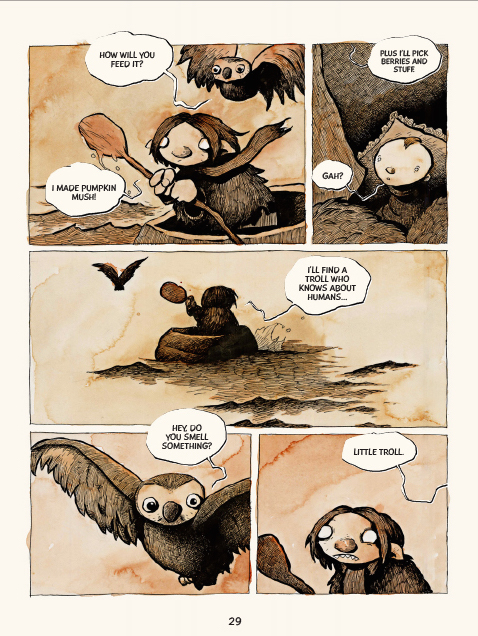
Bera, who lives on an isolated island with her owl companion Winslowe, is the official pumpkin gardener of the Troll King. (There’s the pumpkin connection for Halloween,  and, except for the cover and an occasional candle burning yellow, it’s the colour scheme of all the book’s graphics.)  When Bera rescues a human baby from three evil mermaids (they are not of the lean and lovely variety), she takes upon herself the task of returning the baby to its humans.  But that is contrary to the wishes of the malevolent Cloote, former  head witch of the Troll King, who wishes to use the baby to return to the good graces of the Troll King.
From Bera the One-Headed Troll 
by Eric Orchard
Bera who feels unprepared for dealing with the baby decides to seek a hero from her books, specifically choosing Wulf the Dragon Masher.  On their journey, Bera and the baby, with Winslowe scouting from above, encounter the mermaids again, as well as the Guardian, a sea monster as big as an island, and a bunch of hedgehog wizards.  Thankfully this last group whose mandate it is to protect the creatures of the wood already know firsthand of Cloote’s destruction and offer to steer Bera to Wulf’s tower.  Wulf, a troll of epic proportions and light-spirit (“Hey, is that a baby?”, “Well, look at that” and “Imagine that!”; pg. 52), has not been on an adventure in a very long time and, though willing of spirit, he succumbs to his epic sleepiness.

So Bera goes in search of another hero, finding both Duke Otig, the two-headed troll hero of the troll-giant war, and then the three-headed Nanna the Great.  But the reader will soon realize that heroes are not just those who undertake adventures and engage in battles.  Heroes are also those who make extraordinary sacrifices to do ordinary things, making their own quests in the spirit of goodwill, not glory.
From Bera the One-Headed Troll 
by Eric Orchard
Bera the One-Headed Troll is a offbeat graphic novel filled with trolls (one-, two- and three-headed varieties), goblins, witches, and rats (Vince is particularly helpful) and positive messages about offering assistance to those in need.  With only her want to do the right thing, Bera takes herself out of her comfortable pumpkin patch island and discovers new strengths and instincts, while making some new friends and good karma in the process.  I thought Bera the One-Headed Troll was going to be a dark, dark tale for a Halloween night, and its graphics would’ve supported that notion.  Eric Orchard’s trolls and witches and other creatures could be seen as darkly unnerving, as are the settings of straggly trees and murky swamps and stone edifices.  But Bera the One-Headed Troll is neither dark nor frightening.  It is a positive message wrapped in a dark cloak festooned with pumpkins.  Read it for Halloween but take its guidance beyond the day.

October 28, 2016

Mouse Vacation

by Philip Roy
Illustrated by Andrea Torrey Balsara
Ronsdale Press
978-1-55380-479-6
32 pp.
Ages 4-8
October 2016

Compromise is tough enough between humans.  Imagine trying to compromise with an adorable mouse who has great imagination and wanderlust but no sense of distance or costs.  Happy the Pocket Mouse has decided the solution to a case of the boredom blues is for him and his human, John, to go some where.

For John, though, going somewhere usually means someplace close to home, like the store or the park.  But Happy has other ideas, and he has lots of them.  So, John recommends that they each make a list of places they’d like to go.  John is thinking the woods and the river, but Happy’s thinking the Taj Mahal and New Zealand.

Finally John introduces the idea of compromise, a meeting in the middle, which Happy jumps on, proposing meeting in Egypt, or Paris or even New York City, all of which John nixes based on cost.  John’s suggestion about an overnight bus ride to the nearest city to see the Tall Ships finally grabs Happy’s attention, especially John’s description of them as “ghosts from the past” (pg. 23).  Still, finally settling down for the night, the excited little mouse checks with John about one potential stop on the way home!
From Mouse Vacation 
by Philip Roy, illus. by Andrea Torrey Balsara
I’ve reviewed every Happy the Pocket Mouse story that Philip Roy and Andrea Torrey Balsara have created: Mouse Tales (Ronsdale, 2014); Jellybean Mouse (Ronsdale, 2014); and Mouse Pet (Ronsdale, 2015).  The foundation of each picture book is the endearing relationship between John and Happy.  John is like the laid-back best friend/dad who radiates subtle wisdom and empathy while Happy is this adorable, adorable innocent whose heart is filled with love and mind brims with imagination.  (I love the sweetness of his response to John’s suggestions: “That’s okay, John, we’ll just go somewhere else”; pg. 5) By having John and Happy working out what it means to take a vacation and finding a way to compromise, Philip Roy has again produced a charming life lesson in a story book.  And Andrea Torrey Balsara flawlessly brings the story to visual completion, ensuring John looks like the man who is wise and caring and Happy is effusive with sweetness and virtue.  But, this time, Philip Roy’s story allows Andrea Torrey Balsara to create wild backgrounds for Happy: on a cow at the Taj Mahal, roasting a marshmallow over a candle while camping, riding a camel in Egypt, or sporting an “I ❤︎ NY” T-shirt.  Still, the magic is in the collaboration, between the text and illustration and between John and Happy.  That's what makes the story, and Philip Roy and Andrea Torrey Balsara have done it again, blending the two into a story of adventure for the mind, the heart and the soul.

From Mouse Vacation 
by Philip Roy, illus. by Andrea Torrey Balsara

October 26, 2016

The Story of Canada (new updated edition)

by Janet Lunn and Christopher Moore
Illustrated by Alan Daniel
Scholastic Canada
978-1-4431-1954-2
344 pp.
Ages 9+
September 2016

The Story of Canada was an important book when first published in 1992 by Lester Publishing and Key Porter Books.  It’s still an important book but even more so now with an additional twenty-five or so years of Canadian history to make the story of Canada more complete.  Students and teachers of history and Canadians, new and indigenous, will appreciate the completeness of this newest edition as a true compendium of Canada’s history.

The Story of Canada takes a journey through eleven chapters and an epilogue, with obligatory index, photo credits, and acknowledgements, as well as chronology. The table of contents, now neatly organized onto a single page, lists the following chapters:

  1. A Hundred Centuries
  2. Strangers on the Coast
  3. Habitants and Voyageurs
  4. The Colonists
  5. The Great Northwest
  6. Mountains and Oceans
  7. Confederation Days
  8. Sunny Ways
  9. Stormy Times 
  10. The Flying Years 
  11. New Millennium
  12. Epilogue: Northern Voyagers

Photo of spread from The Story of Canada 
by Janet Lunn and Christopher Moore,
illus. by Alan Daniel

Thought the initial note To the Reader from The Authors at the beginning of the book is not included, The Story of Canada is essentially the same, as would be expected, except for amendments to the formerly-last chapter, The Flying Years, and the addition of an eleventh chapter, New Millennium.  Discussions of First Peoples, the Vikings, New France, exploration, Confederation, the gold rush, immigration, two world wars, the Great Depression, and the 1950s-1970s are essentially unchanged.  But now there are greater discussions about the free trade agreement and what it meant for Canada’s economy and the controversy that was the Meech Lake Accord, as well as conflicts in the global village.  The New Millennium chapter delves more into technological achievements and more milestones for Canada such as Chris Hadfield’s command of the International Space Station, the growing diversity of our populations, and the appropriately-increasing role of women in government and culture.  Sadly this chapter also examines life in the aftermath of September 11, 2000 and the growing reach of terrorism, as  well as the Great Recession, the refugee crisis, environmental disasters and the need for Truth and Reconciliation for our indigenous people.  Though this chapter is hardly one of a contented country, it is not unlike our history in general:  busy with conflict, evolution and achievement, not all of which we should be proud.  But, as is said, it is what it is.  Finally, the epilogue, titled Northern Voyagers, goes beyond the adventures and legendary songs of the Northwest Passage, now emphasizing the discovery of Franklin’s Erebus, ending with the prophetic words of Journey of Nishiyuu leader David Kawapit:
This land, the earth, the rivers, the winds, the mountains, the clouds and all of the creation, we are the true keepers and will continue to do so until time on earth is over. (pg. 313)
As more time passes, The Story of Canada will become the keeper of more and more of our history (the chronology appending the book now extends beyond 1992 to 2016, including Blue Jays’ victories, the establishment of Nunavut, the SARS epidemic and the Vancouver Olympics).  As with the telling of any history, there will be those that disagree with the emphases or perspectives of the authors but I believe that Janet Lunn and Christopher Moore have prepared a fair and comprehensive and up-to-date history of Canada in The Story of Canada, giving voice to all peoples, all centuries, all blemishes and glories, in an effort to recount and enlighten.  Enhanced by numerous photographs and Alan Daniel’s illustrations, includng many double-spread, for which he did exhaustive research at various archives and art collections, The Story of Canada has learned from its own history to become more inclusive and truly more Canadian, reaching beyond what we have been and into the future of what we are to become.

October 25, 2016

I Am Not a Number

by Jenny Kay Dupuis and Kathy Kacer
Illustrated by Gillian Newland
Second Story Press
978-1-927583-94-4
32 pp.
Ages 7+
September 2016
Reviewed from advance reading copy

Stories like I Am Not a Number should always be told.  They should always be told loudly and emphatically and with purpose, to tell of a wrongdoing that was perpetrated against First Nations families like the Couchie family of Nipissing First Nation.  Tales of children stolen from their homes, under the direction of government, to attend and live at residential schools.  Narratives of holding onto self when everything was done to annihilate that sense.  This is the account of author Jenny Kay Dupuis’ granny, Irene Couchie Dupuis.

In 1928, Irene was living with her father, Chief Ernest Couchie, and her mother and two brothers, George and Ephraim, on Nipissing Reserve Number 10 when the Indian agent of the day demanded the children be surrendered to him to deliver to St. Joseph’s Indian Residential School.  Though her parents protest–her mother especially vehement that eight-year-old Irene needed to be with her family–the children are essentially taken by force.

The children are going with me to the residential school.  They are wards of the government, now.  They belong to us. (pg. 2)

With final goodbyes, her mother telling them to “Never forget home or our ways.  Never forget your mother and father.  Never forget who you are.” (pg. 7), the three children are taken away and separated, boys from girls.  Still Irene tries to stay strong, even after she’s told that she will be known as 759, telling herself “I am not a number.  I am Irene Couchie, daughter of Ernest and Mary Ann Couchie.  I will never forget who I am.” (pg. 8).  And through the horrible showering to “scrub all the brown off” (pg. 9) and the cutting of her long hair–normally only cut when a loved one was lost– and burning of her hands as punishment for speaking her own language, Irene heeds her mother’s words to never forget who she is.
From I Am Not a Number 
by Jenny Kay Dupuis and Kathy Kacer, 
illus. by Gillian Newland

After a full year of biting her tongue and dreaming of home, to and from which all letters were banned, Irene and her brothers are sent home for the summer.  As happy as she is to feel the love of her family again, to eat well and speak her own language, Irene is troubled by images of her time at school and her impending return in the fall.  But Irene’s father has other plans for his children and none of them include that horrible place.

Jenny Kay Dupuis does her granny Irene and her heritage honour by telling this story.  It’s a difficult one for all families involved in the residential school debacle, even for generations afterwards but one that Jenny Kay Dupuis tells, in collaboration with award-winning historical fiction and non-fiction writer Kathy Kacer, to inform and clarify for young readers.  It’s a shocking tragedy from our history but one from which we can only hope all learn valuable lessons.  I Am Not a Number is illustrated compassionately by Gillian Newland, who also illustrated Kathy Kacer’s The Magician of Auschwitz (Second Story Press, 2014) and A Boy Asked the Wind (Barbara Nickel, Red Deer Press, 2015). In the realistic style of Alex Colville and using the sombre tones of greys, blacks and browns for the residential school and a similar palette with splashes of gold and green away from that setting, Gillian Newland evokes the appropriate sentiment the book.  I Am Not a Number may be illustrated and classified as juvenile non-fiction but the extensive text and the account within is a mature one, yet one that can be told and taught and learned with empathy and as tribute.
From I Am Not a Number 
by Jenny Kay Dupuis and Kathy Kacer, 
illus. by Gillian Newland

October 24, 2016

Tank and Fizz: The Case of the Battling Bots

Written by Liam O’Donnell
Illustrated by Mike Deas
Orca Book Publishers
978-1-4598-0813-3
163 pp.
Ages 8–11
2016

We all know cheaters, those vile people who manipulate circumstances in their favour, regardless of others.  At the simplest, they are kids who cheat on tests or lie to cover up some misdemeanour.  At worst, they are adults who perpetrate crimes for their own purposes.  It is so satisfying when a cheater gets caught because that’s what they deserve and it’s a small step in making the world a safer and better place for all.  It’s not surprising, thus, that when Tank and Fizz, our intrepid detectives from The Case of the Slime Stampede (Orca, 2015)  are asked by the school Troll Patrol to prove that wealthy and reprehensible classmate Rizzo Rawlins is cheating in the local battle bot competition, that the two monsters are eager to take on the case. If only all cheaters could be caught by Tank and Fizz.
All year, I had watched Rizzo cheat in class.  Math test, science quizzes, coloring contests.  You name it, Rizzo Rawlins cheated.  He bribed the school math whizzes for test answers.  His goons sabotaged classmates’ experiments.  He hired professional artists to do his cut-and-past craft projects. Rizzo Rawlins had to win at everything, every time, any way he could.  I had seen the trail of broken dreams in my schoolmates’ tears.  When I’d seen the sad faces of the Troll Patrol,  I knew Rizzo’s cheating had to stop.  And I was the goblin to make it happen. (pg. 21-22)
But, as is usually the case, everyone knows about the cheating but proving it is far more difficult.  Even with Tank’s code sniffer–her invention to sniff out codes originating from beyond the school–that proves Rizzo’s bot, the Rawlins Reaper, should be disqualified, Principal Weaver refuses to believe Rizzo is anything but a model student, probably because Rizzo’s father makes huge financial donations to the school.  When the two detectives follow Rizzo to the almost complete new stadium, Slurp Stadium, they witness his acquisition of a new illegal part for his bot and his interactions, by screen, with a masked hacker called the Codex.  But the search for evidence of Rizzo’s cheating becomes linked to a situation in which the Codex threatens Mayor Grimlock to suffer unforeseen consequences if the new stadium is ever opened.  The goblin and troll duo undertake surveillance, alongside magic-spinning friend, Aleetha, a lava elf, and discover a conspiracy involving Sanzin Balazar, the wealthy entrepreneur behind SlugCo and the new stadium, a banished demon of goblin legends, and a threat to Slick City of monstrous proportions.  But can they stop the chaos before everything is lost?

Liam O’Donnell has a fun way with words, and more so in his creation of the world in which Tank and Fizz live.
You know that feeling you get when you try to stop a demon from being summoned but accidentally help summon it?  It definitely takes the shine off your scales. (pg. 136)
There are double grubnug-fudge smoothies, glowshroom groves, spicy lizard dogs and choco-slug cookies, and mothers who scratch the scales behind your ears. (Aw.)  And Tank’s inventions, like her spybot and springers, are the contraptions of kids’ dreams. Mike Deas’ graphic novel-type illustrations suggest he got as much amusement as the author in creating the assortment of monsters that populate Slick City and the Tank and Fizz books in general. (Books 3, The Case of the Missing Mage is set for release April 2017.)

From Tank and Fizz: The Case of the Battling Bots 
by Liam O'Donnell, illus. by Mikes Deas
Since the book’s dedication is “To goblin detectives and troll tinkerers everywhere”, it seems only right to review The Case of the Battling Bots in October, the month of goblins, trolls, witches, elves and more. Moreover, the book was just nominated for the 2017 Silver Birch Express award, so it’s review at this time is only fitting.  But the outrageous antics of Tank and Fizz, all in good fun and with the best of intentions, will always entertain, regardless of the time of year, as long as early and middle-grade readers enjoy a bit of fun with their creepy and a bit, but not too much, of the graphic-novel  format to dress up a strongly-plotted story.

October 21, 2016

King Baby

Written and illustrated by Kate Beaton
Arthur A. Levine Books/Scholastic
978-0-545-63754-1
40 pp.
Ages 4-8
September 2016

Though some parents might not find it humourous the way the baby in King Baby has his parents running to and fro to make his life perfect–perhaps they'll see it as castigating their own efforts–children and others will laugh at the uproarious manipulation by a swaddled egg of a baby to get everything, and I mean everything, that he desires, now and forever.  Yep, as the book says, "It is good to be king."

From King Baby by Kate Beaton

From King Baby’s birth, after which he is presented to his many admirers bearing gifts and admiration, the baby is generous with his smiles and laughs and kisses, his wiggles, gurgles and coos.  But then he begins to demand: food, burping, changing, bouncing, being carried.  It’s endless.  For King Baby, life is grand.  For King Baby’s parents, life is exhausting.  He sees them as subjects, fools even, though their ineptitude finally gets him up and toddling.  His future is even more glorious now with all that he can accomplish, though not always to everyone’s delight. (The cat looks a little dismayed.)  But King Baby has to grow up, and becoming a big boy, he learns that they’ll be going through the whole process again, this time with Queen Baby.

It’s obvious that Kate Beaton, known as Auntie Katie to the Malcolm to whom she dedicates the book, knows that of which she writes and illustrates.  A new baby is a wondrous joy but an exhausting one.  Kate Beaton’s quirky illustrations, especially of King Baby as a rotund creature swaddled in a blanket and topped with a golden crown, are too funny, and lend a comical air to a bizarrely normal yet wacky situation i.e., the joy and adoration of a new baby.  I don’t know if Kate Beaton meant to give King Baby that evil glint in his eye but he seems to know what he’s doing i.e., making everyone jump to satisfy his every whim.  Without the means to communicate with clarity, King Baby has them running around doing everything to appease him.  Ah, it’s good to be king!
From King Baby by Kate Beaton

Share this hilarious book with any new parents you know.  If they’re not too tired, they’ll certainly see the humour in their situation.  And if they’re just too tired, share it with the aunts and uncles and grandmothers and grandfathers and godmothers and everyone else who appreciate the cuteness that is a new baby but recognize the long haul of parenting still to come.  Hail the royal entourage!

October 20, 2016

The Wolf-Birds

by Willow Dawson
Owlkids Books
978-1-77147-054-4
40 pp.
Ages 5-8
2015

Sometimes I receive review copies of books that get office-bushwhacked on their way to reviews on CanLit for LittleCanadians.  Sometimes I get back to them, and sometimes I don’t.  And then sometimes because of award nominations I feel compelled to finally get that review out.  Such is the case with Willow Dawson’s The Wolf-Birds, recently nominated for the 2016 TD Canadian Children’s Literature Award and the Marilyn Baillie Picture Book Award, the 2016 Information Book Award and the 2017 Blue Spruce Award.  Mea culpa for not reviewing The Wolf-Birds sooner.

The Wolf-Birds is a story of survival in the natural world and it’s not an easy one.  But when life is governed by the weather and food availability, how can it be anything but perilous?  Two hungry ravens endure the cold of winter, scavenging for food wherever possible.  When they hear four wolves in pursuit of a buffalo, they follow, expectant of some scraps.  Instead, one of the wolves is killed and the three remaining wolves continue their own search for food, alerted by the ravens to a starving and injured deer.  

From The Wolf-Birds by Willow Dawson

In the wild winter wood…

…one animal’s life helps many others live.  

From strongest to smallest,

everyone feasts in turn, filling
bellies and beaks. (pg. 24-27)
The interdependent relationship between the ravens and wolves is recognized by the common use of the term “wolf-birds” for ravens, acknowledging the unique connection between the two creatures.  As Willow Dawson’s story reveals, ravens are prepared to steal food killed by wolves as well as lead them by call and display to potential prey, while wolves pay attention to where ravens congregate and willingly clean up that which the birds do not eat.  It’s a unique interdependence and one that affords greater discussion in science classrooms, discussions aptly supported by the book’s references and information guide available at the Owlkids website here.

But, The Wolf-Birds is an illustrated children’s book and one whose artwork must be recognized as fundamental in the telling of its story.  The text is spare and that is because the illustrations, acrylic paint on board, propel the story through the cycles of food and life. Eerily reminiscent of the sleek animals of cave dwellings, Willow Dawson’s fauna are simple, outlined creatures, unadorned but easily identifiable, coloured in muted earth tones of feathers and fur, alongside cool snow and winter skies, with occasional brightness of rose or green.
From The Wolf-Birds by Willow Dawson
There is a story to tell here of life in the wild and a mutualistic relationship of which many readers are unaware.  The Wolf-Birds, beautifully depicted by Willow Dawson's artwork, is a story that must be told and appreciated for its lessons and its message about working together and survival, teachings that go far beyond the natural environment portrayed within.