April 08, 2026

The Man In Motion: How Rick Hansen's World Tour Helped Break Down Barriers for People with Disabilities

Written by Lorna Schultz Nicholson with Rick Hansen
Illustrated by Emma Fitzgerald
Owlkids Books
978-1-77147-677-5
40 pp.
Ages 5–8
April 2026 
 
While people of my generation will remember Rick Hansen and his World Tour, many younger readers will know little of this extraordinary Canadian and his determination to help the world become more accessible for persons with disabilities. Now, Lorna Schultz Nicholson with Rick Hansen are bringing his story to inform young readers of his heroic accomplishments. 
From The Man In Motion: How Rick Hansen's World Tour Helped Break Down Barriers for People with Disabilities, written by Lorna Schultz Nicholson with Rick Hansen, illustrated by Emma Fitzgerald
Rick Hansen's story is told from his accident at age 15 when he'd broken his back and required use of a wheelchair. But in the 1970s, many buildings lacked accessibility features like ramps. Moreover, Rick noticed that people treated him differently, now seeing "his chair without seeing him." (pg. 5) Though he'd won wheelchair marathons and Paralympic events, he wanted to do more. With the help of some friends, he planned the Man In Motion World Tour with the aim of travelling by wheelchair over four continents to thirty-four countries. He set out on March 21, 1985 with his team.
From The Man In Motion: How Rick Hansen's World Tour Helped Break Down Barriers for People with Disabilities, written by Lorna Schultz Nicholson with Rick Hansen, illustrated by Emma Fitzgerald
From the onset, the road was long and challenging, and Rick faced potential setbacks like a smashed spare wheelchair, as well as inclement weather. Getting media attention and donations was arduous. But Rick and his team continued pushing through the United States, and then into Europe, Asia, and Oceania. He visited numerous countries, saw wondrous things, and often wondered if he'd done enough. 
From The Man In Motion: How Rick Hansen's World Tour Helped Break Down Barriers for People with Disabilities, written by Lorna Schultz Nicholson with Rick Hansen, illustrated by Emma Fitzgerald
Rick had been on his World Tour for over a year when he returned to North America. After being interviewed on The Today Show, more people became aware of Rick and the Tour. Finally, Rick had become famous enough to bring attention and get donations to support his tour and spinal cord research.
 
His final section of the Tour was across Canada, and he was given a hero's welcome everywhere. When his journey ended on May 22, 1987, he'd "raised $26 million and showed the world that people with disabilities have extraordinary potential." (pg. 35)
From The Man In Motion: How Rick Hansen's World Tour Helped Break Down Barriers for People with Disabilities, written by Lorna Schultz Nicholson with Rick Hansen, illustrated by Emma Fitzgerald
Lorna Schultz Nicholson gives us the hero of Rick Hansen without minimizing the struggles he faced on his tour. Her text, as well as a "Fun Facts" section, a summary of his story, and a note from Rick, remind us of the extraordinary efforts required to complete the Man In Motion World Tour. (For example, Rick travelled 40,075 km, wore out 160 tires, and burned through 94 pairs of gloves.) This is a story of the extraordinary by an extraordinary person, and Lorna Schultz Nicholson emphasizes this always. And she does it with a quiet fascination and casual storytelling that may make the reader forget that this is non-fiction. It's an amazing story and she tells it very well.
 
Emma Fitzgerald's pen and ink illustrations, later coloured digitally, give incredible detail to the story, whether it's the textures of a forest, the busyness of a street scene, or the toil of harsh weather. This Nova Scotia artist delivers the vastness of Rick Hansen's tour, from people and place to weather and hassles. And even though there is little detail in Rick and others, there is enough to see joy, apprehension, warmth, and even muscle-building. 

Forty years ago, Rick Hansen was in the middle of his Man In Motion World Tour. His aspiration to bring awareness to persons with disabilities, and the need for accessibility and spinal cord research was fulfilled but not finished. Even his "Note from Rick" invites young readers to think more deeply about persons with disabilities and about accessibility issues so that they too might help make a difference. By asking them to think about his story and those of other persons with disabilities, Lorna Schultz Nicholson and Rick Hansen have taken his story from one of then to one of now and into one of potential action. 

April 06, 2026

Now I See . . . board book series

Written by Mac Barnett
Illustrated by Jon Klassen
Tundra Books
24 pp.
Ages 2–5
April 2026 
 
There are only 35 words in the four board books in Mac Barnett and Jon Klassen's new series, Now I See. That's because each book has the same 35 words, in the same order, and describing almost the same things. What changes is what is happening to the people and places over the four different seasons, and that is communicated with the dramatic and yet straightforward artwork of Jon Klassen.
 
The four books are as follows:

 
Now I See Spring
978-1-77488-673-1


Now I See Summer
978-1-77488-677-9


Now I See Fall
978-1-77488-665-6


Now I See Winter
978-1-77488-669-4


In each book, a double-page spread focuses on an illustration of one element and then its identification. They are the house; the tree; the garden; me (shadow of a child on the side of a house); some birds; a treat (that's nice and sweet); the farm; the sky; the wise old cat; something red; and the perfect hat. The final text is a declaration that, "it's my favorite time of the year." But, in each book, each element is a little different. The tree might be leafing out in Now I See Spring, fully green in summer, losing its red leaves in the fall, and bare in the winter. Each season brings something different in where we live, what we wear, what we like to eat, and what we see. And they are all true.
From Now I See Spring, written by Mac Barnett, illustrated by Jon Klassen
Mac Barnett and Jon Klassen collaborate to produce extraordinary books. There's their Caldecott Honor books Extra Yarn (2012) and Sam and Dave Dig a Hole (2014)—Jon Klassen won the Caldecott Medal for his own This Is Not My Hat (2012)—and their Shape trilogy of Triangle (2017), Square (2018) and Circle (2019). The Now I See books equal these earlier books in their verve, teaching an important concept without instruction. They teach by helping children make observations and connect to that which they experience in their own lives. And, by reading all four books together, children will see how the seasons change and their reading of simple words, repeated in each book, will be reinforced.
From Now I See Winter, written by Mac Barnett, illustrated by Jon Klassen
Mac Barnett gets the text right by keeping the words simple—mostly articles and nouns—and giving them rhythm, though not necessarily rhyme. The text has a quiet pep to it, carrying the reader from one scene to another. And Jon Klassen's watercolour and digital art is the ideal medium for giving a lot in an unambiguous way. His lines and shapes give us the seasons with their distinctions, emphasizing both colour and shape to the familiar and perhaps less familiar. 
From Now I See Summer, written by Mac Barnett, illustrated by Jon Klassen
Exceptional concept books are those that do more than teach. They delight with their words, they charm with their artwork, and they engage readers by inviting them to be part of the story. Mac Barnett and Jon Klassen's Now I See series is fresh in its exceptionality.

April 01, 2026

A Little Halwa and a Big Family

Written by Farid Bazger
Illustrated by Sahar Abdallah
Running the Goat, Books & Broadsides
978-1-998802302
40 pp.
Ages 4–8
March 2026  
 
Halwa is a confectionery traditional to many countries from Central Asia to the Middle East and into Africa and Europe. And when Mama and Papa have a craving for it one night, but little in the way of ingredients for their large family, they plan a secret treat for themselves once their children are in bed. But, unbeknownst to them, everything will change when little Malala overhears their plan.
From A Little Halwa and a Big Family, written by Farid Bazger, illustrated by Sahar Abdallah
Malala tells her older brother Bahir, who tells his older brother Azmoon, who tells his older sister Lima, who tells her older brother Abasim, who tells his older brother Zareen, who tells his older sister Zala. And with that, seven children hatch a plan to be in on the late-night treat.
From A Little Halwa and a Big Family, written by Farid Bazger, illustrated by Sahar Abdallah
When the parents see the children have brushed their teeth and been tucked into bed, they head to the kitchen. But, when Mama starts to prepare all she needs for cooking the halwa, from matches to light the stove, and flour and sugar and other ingredients, she finds them all missing. The children obviously know what Mama will use, and with every staple needed, a child appears to deliver it. And with each delivery, the child is invited to sit and watch and wait to share in the halwa.
 
But the same problem that the parents recognized initially—insufficient ingredients to feed their large family the special treat—is still a problem, with every child getting a little halwa and the parents giving themselves none. Is there a way for a little halwa to feed a big family?
From A Little Halwa and a Big Family, written by Farid Bazger, illustrated by Sahar Abdallah
A Little Halwa and a Big Family is a version of a chain story in that there are seven children and a similar number of ingredients or elements needed to make the halwa. (A recipe is included.) With seven Afghan children to bring in the missing ingredients, it's a tale that emphasizes unity, sharing, and even teamwork, in a very playful way. Originally from Afghanistan, Farid Bazger blends his traditional culture with the mischief of children and the unselfishness of parents. From the tasty treat to the family dynamics, this is a large Afghan family rooted in affection and consideration. While the parents may initially seem a bit selfish hiding their planned treat from their children, they really aren't. It is just Papa having a craving and Mama happy to make it for him. And yet, when she finally starts cooking it, there is never any option other than sharing with their children. The parents are giving and caring and these same traits have been bestowed upon their children who want to do the same for their parents. 
 
Sahar Abdallah, an Egyptian-Canadian artist, uses pencil crayon, soft pastels, and powder pigments (see the video of her creating an illustration here) on brown Kraft paper. Her media give a softness of texture as well as colour, creating a homey feel within the illustrations. It's perfect for a story in an Afghan home with its large family of boys and girls wearing clothes of bright colours of green, orange, white, blue, and gold. Sahar Abdallah gives the story the warmth that Farid Bazger's family shows in its hospitality.
From A Little Halwa and a Big Family, written by Farid Bazger, illustrated by Sahar Abdallah
Whether you try the halwa recipe included or just enjoy being welcomed into this family's abode, A Little Halwa and a Big Family 
proves that, when there is kindness, there is always enough food to share.

March 31, 2026

2026 Ann Connor Brimer Award for Atlantic Canadian Children's Literature: Shortlist announced


Yesterday, the shortlist for the Ann Conner Brimer Award, one of the Atlantic Book Awards, was announced. This award, established in 1992 and administered by the Writers' Federation of Nova Scotia and supported by Gavin Brimer, son of the teacher, researcher and bookseller for whom the award is named, celebrates outstanding contributions to writing for Atlantic Canadian young people, and comes with a $5,000 prize. 
 
Congratulations to the following titles and their authors on being shortlisted for this award.
 

Bertie Stewart Is Perfectly Imperfect
Written by Melanie Mosher
Nimbus Publishing
192 pp.
Ages 7–11
2024 
 

Joe and the Wreck of the Tribune
Written by Jacqueline Halsey
Nimbus Publishing
176 pp.
Ages 8–12 
2025 
 

The Mystery of the Haunted Dance Hall
Written by Charis Cotter
Tundra Books 
392 pp.
Ages 9–12 
2025 


The Newest Gnome
Written by Lauren Soloy
Tundra Books 
72 pp.
Ages 3–7 
2025 
 

Our Ancestor's Kitchen
Written by Willie Poll
Illustrated by Shaikara David 
Annick Press
36 pp.
Ages 4–7 
2025 


 Winners of all Atlantic Book Awards, including the Ann Connor Brimer Award, will be announced on Thursday, June 4, 2026 in Halifax.


March 29, 2026

Raven & Friends: A Roy Henry Vickers Colouring Book for Kids

Written and illustrated by Roy Henry Vickers
Harbour Publishing
978-1-998526543
60 pp.
Ages 6–8
February 2026 
 
Raven & Friends is more than a colouring book. It's an invitation to learn how to draw in the style of Northwest Coast art. It's an offer to visit the animals of the land, water, and sky that inhabit this area. And it's a promise to help us see more than just ourselves.
From Raven & Friends: A Roy Henry Vickers Colouring Book for Kids
written and illustrated by Roy Henry Vickers
While the emphasis is on Raven and other animals like Hummingbird, Sealions, and Salmon, Roy Henry Vickers also takes us to see the sun and a Pacific sunset, and as well as a Raven Dancer and our place in the world. With Raven & Friends, Roy Henry Vickers helps us appreciate his Northwest Coast as he sees it: beautiful, natural, and part of something bigger.
From Raven & Friends: A Roy Henry Vickers Colouring Book for Kids
written and illustrated by Roy Henry Vickers
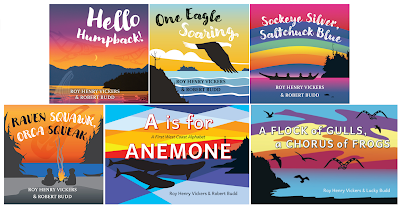
Roy Henry Vickers, with whose art I first became familiar through his First West Coast Book series with Robert "Lucky" Budd, will inspire young readers to colour but to also draw. He instructs them how to make shapes used in Northwest Coast art and allows them to practise before helping them put the shapes together into a stylized animal. But even if they aren't interested in trying their hand at drawing—though that would surprise me—Raven & Friends offers an opportunity for colour creativity and relaxation, even stress reduction. The act of putting paint, marker or crayon, pencil or wax, to paper brings calm. But with Roy Henry Vickers's artwork, that calm is sublime, transporting us to the Northwest Coast, compelling us to see beyond our own worries and intrusive thoughts, and inviting us to be present and mindful of the beauty within Raven & Friends and its subject locale.
From Raven & Friends: A Roy Henry Vickers Colouring Book for Kids
written and illustrated by Roy Henry Vickers
Roy Henry Vickers's first colouring book, Inspired (2025), was more complex, appropriate for all ages, young and adult. Raven & Friends may be considered more straightforward, less detailed in line and context, but the beauty in his art is accessible to all. For me, a retired teacher librarian, I see such elegance in Roy Henry Vickers's lines and shapes and how they merge into stunning reflections of his home, his cultures and his ancestry—Haida, Heiltsuk, Tsimshian and European—that I'm tempted to visit the Northwest Coast with my own colours and his art. I hope that whether you're six or sixty, you'll let Roy Henry Vickers guide you to a place of organic charm with his art and your colouring tools.
 
 
Check out the First West Coast Book series that Roy Henry Vickers created with Robert "Lucky" Budd.
 

March 24, 2026

Kaboom!: Blast Off

Written by Jay Odjick
Illustrated by KC Oster
Scholastic Canada
978-1-4431-9836-3 
142 pp.
Ages 8–12
February 2026 
 
Zack seems like a regular kid. He likes riding his bike and imagining himself as a superhero. He is lured by ads for the snack Choco Pops and the energy drink Splurge and is impressed with the fabulously rich like Konstantin Pierce. Compared to his boring parents who sell refrigerators, Pierce looks pretty exciting. But there seems to be another story that the imaginative Zack does not know. While he believes his parents are at a trade show and he's staying with his Auntie Jess, his mom and dad, calling each other Shadowbird and Greywolf, are working for F.U.S.I.O.N. as true superheroes, currently stopping those who steal ancient artifacts. As for Konstantin Pierce, he's more villain than entrepreneurial genius.
From Kaboom!: Blast Off, written by Jay Odjick, illustrated by KC Oster
Pierce is looking to extort world powers by controlling the weather and he's concerned that F.U.S.I.O.N. agents are going to get in the way. He arranges for them to be eliminated. Not surprising that Zack is shocked when flying robots and a masked man come and take his parents and aunt away. Thankfully his parents have a household security system to protect Zack and he, along with a cute robotic dog rejected by Pierce, are whisked to his parents' underground headquarters where he virtually meets Tana a.k.a. Teknik from New Zealand. Tana/Teknik explains that, like his parents and her Māori father, she is an agent of F.U.S.I.O.N., the First Universal Secret Indigenous Operatives Network, which is tasked with working against any threat to Indigenous Peoples, cultures, and ways of life.
From Kaboom!: Blast Off, written by Jay Odjick, illustrated by KC Oster
So, as Zack and his new robot sidekick Rusty poke around his superhero parents' secret den, Pierce is threatening the U.N. even though he realizes that a thumb drive with the activation codes is missing. But, after finding a special Lycra suit fit for a superhero, Zack, who becomes known as Kaboom, works to help get his parents back and thwart Konstantin Pierce and his villainous henchman and drones. 
 
Looks like there's a new superhero in town as Blast Off! is just the first book in the new Kaboom! graphic novel series. Zack a.k.a Kaboom is a little impetuous, a lot funny, and kind of sweet, and he's a character whose adventures middle graders will want to follow. Jay Odjick, who'd previously illustrated Robert Munsch's Bear for Breakfast / Makwa kidji kijebà wìsiniyàn (2019), gives us a story in which a kid becomes a hero. But Jay Odjick also blends Zack's story with Indigenous superheroes from around the world—Māori, Inuit, Nahua, Khalka, and Algonquin appear in Blast Off—and the importance of doing good. Still Kaboom!: Blast Off is not a story that is told to preach or convey messages of how to live. It's about superhero fun with lots of humour, like when Zack starts pushing buttons he shouldn't or when he mishears Tana when she says kinetic and he hears Connecticut. With Zack just being Zack and Jay Odjick getting all the voices just right for all his characters, Kaboom!: Blast Off entertains completely.
From Kaboom!: Blast Off, written by Jay Odjick, illustrated by KC Oster
But, without the artwork of KC Oster, a new illustrator for me, Kaboom!: Blast Off just wouldn't be the hit it is. I like the style of this Ojibwe-Anishinaabe comic artist, who previously did the art for Rabbit Chase (written Elizabeth LaPensée, 2022). Their graphics are not cluttered, focusing on Zack and the other characters, keeping the details for lively interactions like altercations with the bad guys and fight scenes. And by not limiting their palette of colours, KC Oster makes the art exciting and lavish.
 
An Indigenous superhero organization, a kid hero, a robotic dog, and operations to stop the bad guys sounds like the kind of graphic novel that middle-grade readers will latch onto. I think Kaboom! has just made a dynamite arrival.

March 22, 2026

The Cedar Mother (Mothers of Xsan)

Written by Hetxw'ms Gyetxw (Brett D. Huson)
Illustrated by Natasha Donovan
HighWater Press
978-1-77492-158-6
32 pp.
Ages 9–12
February 2026
 
Eight years ago, Hetxw'ms Gyetxw, who is also known as Brett D. Huson, started his Mothers of Xsan graphic novel series to share his knowledge of the stories of the Gitxsan Nation of the Northwest Interior of BC. This series, now of eight books, has covered insects, fish, birds, amphibians, and mammals, and now I'm delighted to share his book about the cedar tree. Not only does The Cedar Mother speak to the life cycle of a cedar tree and its connection with other living things, but Hetxw'ms Gyetxw also shares his knowledge of the Gitxsan Nation and their Moons.
From The Cedar Mother, written by Hetxw'ms Gyetxw, illustrated by Natasha Donovan
This story of the western red cedar begins in April and the Spring Salmon's Returning Home Moon (Lasa ya'a). This tree, which has been around for over 300 years, now sits by a road that was "only a trail used by the Gitxsan, who had never seen a car, wagon, or horse." (pg. 2) Its growth from a tiny seed is helped by nutrients, rain, and sun. (Words that might be new to young readers, including nutrients, foliage, photosynthesis, and reverence, are defined in info boxes throughout the book.) 
 
But Hetxw'ms Gyetxw also explains how Nox Sim Gan (the cedar mother) is connected to other organisms in the ecosystem. She provides shelter and feeds animals with foliage and oxygen. She gives materials to the Gitxsan for clothing, for home-building, for medicines and, at the end of her life cycle, she will become a story pole. Because of her persistence and vitality, "she is a beacon of hope and a symbol of the enduring strength of the natural world. (pg. 15)
From The Cedar Mother, written by Hetxw'ms Gyetxw, illustrated by Natasha Donovan
Hetxw'ms Gyetxw writes with reverence for Nox Sim Gan in The Cedar Mother and for the role she plays in the environment and for the Gitxsan Nation. From birth through death, she provides. And, because of this, Hetxw'ms Gyetxw gently reminds us that attention must be paid, and our stewardship is required so that she may continue to share herself with the earth and its living things. Not a boring life cycle story, The Cedar Mother tells us how a western red cedar is a part of something far greater. It is part of a community.
From The Cedar Mother, written by Hetxw'ms Gyetxw, illustrated by Natasha Donovan
Natasha Donovan, who illustrated the earlier books in Mothers of Xsan series and Tasha Spillett's Surviving the City series, takes readers into the forests where Nox Sim Gan grows and flourishes, giving and sharing. Its majesty is evident from the scale at which she draws it, and the benevolence of its presence is clear in all illustrations as it interacts with other species. Natasha Donovan keeps the focus on Nox Sim Gan always, whether at the base of its trunk or buried in its foliage, preserving the natural elements in earthy colours of browns and greens. With Natasha Donovan's illustrations and Hetxw'ms Gyetxw's occasional contributions of formline art (see the spirit pole above), as well as his text, The Cedar Mother is a respectful acknowledgement of the connection between the natural world and the Gitxsan, and the reverence necessary to appreciate and to sustain its place.

 • • • • • • •
 
Mothers of Xsan series
The Sockeye Mother
(2018)
The Grizzly Mother (2019)
The Eagle Mother (2020)
The Frog Mother (2021)
The Raven Mother (2022)