March 06, 2023

Forest of Reading Kid and Teen Committees: 2023 Applications now being accepted


Do you love books?
 
Do you know Canadian books and authors?
 
Would you like to talk about books with other young readers?
 
How about contributing your recommendations to a summer reading list?
 
If you answered "Yes" to these questions, then have I got an activity for you!


Applications are now being accepted for the Forest of Reading's Forest Kid and Teen Committees. These committees bring young readers together to talk Canadian books and prepare summer reading lists for their peers. 
 
 
Who can apply?
There are three committees, based on grade level, who will meet on Zoom on different days in May. They are:
  • Silver Birch Kid Committee (for Grades 3-6)
  • Red Maple Kid Committee (for Grades 7-8)
  • White Pine Teen Committee (for Grades 9-12)
 
When will they meet?
  • Silver Birch Kid Committee: May 1, 2023 (9 AM- 12:30 PM EST)
  • Red Maple Kid Committee: May 2, 2023 (9 AM- 12:30 PM EST)
  • White Pine Teen Committee: May 4, 2023 (9 AM- 12:30 PM EST)
 
What happens during these meetings?
Young readers will meet on Zoom and share their opinions about recently published (from the last two years) Canadian books that they have read and enjoyed. These books should be appropriate for their age groups and not already been included on Forest of Reading nominated lists of titles. Under the guidance of Meredith Tutching, Director of the Forest of Reading, and a facilitator, readers will recommend titles, discuss their stories and the writing, and then vote on which titles, usually between 10 and 20 books, to include on the 2023 summer reading list. (Here's a pdf of a sample reading list from 2021.)

There are always special guests that drop in to speak to the committee and share their own recommendations. Past guests have included Kevin Sylvester, S. K. Ali, Kenneth Oppel, Kelley Armstrong, Eric Walters, David A. Robertson, Colleen Nelson, Zetta Elliott, Natasha Deen, Angela Ahn, Melanie Florence, and Gordon Korman.


How to apply?
Submit your application via Google form here.
Deadline for applying is April 1, 2023.

Readers will be asked to provide contact information, and information about favourite Canadian books and recently read Canadian books. (The key here is that the books must be Canadian, written by Canadian citizens or residents.)

Full details are available at the Forest of Reading website here.

March 03, 2023

Smile So Big

Written by Sunshine Quem Tenasco
Illustrated by Chief Lady Bird
North Winds Press (Scholastic Canada)
978-1-4431-8767-1
32 pp.
Ages 4-8
March 2023

Most of us, adult and child alike, will see something less than perfect in our appearance: too wide, too short, too white, too dark, nose or teeth too big, eyes too widely-spaced. There’s always seems to something that we see that others may or may not. How to see the truth?
From Smile So Big by Sunshine Quem Tenasco, illus. by Chief Lady Bird
Challa has a big, toothy smile and when she gets teased about it, her mom reassures her and shows Challa a beautiful mirror with a thunderbird design and fringe. Her mother tells her that this family heirloom would show the holder's true self, but the rule was that they "had to say what they saw in the reflection." Challa looks into the mirror and sees all her attributes and says, "I'm smiling so big. I sure do look cute." With that, the beads around the mirror light up. Challa is delighted.

From Smile So Big by Sunshine Quem Tenasco, illus. by Chief Lady Bird
When she shows her friend Neebin, who was always being teased about his long hair, Challa notices how he smiles and looks so cute when looking in the mirror. When he acknowledges aloud that he loves his long braid hair, not only do the beads light up, but the whole playground shakes and sparkles with magic! The same happens when her cousin Keggy recognizes how much she loves her dark skin and the house shakes and sparkles as it's enveloped in the magic of the thunderbird. When her friend Kiniw sees his own beauty and accepts his small size, the magic is revealed again.
From Smile So Big by Sunshine Quem Tenasco, illus. by Chief Lady Bird
Challa is perplexed why she only saw the beads light up, not the magic that came with it. She tries again to acknowledge her eyes, her nose, her hair, and her dimple but the magic doesn't appear until she feels and expresses real love for her smile.

Sunshine Quem Tenasco, Anishinaabe from Kitigan Zibi Anishinabeg, brings young readers to an Indigenous community and yet the story she tells will be understood by all of us who may be teased, or worse, about some aspect of our physical nature. With a little help from a magic mirror and the support of those who love us and came before us, we can all see, accept, and appreciate who we really are. Whether there's a magical mirror in your life or not, there are those who help you see the beauty within and those people, whether in our lives now or gone already, are our greatest champions. It's not because of validating who we are; it's because they reflect who we are through their love. Sunshine Quem Tenasco's dedication includes the following words: "To all the Indigenous kids on Turtle Island and to all the boys with braids, you are so loved. You are important. You are powerful." Her words lift those to whom she has dedicated her book but also to every child who has the good fortune to read this picture book.

Chief Lady Bird, a Chippewa and Potawatomi artist who collaborated with Sunshine Quem Tenasco on Nibi's Water Song (2019), gives us both the realism and the magic in her illustrations. The boldness of her colour and shapes impress with their power of message about beauty and self, encouragement, and heritage. Chief Lady Bird gives life and context to Sunshine Quem Tenasco's words, and together Smile So Big is as enchanting as it is grounded.

For every smile hidden because of unease, and for every cruel teasing endured, Smile So Big gives young readers the courage to see their beauty as reflected in their own mirrors, magical or not, as held by themselves and those who love them.

February 28, 2023

Meet J. Armand Bombardier (Scholastic Canada Biography)

Written by Elizabeth MacLeod
Illustrated by Mike Deas
Scholastic Canada
978-1-4431-9133-3
32 pp.
Ages 6-10
2022
 
Learning and teaching about amazing scientists, athletes, activists and other important persons who have helped shape Canada's history have been made all the easier and captivating with Elizabeth MacLeod and Mike Deas's illustrated biography series, Scholastic Canada Biography. Their latest collaboration highlights the inventiveness and achievements of Quebec's Joseph-Armand Bombardier, inventor of the snowmobile.
From Meet J. Armand Bombardier by Elizabeth MacLeod, illus. by Mike Deas
Born in 1907 Valcourt, Quebec, Joseph-Armand Bombardier loved tinkering with machines and building things from a young age. At fifteen, he invented his first snow machine, though its success was very limited. Not surprising he apprenticed with a mechanic to develop his skills before studying mechanical and electrical engineering. But the idea of a machine that could float over the snow was always in the back of his mind.
From Meet J. Armand Bombardier by Elizabeth MacLeod, illus. by Mike Deas
As he grew older and established his own garage, married and had kids, Armand found a new reason to pursue his snow machine when his young son could not get to hospital because of the snow. Using skis instead of wheels, repositioning the engine, and adding special toothed gear wheels, Armand's machine finally worked. It may not have looked like the snowmobile we know today, but it was the foundation for numerous other machines, from tractor track attachments and muskeg tractors to the famous Ski-Doo (only named this because of a typo of Ski-Dog).
 
When Joseph-Armand Bombardier died in 1964, he left a legacy of extraordinary invention and Elizabeth MacLeod makes sure to tell that story in addition to his personal details. It's a rich legacy of vision and pursuit that impacted the individual as well as commercial enterprises from the oil fields and resource development to the military. Yet Elizabeth MacLeod still makes sure to give us the personal side of Bombardier's story, particularly the home life and education and tragedies that compelled him to invent a snow machine. (A timeline of key events in Joseph-Armand Bombardier's life and afterwards is appended to the story, along with several photos.)
From Meet J. Armand Bombardier by Elizabeth MacLeod, illus. by Mike Deas
Though Mike Deas creates sketch-like illustrations, they are actually sophisticated art that blend watercolour, gouache and ink with digital means. As such, he gives both a gravitas and lightness to the story with his artistry. From Bombardier taking apart the family car as a child to children using a school snowmobile bus in the 1950s, Mike Deas gives his art some playfulness. But, recognizing the seriousness of a child's illness and the implementation of Bombardier's designs for all manner of machines, he also gives his art an authentic quality, as recording important milestones in Bombardier's life and inventing history. The illustrations help tell the story but never overwhelm or trample it with realism.

I recall teaching students about Canadian scientists and including the story of Joseph-Armand Bombardier but my students' learning would have been far greater if they'd had access to Elizabeth MacLeod and Mike Deas's Scholastic Canada Biography of this inventor. They make him human and tell his story with completeness and consideration, and remind us of the heritage of the Bombardier name and his legacy.

• • • • • • •

With Meet J. Armand Bombardier, the Scholastic Canada Biography series by Elizabeth MacLeod and Mike Deas now includes ten titles with an eleventh (Meet Buffy Sainte-Marie) scheduled for May of this year. I encourage schools and young readers to check out the whole series.
Meet Thérèse Casgrain (2021)
Meet David Suzuki (2021)
Meet J. Armand Bombardier (2022)
Meet Buffy Sainte-Marie (for release May 2023)

February 27, 2023

The Prisoner and the Writer: Guest review

This review was written by student Bronte L.
 
Written by Heather Camlot
Illustrated by Sophie Casson
Groundwood Books
978-1-773066325 
64 pp.
Ages 9-12
2022

The year is 1895 and Alfred Dreyfus is imprisoned on Devil’s Island off the coast of South America. The French government has accused him of selling military secrets to the German government. All he has are the books and letters his wife sends him and the memories. There are the memories of the day the stripes were ripped off his military uniform and his sword broken in two, and all the people shouting for him to be dead, because of the crime he did not commit, and because he was a Jew. And, of course, there are the memories of his children and wife back in Paris. Dreyfus had been sentenced here for life, and, although he knows he is innocent, there is nothing he can do.
From The Prisoner and the Writer by Heather Camlot, illus. by Sophie Casson
Back in France, in 1897, Emile Zola hears Dreyfus’ story. The newspapers say he is guilty, but many people think otherwise. Zola is captivated by this debate. He learns about the trial, searches for the facts, and eventually he is led to the truth that Alfred Dreyfus was innocent and a victim of antisemitism, now suffering for a crime he did not commit. Although Zola is a stranger to Dreyfus, and his successful career could be on the line, Zola decides to speak against the government, and tell the country what has happened. Emile Zola writes “J’accuse…!”, an open letter laying out all he has learned, and why Dreyfus should be released. This letter will change both their lives.
From The Prisoner and the Writer by Heather Camlot, illus. by Sophie Casson
The Prisoner and the Writer, written by Heather Camlot and illustrated by Sophie Casson, is a short, nonfiction picture book about the story of Alfred Dreyfus and Emile Zola. It tells how one stranger’s bravery and search for justice saved the life of an innocent man, and made news across the country. The book includes additional notes about this historical event, and teaches the reader how to identify disinformation and biased news, which is certainly an important skill in our current times.

Before reading this book, I had never heard of Dreyfus or Zola, or their incredible story. I can’t believe that’s the case, because it is such an inspirational one! Heather Camlot’s poetic writing, paired with Sophie Casson’s cool pastel illustrations, with dashes of fiery reds and glowing oranges, make you feel as though you’re watching a historical drama. The author’s notes on the affair and issues in the press today were just as essential, tying the story to the work we still have in improving our media, and in becoming more inclusive.

I give The Prisoner and the Writer a rating of 4.5 out of 5. I would recommend it to Grades 4 and up; to anyone trying to teach kids about disinformation, media, or persuasive writing; to those with a passion for history; and, of course, to anyone who hasn’t heard the sensational story of Emile Zola and  Alfred Dreyfus! 
 
~ Written by Bronte L., a Grade 9 student

February 24, 2023

The Pancake Problem: Weenie Featuring Frank and Beans #2

Written by Maureen Fergus
Illustrated by Alexandra Bye
Tundra Books
978-0-7352-6794-7
48 pp.
Ages 6-9
January 2023
 
In this second Weenie Featuring Frank and Beans story from Maureen Fergus, a dachshund named Weenie, a cat named Frank and a guinea pig named Beans navigate a typical day but one in which their person, Bob, is more interested in sleeping than feeding the ever-hungry Weenie. But what will they do when Bob's #1 Rule is to "Never, ever, ever wake Bob up early on the weekend" and #2 is "Always follow Bob's number one rule." Certainly, it's certainly a dilemma for the trio.
From The Pancake Problem by Maureen Fergus, illus. by Alexandra Bye
Though Frank and Beans offer Weenie sage advice when Weenie contemplates breaking the rules, Weenie's enthusiasm for his breakfast supplants all wisdom. Eventually, Weenie realizing that Bob will not get up–and yes, he tries to encourage him to do so–Weenie brings out his Supersonic Pancake Maker, intent on making his own breakfast.
From The Pancake Problem by Maureen Fergus, illus. by Alexandra Bye
But, Weenie's very slick invention, using a multitude of Bob's things from his underwear and lightbulb to his car's steering wheel, doesn't exactly work as it might. Instead of pancakes, the invention pops out Brussels sprouts and a wagonload of them. Now, the ever-resourceful Weenie must come up with a plan to get rid of the Brussels sprouts. But one bad idea leads to another and another, though the Brussel sprouts eventually find a grateful recipient and Weenie and friends get their pancakes.
From The Pancake Problem by Maureen Fergus, illus. by Alexandra Bye
For a little dog, Weenie has big ideas, and he has no problem implementing them, whether it's inventing a machine to make pancakes, holding a yard sale, or passing off Brussels sprouts as art. He's a little over the top but Maureen Fergus makes him so lovable in his logic and attitude that readers will smile at his antics and wonder what he'll try next. Thankfully Maureen Fergus gives him the wisdom of his friends as Frank and Beans can see through much of his naivete though they never stop him from implementing his wacky plans. They do, however, question him and make pointed comments that suggest they always know better.

New Hampshire's Alexandra Bye brings the lightness and fun of an early reader graphic novel. Her animals are simple but quirky, and she keeps the backgrounds uncluttered, only including what is necessary to carry the story. That doesn't mean her illustrations are austere. No, she includes little details like a calendar which includes a haircut for the almost bald Bob, a mug for Frank that reads "Coffee Right Meow" and a pink and purple monster apparently hiding beneath Bob's bed covers.

The Pancake Problem is not meant to teach any lesson or send a message about following rules or eating in excess. It's just a fun read about a wiener dog who must deal with a typical problem–waiting to get fed–but who finds an atypical solution that causes more problems. Even with his sidekicks offering an opportunity for banter and insight, Weenie's problem is solved by a fluke, and he happily gets his pancakes in the end. Hopefully his machine will be fixed or redesigned as I suspect that, since The Pancake Problem is a sequel to Mad about Meatloaf, there will be more food calamities in Weenie's future, with Frank and Beans always there to offer their loyalty.

Weenie Featuring Frank and Beans series
#1 Mad about Meatloaf (2021)
#2 The Pancake Problem (2023)

February 21, 2023

A Blanket of Butterflies: The Spirit of Denendeh, Volume 1

Written by Richard Van Camp
Illustrated by Scott B. Henderson
Colours by Donovan Yaciuk
HighWater Press
978-1-77492-040-4
56 pp.
Ages 12 +
2022 
 
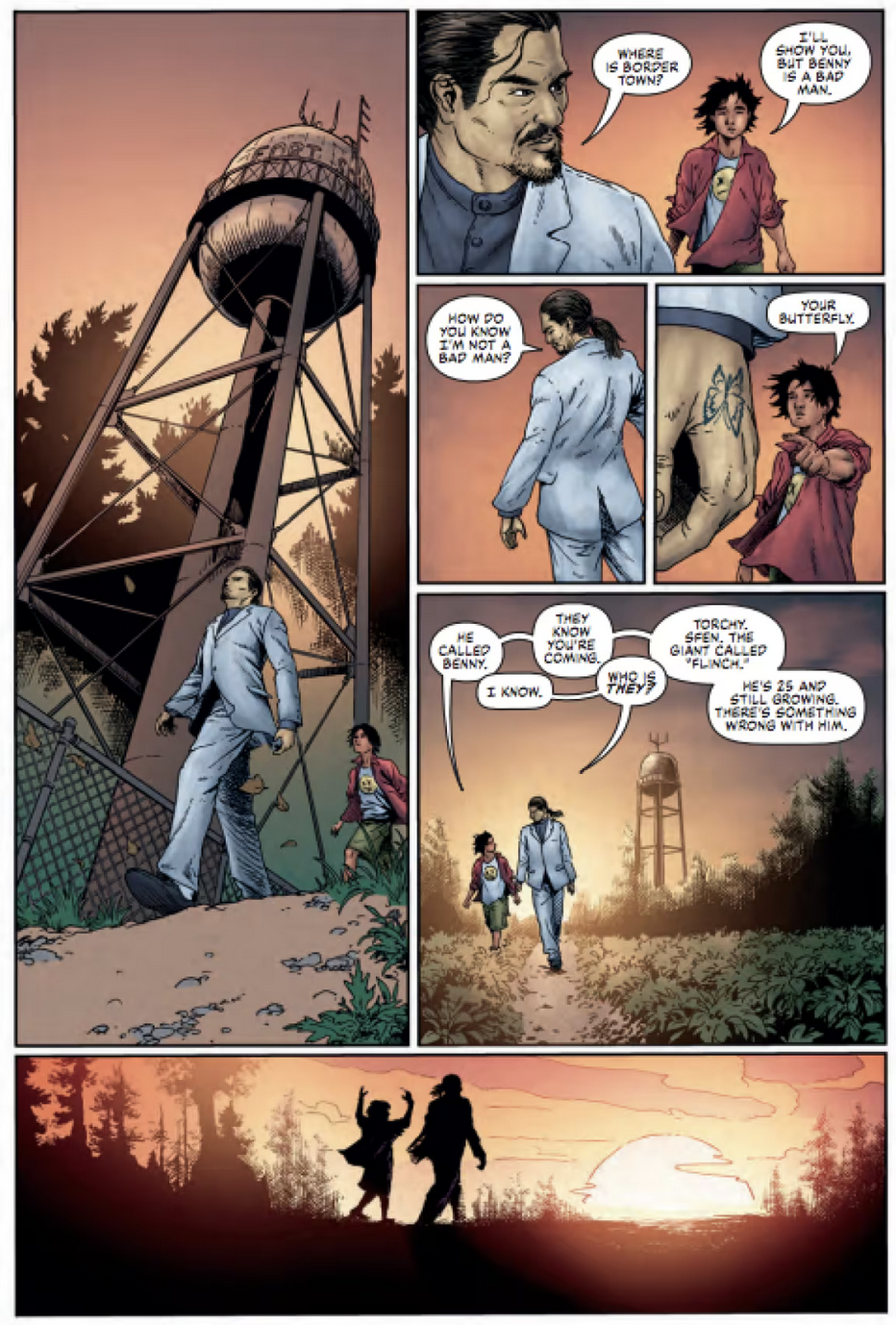
When Shinobu arrives in the Northwest Territories to reclaim his family's samurai armour housed at the Fort Smith museum, he learns that the sword has gone AWOL after Benny, the last museum manager, gambled it away. Sonny, a Tłı̨chÇ« Dene boy who was at the museum, offers to take Shinobu to Benny's residence, though Sonny warns that the man will undoubtedly be supported by a trio of thugs named Torchy, Sfen and Flinch. 
From A Blanket of Butterflies by Richard Van Camp, illus. by Scott B. Henderson, coloured by Donovan Yaciuk
Not surprising Shinobu is attacked and, though he valiantly defends himself, he is left almost dead. Sonny and some friends take the man to Sonny's grandmother's house. Though Shinobu's extensive tattoos  frighten Sonny's Ehtsi, she tends to his wounds. With Sonny's support for "the butterfly man"–because of his butterfly tats–and a visitation from the spirit of Sonny's sister, Sonny's grandmother wants to know more. Shinobu tells her he is from Nagasaki, Japan and she realizes the connection their people have with the Japanese linked to the atomic bombing of 1945. She relates this in terms of a powerful bird being fed black eggs and "a fire so bright it left only their shadows on what was left of their homes" (pg. 24).
From A Blanket of Butterflies by Richard Van Camp, illus. by Scott B. Henderson, coloured by Donovan Yaciuk
Shinobu tells them the story of the creation of the sword by his 2 times great grandfather and his need to reclaim it before the August full moon. Because that full moon was that very night, the three head out together to Benny's. Again they are set upon but Sonny's grandmother is a formidable woman whose words stop the thugs. And with words and memories, as well as a blanket for Benny, Sonny's Ehtsi finds a connection between the men and the opportunity for benevolence.
From A Blanket of Butterflies by Richard Van Camp, illus. by Scott B. Henderson, coloured by Donovan Yaciuk
Originally published in 2015, A Blanket of Butterflies has been reissued with full colour, additional background information and cultural context. Still the story is fresh as an intersection of two cultures, one Indigenous and the other Japanese, and how they connect both on a historical and a more personal level. Richard Van Camp, Tłı̨chÇ« Dene from Fort Smith NWT, has borrowed from his youth a story of an unlikely suit of samurai armour but he has developed it into a far greater story by asking a series of What If? questions. Sadly, how that suit was lost from a Japanese family is undoubtedly tied to the theft and seizure of the possessions of those interned. Still, Richard Van Camp doesn't emphasize that part of the story but rather the connections that both the Indigenous and Japanese communities have experienced through a history of loss and the substance of family. 

There is a darkness to this story because of that history and that loss. And that darkness comes through in Scott B. Henderson's illustrations, expertly coloured by Donovan Yaciuk. The artwork plays up the conflict that converts remarkably to connection both in its action, expression and colour.

The Spirit of Denendeh tells stories of the People of that land and A Blanket of Butterflies gives us glimpses into the natural and supernatural elements of those lives. I suspect that when Volume 2,  As I Enfold You in Petals, releases in April of this year, there will be another story from Denendeh, the Land of the People, again rooted in reality and upholding a legacy of kinship.

February 17, 2023

Arthur Who Wrote Sherlock

Written by Linda Bailey
Illustrated by Isabelle Follath
Tundra Books
978-0-7352-6925-5
56 pp.
Ages 5-9
2022

Many young readers will know the name Sherlock Holmes, probably from TV or movies, though perhaps more rarely from the books in which he stars, and I suspect fewer will know his creator, Sir Arthur Conan Doyle. Linda Bailey is sure to remedy that with her latest illustrated creative biography in Tundra's Who Wrote Classics series by shining a spotlight on the author and how Sherlock came to be.
From Arthur Who Wrote Sherlock by Linda Bailey, illus. by Isabelle Follath
From listening to stories told by his mother, learning to read and becoming a voracious reader, and then writing his first story at age 6, Arthur had a history of love for words and the magic they could create. That love of words would certainly help sustain him as his family dealt with poverty and a mentally ill father who turned to alcohol. When sent away to boarding school by his rich uncles, Arthur struggled with new challenges but could always rely on his storytelling to help him through. 
From Arthur Who Wrote Sherlock by Linda Bailey, illus. by Isabelle Follath
At 17, Arthur went to medical school where he became the assistant to the amazing Dr. Joseph Bell from whom he learned much about observation to aid in diagnosis. Throughout his studies he took on a variety of jobs to earn money. But these jobs, which included being a ship's medical officer, provided him with the adventures and anecdotes that would later feature in his stories. These would be important because, as Arthur struggled to establish a medical practice, he wrote. And, among all his writing endeavours, he created a detective based on his brilliant teacher, Dr. Bell. Though getting published was laborious, Arthur tweaked onto the idea of serializing Sherlock's stories and publishing them regularly in the same magazine to get readers excited and hooked. With that endeavour, Sherlock became a hit. 
From Arthur Who Wrote Sherlock by Linda Bailey, illus. by Isabelle Follath
Surprisingly, Sherlock was such a hit that readers were convinced he was real, and Arthur was left with no time for anything except Sherlock. Even when he resolved to kill off his detective, he was drawn back in by fans, and found a way to resurrect Sherlock and control what he chose to write, always with the aim of ensuring justice and fairness prevailed, whether in real life or in his stories.
 
Linda Bailey wanted to make Arthur the star of his story. Everyone knew and knows Sherlock Holmes, dubbed "the world's most famous man who never was" but Arthur Conan Doyle is a lesser character in his own story. Linda Bailey, though, makes him the lead in Arthur Who Wrote Sherlock, just as she did for Mary Shelley in her earlier book Mary Who Wrote Frankenstein (2018). Arthur is no longer the man behind the man. He is Arthur Conan Doyle and Sherlock comes from him; this is what Swiss illustrator Isabelle Follath depicts in the book's cover. But beyond highlighting the author of Sherlock, Linda Bailey tells us the story of Arthur Conan Doyle both around and beyond Sherlock. This is an illustrated biography and Linda Bailey makes sure to tell us everything of Conan Doyle's beginnings and trajectory to famous author. His story is full and what she doesn't tell us in the text she includes in an extensive "Author's Note" with references at the end of the book. There's lots to learn about the man and the writer and Linda Bailey makes sure that we know who wrote the stories of Sherlock Holmes.

Isabelle Follath's artwork, primarily in watercolour and pencil, play up the realism of a biography, though her depictions of the fancy of Conan Doyle's imagination allow for some whimsy and dramatic abandon from the tangible of a life of poverty, challenges, and work.

Young readers may learn a little bit more about Sherlock Holmes, but they will most definitely learn loads about Arthur Conan Doyle and understand better how he became the man who wrote Sherlock.