April 19, 2022

A Bend in the Breeze: Book discussion (online)

 Join author Valerie Sherrard
 

for a book discussion to launch 
her newest middle-grade novel
 
A Bend in the Breeze
 Written by Valerie Sherrard
DCB
978-1-77086-647-8
248 pp.
Ages 9-12
April 2022 
 

on April 21, 2022
 
2 - 3 PM (ET)
 
Hosted by Bobbie Henley,

this online event (via Zoom) is free 
and a great opportunity for young readers 
to connect with an award-winning Canadian author 
and hear about her newest book
 
Register at EventBrite here

April 18, 2022

A Bend in the Breeze

 
Written by Valerie Sherrard
DCB
978-1-77086-647-8
248 pp.
Ages 9-12
April 2022 
...there are things in this world that can only be seen by the innocent eyes of youth and by our friends in nature. (pg. 128)
You never know where a bend in the breeze can take you: here or there, away or to. And the bend in the breeze that transports 11-year-old Pascale Chardon to the island of TeJÉ might have done all those things.
 
The small island community of TeJΓ‰ had been established many, many years ago by a twin brother and sister who'd sought a place of peace and happiness. But, as in any community, small discourtesies, some impatiences and ingratitude crept into that goodness. The brother, before his passing, dreamed that a bend in the breeze would bring a stranger who would determine whether the future of the island's people held happiness or misery. So when Pascale, the first ever stranger on TeJΓ‰ appears, they suspect she is the Long Awaited, and anticipate her revelation after the requisite seventeen days on the island.  

Worried about her family and saddened by her predicament, Pascale tries to make the best of her situation. Accompanied by her companion beetle, Inch, Pascale sees much of the goodness of the island. There are her two new friends, Kenta Morningbay and Karuna Cloudwater, and the blind Mrs. Wintercreek with whom Pascale is sheltered. She's delighted with their outdoor school and begins to learn of the island traditions for Union Day (wedding) and addressing concerns to the three Elders at the Place of Matters. Though Pascale is grateful for much, below the surface she is grieving for her situation. This is not unlike the island with its emphasis on harmony but with underlying iniquities that could shatter its future. And then there's the mystery of her boat leaving a hole in the water where it had rested. It would seem there might be another element that will determine the futures of the island and Pascale.
 
TeJÉ may be a small community but it is a microcosm of those who are wise and those who are foolish, those who seek approval and those who seek attention, the kind, the mean, those who cannot see and even those who are blind and see perfectly. It may strive for harmony but, as it is populated by humans, it cannot be perfect. Dropped into this community, Pascale tries to see its goodness, even when unkindness is evident, remembering well what her mother always told her. "No one can be happy until they first learn to be grateful." (pg. 97) But this is a real community of people. And whether she's writing historical fiction like her award-winning The Glory Wind and Rain Shadow, novels in verse like Counting Back from Nine or contemporary stories like Birdspell and Driftwood, Valerie Sherrard always tells of real people who are strong and vulnerable, confused and steadfast, and living with circumstances with which young readers can often relate. Though A Bend in the Breeze takes those readers to a secluded island via a stranded and unaccompanied child, circumstances which undoubtedly none have experienced, Valerie Sherrard does bring them to a relatable story. There's a child who feels alone and wishes to be with her family. There's a community that strives for harmony but includes a veneer of conflict. There is companionship with friends and animals, questioning about self, people and circumstances, and there is uncertainty. This is childhood for many. Thankfully, Valerie Sherrard also resolves Pascale's story. It might be unexpected but it is wrap that readers will appreciate.

Think of A Bend in the Breeze as The Little Prince meets Island of the Blue Dolphins in that a child is stranded on an island, away from family, and learns and imparts lessons about compassion, acceptance, and gratitude. It's also about forgiveness and hope. Big lessons on a small island. That's where A Bend in the Breeze will take young readers.
 
🏝🏝🏝🏝🏝

See my next post about a free online book discussion
 this Thursday, April 21, 2022 
with author Valerie Sherrard about A Bend in the Breeze.

🏝🏝🏝🏝🏝

April 13, 2022

Sing in the Spring!

Written by Sheree Fitch
Art by Deb Plestid
Nimbus Publishing
978-1-77471-039-5
32 pp.
Ages 3-7
March 2022

Though spring officially hit the calendar last month, we know the unpredictability of April, a month in which snowstorms can follow on the heels of mild temperatures and budding snowdrops and croci are challenged with fickle weather. In fact, as I look out my open windows and enjoy a light breeze of 17oC weather, Manitoba and northern Ontario are bracing for a snow storm of epic proportions. So, let's let Sheree Fitch's verses help transition all of us from winter when...
There's a secret hush of magic 
when winter lingers on,
when our garden patch
is still a quilt of white.
And with the real quilts of Deb Plestid's fabric art, the transition to spring and rains and flowers, birds and butterflies is well-serenaded.
From Sing in the Spring! by Sheree Fitch, art by Deb Plestid
While the days are getting longer, a child still enjoys a winter of tracks in the snow and snowshoeing with their father. There may still be storms and power outages, fires and mittens, but they know what is coming. From the roots growing beneath the surface and insects and more resting, perhaps even dreaming, the onset of spring is anticipated.  And then it starts.
The frozen river cracks
and groans
like a giant's belly rumbles
like a thunder god who grumbles
Fee-fi-fo-fum!
From Sing in the Spring! by Sheree Fitch, art by Deb Plestid
The awakening is seen and heard. There's a dance of movement, as asparagus tips push upwards and leaves unfurl, and of song, with dripping rain–Spring rain's garden fairies weeping happy tears–and peepers peeping. The shift from winter to spring is both slow and fast, like a ballad that is both lullaby and swing, soft and cacophonous. And when it has finally arrived, it is...
SPRING!
heart sparkly
gold glittery
glad shimmery
LIGHT
on
EVERYTHING!
Sheree Fitch's words have always sparkled with insight and heart. She feels and she shares, sometimes with humour, sometimes with poignancy. With her words, Sheree Fitch has created music that carries young readers of her free verse along in that transformation from winter season to spring. No matter where they are in our country, children will recognize elements that define the seasons for them, though some may present themselves earlier or later. They'll be looking for plants and insects outdoors but also in the quilted art of Deb Plestid. Her fabric art is astounding. She gives such texture through her choice of fabrics, colours, stitching and patterns. Not only can Deb Plestid depict natural elements authentically, she installs them in rivers that are cold, leaf litter that is expectant, and skies that are alive. As Sheree Fitch brings song into spring with her words, Deb Plestid does so with quilted art.
From Sing in the Spring! by Sheree Fitch, art by Deb Plestid
Whether this month or next, I can surely see Sheree Fitch dancing with her arms raised high as fiddleheads emerge and the hummingbirds arrive and Deb Plestid stitching tableaux of the natural world as she captures each new shift and development. The coming of spring has never been so lyrical and bright.

April 11, 2022

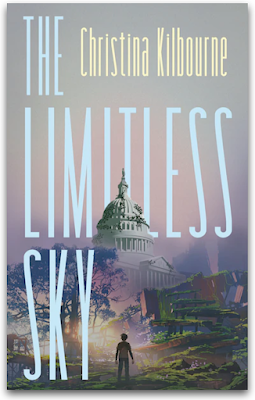
The Limitless Sky

Written by Christina Kilbourne
Dundurn
978-1-45974-887-3
384 pp.
Ages 12+
May 2022

They may be living in the same world, but Rook and Gage don't know it. 
 
Rook lives with her family in ArHK whose descendants, the Chosen Ones, had left the Outside hundreds of OT (Outside Time) years ago. In ArHK where she lives with her father and mother and young sister Sparrow in their pod on the Knowledge Level, one of four levels in ArHK, Rook is destined to be a Keeper, running the Archives and monitoring the Great Hall of Human Records, as is her family's heritage. 

Fifteen-year-old Gage lives with his parents, younger sister Brindle and dog Scruff in a yurt at a scouts' base camp. Organized by the Scholars, scouts have been going out for generations to find the Ship of Knowledge purportedly in the ancient city of Washington. When Chief Coil's map readers believe they are at the gateway to that city, Gage volunteers to join the scouting expedition as a Reader to assist his father and others in looking for artefacts and old structures that might reveal the ancients' knowledge of curing diseases, harnessing power and communication over vast distances.

During her regular assignments and exploratory days at the Archives, Rook delves into restricted files and starts piecing ArHK's history, much of which was buried by the Governors and for which her Grandmam had been exiled to the Growing Sector. Meanwhile, just as Rook is coming to some startling revelations, Gage is making his own discovery and one that will bring their two worlds together, even if at a distance.

Christina Kilbourne has not just created one new world; she has created two. Both are borne out of poisonous air, fires, floods and winds, with one world escaping into a newly-manufactured one and the other surviving in what is left behind. Though readers will be hopeful that the two worlds, those of Rook and Gage, will ultimately come together so that they might become whole again, Christina Kilbourne does not guarantee anything. She shows us alternatives of what our world might be like after climatic change has altered our landscapes and societies and offers an opportunity to see how power can corrupt, how progress can be a setback, and how inspiration may come from our youth. How limited our world is comes down to us.

Dystopian novels have always offered us a mix of angst and aspiration, and The Limitless Sky does just this. In a gritty read that will work for middle-grade readers as well as teens, The Limitless Sky begins a new story for a future that may or may not be. And, as this is first book in the potential trilogy, it's a future I'm looking forward to reading about.

April 08, 2022

West Coast Wild ABC

Written by Deborah Hodge
Illustrated by Karen Reczuch
Groundwood Books
978-1-773066219
26 pp.
Ages 0-3
May 2022
 
Concept books are valuable vehicles for teaching concepts like the alphabet. But most become dreary listings of themed objects, especially for the very young, that trudge through 26 letters without any heart or atmosphere.  Deborah Hodge and Karen Reczuch's West Coast Wild ABC does not belong with those humdrum tomes. This board book has substance in both the content of its words and art, being both relevant culturally, ecologically and geographically.

From West Coast Wild ABC by Deborah Hodge, illus. by Karen Reczuch

For children who live on the West Coast, West Coast Wild ABC will engage them with familiar words and images, taking them through natural landscapes of forests, shorelines and water. There are fish and eagles, sandpipers and whales. There are plants like huckleberries and kelp, weather of rain and sunshine, and geographical features like the Pacific Ocean and phenomena like tides.
From West Coast Wild ABC by Deborah Hodge, illus. by Karen Reczuch

And, with everything, there is activity. There is shimmering and clinging, roaring and stinging, swishing and drifting. Even with elements that are relatively static like plants, there is towering and ripening. Life is happening on the West Coast and Deborah Hodge has seen it and Karen Reczuch has illustrated it.
From West Coast Wild ABC by Deborah Hodge, illus. by Karen Reczuch
The collaboration between Deborah Hodge and Karen Reczuch has helped young readers across our country visit the Pacific coast in earlier books in the West Coast Wild series: West Coast Wild, West Coast Wild Babies, and West Coast Wild at Low Tide. As with the others, the landscape of the picture book is the West Coast but it goes beyond space and presents a strong STEM foundation in ecology. Living things and their relationships with their environment and each other are paramount, as is ensuring they remain healthy and flourishing, as evidenced by the life they display in West Coast Wild ABC. Deborah Hodge may use few words–only two or three for each letter except the concluding "z"–but she spotlights each letter appropriately for our youngest children. A noun and a verb is all it takes for each to represent the West Coast properly and teach the alphabet. Similarly, Karen Reczuch may have illustrated each alphabet letter's page with simplicity in mind of her audience but she gives us the detail and realism that takes us to those shores and into the water and forest. I didn't know what a velella velella was before West Coast Wild ABC but Karen Reczuch depicts the morphology of the sail jellyfish, as well as the quillback rockfish, cougar, xiphister and others, so well that it becomes recognizable, and, by giving each living thing context, from a nest or tidal, Karen Reczuch also gives teachers and parents the basis for STEM lessons.

If you live on the West Coast, then West Coast Wild ABC will be almost a guidebook for young children with a opportunity for learning the alphabet by making connections to home. And if you don't live on the Pacific side of our country, West Coast Wild ABC lets you visit vicariously and open discussions about new places and the similarities and differences that come with a rich diversity of environments.

April 05, 2022

The Red Palace

Written by June Hur
Feiwel and Friends
978-1-250-80055-8
336 pp.
Ages 13-18
January 2022
Revenge begets revenge; the anger is unquenchable. We become the monsters we are trying to punish. Justice, however, brings closure, and that is what I want. It can only be achieved by remaining sober-minded and rational. (pg. 173)
It is 1758, and eighteen-year-old Baek-hyeon is a nurse (uniyeo) at Changdeok Palace, a position for which she has worked tirelessly in her efforts to gain the attention of her biological father, Lord Shin, and appreciation of her mother, one of his oft-neglected concubines. But the palace is a place of spies, secrets, and worse, and Hyeon learns first-hand to keep her counsel when she and her friend Nurse Jieun and a royal physician are called to the Crown Prince's chambers to participate in a charade of caring for Prince Jangheon who is AWOL. But then the nurses are alerted to a massacre at the Hyeminseo, the public medical office where Hyeon had studied to become a nurse. Two student nurses, Head Nurse Heejin and Court Lady Ahnbi, who served Madam Mun, the King's concubine, have all been violently murdered and Hyeon's mentor, Nurse Jeongsu, is Commander Song's prime suspect.
 
Hyeon vows to prove Nurse Jeongsu's innocence, even as Commander Song endeavours to torture a confession from her. It seems someone else thinks the same, peppering the capital with handbills declaring the Crown Prince to be a murderer. Undertaking her own investigation, speaking with several nurses including Nurse Inyeong who'd reported the murders, with Royal Physician Khun who'd been seen arguing with Court Lady Ahnbi, and with Sulbi, a damo working for the police bureau, Hyeon forms an unlikely alliance with the young Police Inspector Seo whom she believes at first is only Eojin, a police servant. Together, the two young people work to uncover lies and truths, protect the innocent, thwart injustice and develop a relationship deemed socially improbable.

The Joseon dynasty which ruled Korea from the 1300s to the 1800s is not a familiar one for this reviewer or many readers. But June Hur skillfully takes us to this era and its society of classes ranging from royalty and the nobility to the cheonmin (vulgar commoners). It is a time when men kept concubines, sons were revered over daughters, and Confucian ideals were followed. From the clothing which marks the roles and status of many, like the nurse uniform of pale blue silk jacket and dark blue skirt and white apron with garima headpiece,  and meals of gukbap and sullungang, to naming protocols, June Hur makes us believe in this reality, with these people and these histories. Her "Author's Note" reveals the true history which she incorporated into her story but her characters and the mystery to be solved are all her own, intricate and vivid. As with her earlier books, The Silence of Bones (2020) and The Forest of Stolen Girls (2021), June Hur tells a story but readers do more than just absorb it. They become invested in it. Even as I learned of a different culture, I wanted justice for the honourable Hyeon, for the victims of violence, and for women who were limited by their birth. I wanted resolution. And, with tenderness, compassion and honesty to time and place, June Hur eloquently gives readers that.

March 30, 2022

Josie's Busy Calendar

Written by Jenn Wint
Illustrated by Allison Arndt
East 26th Publishing
978-1-955077323
42 pp.
Ages 3-7
October 2021
 
Like many children in Canada, Josie has had to endure the challenge of staying at home and away from school and friends and activities that have always added to her life. She has found many things to do, from creating art to running laps, watching TV to baking, but she misses her old life.
But, after weeks of playing on her own, Josie was officially lonely.
From Josie's Busy Calendar by Jenn Wint, illus. by Allison Arndt
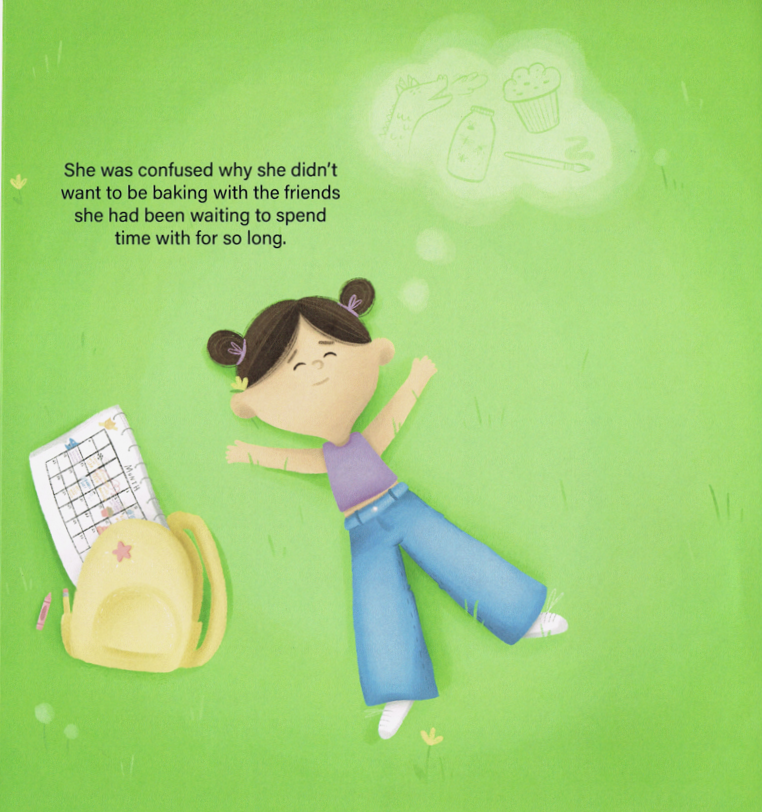
But, then things open up again and Josie is able to return to school. The little girl is thrilled. Once she reconnects with her friends, she is filling her calendar with play dates for soccer and baking, riding bikes and swimming. But, like anything, too much of a good thing can be just as onerous, and Josie finds that "her tummy was in knots" though she doesn't understand why.
From Josie's Busy Calendar by Jenn Wint, illus. by Allison Arndt
Realizing that she misses her alone time, Josie schedules herself into that calendar and finds that a balance of commitments to others and herself is what makes her feel calm enough to do it all.
From Josie's Busy Calendar by Jenn Wint, illus. by Allison Arndt
Vancouver's Jenn Wint knows that, like adults such as herself, children experience anxiety but probably don't understand it, and coming out of this pandemic–fingers crossed–there will be many children who have and will experience anxiety to some degree. After years of restricted social activities–a source of anxiety for some–many children will go overboard and want to do everything: sports, music, play, etc. But, if Josie’s Busy Calendar teaches us anything it’s that there is always a limit. Too little opportunity for interaction and activity is just as bad as too much. Down time is also important. In fact, for many, it’s the only means by which they can recharge to do those activities in the first place. 
From Josie's Busy Calendar by Jenn Wint, illus. by Allison Arndt
With Allison Arndt's whimsical illustrations, Josie comes across as a typical child whose life is filled with people and activities but who has learned to appreciate quiet time, whether it's for reflection, for the clean fun of bubble baths or creating art. So, for your children and your students, consider that busy calendar as a potential source of both fatigue and fun and schedule in some time for quiet, whether to look inward with self-reflection or to daydream about what could be.