February 23, 2015

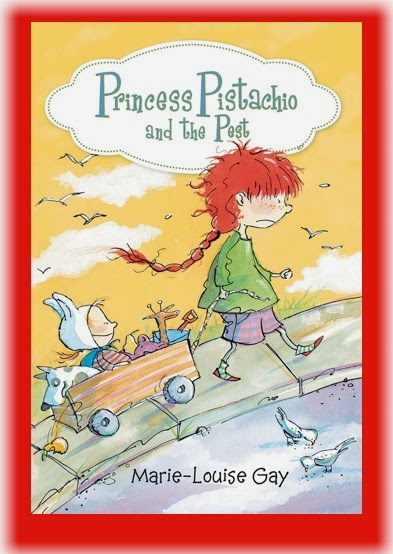
Princess Pistachio and the Pest

by Marie-Louise Gay
Translated by Jacob Homel
Pajama Press
978-1-927485-73-6
48 pp.
Ages 5-8
For release March, 2015

Pistachio Shoelace may have been disappointed when she learned the true nature of her royal status, or lack thereof, in Princess Pistachio (Pajama Press, 2014) but the little red-haired wonder of Marie-Louise Gay's newest series has unforeseen challenges to address in her second adventure, Princess Pistachio and the Pest.  And we're so delighted to share in it with her.

Waking up from a horrible school dream in which she is humiliated when she can't answer a simple addition problem, Pistachio is thrilled to realize it's the first day of summer vacation.  She's ready for adventures with her friends Madeline and Chichi exploring a local cavern. But "Pistachio's heart falls to her belly button" (pg. 12) when her mother instructs her to take her baby sister Penny to the park.

Dragging a wagon loaded with Penny, a tower of toys and the hidden dog, Pistachio continues to daydream about exploring the cavern and what she might find.  Meanwhile, Penny dressed in her rabbit-ear hat and Superman cape, proclaims herself to be Super-Rabbit and repeatedly demonstrates that her super-powers are of the unorthodox kind: pilfering fruit from Mr. Pomodoro's grocery stand; climbing up on a wall and falling into Mrs. Oldtooth's garden; and scavenging treasure from the park's fountain.  Unfortunately, Pistachio is taken as responsible for Penny's misdeeds.

Courtesy of her baby sister, Pistachio is never bored and, upon returning home, realizes that there are worse ways to spend a day than babysitting Penny.  But, it's Pistachio herself, with her imaginative daydreams to compensate for missed adventures and with her reactive diatribes to unexpected turns of events, who makes the day eventful.  Her fiery temper may share each disappointment but it's her exuberance for life that mitigates any annoyances the readers may have about her exasperation.  After all, it was the first day of summer holidays and Pistachio's mother knew to use her "maple syrup tone" (pg. 12) to attempt to sway her daughter.  I suspect the girls' mother, with her own fiery red
hair and foxy twinkle, knows well enough what Pistachio feels.  And luckily, Pistachio may feel many things–embarrassment, disappointment, irritation, fear, inspiration–but never boredom.  

Again, Marie-Louise Gay takes our Pippi-Longstocking-esque young character and places her in classic childhood scenarios to which Pistachio must adapt.  Babysitting younger brothers and sisters during summer vacation is not uncommon for children.  But by taking Pistachio into a neighbourhood of colourful people, diverse friends, and lively interactions, young readers may find the means to endure, even enjoy, surprises that arise during the crazy, lazy days of summer when anything can happen, as it does in Princess Pistachio and the Pest.

February 22, 2015

Switch

by Douglas Davey
Red Deer Press
978-0-88995-524-0
252 pp.
Ages 15+
2014

Back in 1988, when Sheldon Bates was seventeen, a confusing encounter during swimming practice sets him asking big questions about his sexuality. Now, through his personal notes from the time, footnoted with his current thoughts, Sheldon records that tumultuous year of discovery, fear, discomfiture, bullying, and understanding in Switch.

Though dating Jenny, to whom he is wildly attracted, Sheldon conducts a little experiment and some research, hoping to clarify for himself what he is feeling. His wish, "Please, please, please let me not be gay..." (pg. 22), suggests his ensuing stress and incomprehension, not surprising in a time when discussions of sexual orientation were verboten and information limited to a dictionary and a thesaurus. And, if he can't understand it, how will Jenny, best friend Dan or older brother Bill react? Sadly, not as he expects, and his personal issue becomes fodder for school gossip and verbal and physical abuse.
I ate. I slept. I went to class. I watched TV. I looked like I was awake but in fact I was sleepwalking through life with no clue how to wake up or get out. After a while, the terrible flow of days became a gray smear. (pg. 79)
Two things change everything. First, Sheldon is invited to join several other students at lunch in Room 115. There in Mr. Aiden's classroom, Sheldon feels safe. He can access a cupboard of relevant informational books and pamphlets. He can also choose to interact with a handful of students grappling with their own sexuality. Secondly, his English teacher, Mrs. Piedmont, assigns her students speeches, and Sheldon thinks about focusing on what he's going through as a possible topic. That decision will bring Sheldon both tragedy and deliverance.

I, for one, would never want to return to my high school years. Even without the aggravation of questioning your sexual orientation, teens have so much with which they must deal: puberty, body image, independence, career choices, responsibility. And not every teen has resources available to help them navigate those complicated treks. In the late 1980s, with no internet, with the AIDS crisis, and the secrecy virtually mandated by societal discrimination, the topic of bisexuality was still taboo, and kids like Sheldon would inevitably be left floundering for support. How he was able to survive, emotionally and physically, is both remarkable and gratifying. Douglas Davey, who was able to evoke that same trepidation and confusion in M in the Abstract (Red Deer Press, 2013), keeps readers repeatedly wondering how Sheldon will address his latest dilemma, or whether he will expose himself to more abuse by speaking publicly of his bisexuality, or when he will ask for the support of the school's administration or his parents. It is hard to believe the youthful Douglas Davey could present the 1980s of Sheldon's story so completely but that grey haze of being exposed to public scrutiny and discrimination is subtly exposed as a sign of the times and hopefully one that efforts have been made to rewrite.

Switch should belong in the 2015 version of Mr. Aiden's cupboard or, better yet, in high school libraries where everyone and anyone, regardless of sexual orientation, could share in the emotional turmoil of Sheldon Bates. Douglas Davey is providing us with the insight that, with greater awareness, could help us become more empathetic to those struggling with issues of sexual orientation. Let's hope we all accept Switch as that tool for learning.

February 19, 2015

Hexed

by Michelle Krys
Doubleday Canada
978-0385680509
384 pp.
Ages 14+
2014

Other than her best friend, Bianca, acting like a tyrannical cheer captain, and her Wicca-practising mom always droning on about protecting the Witch Hunter's Bible, and geeky neighbour Paige Abernathy constantly trying to re-establish their former friendship, Indigo Blackwood could be any sixteen-year-old teen.  That is, until a guy in leather–unusual in the heat of L.A.–starts showing up around her, laughing at her, making odd comments, and starting to cause her some concern.

When the Witch Hunter's Bible is stolen, Indie seeks out this handsome young man, who calls himself Bishop, sure that he is responsible for its disappearance.  With a twist of fate that has her reconnecting with trustworthy Paige, Indie learns that she may be a witch, that a group of sorcerers called the Priory are after the Bible in order to wield power over witches, and that Bishop has been sent by the Family–the governing body of witches–to help Indigo.

That hardly covers the breadth of supernatural goings-on: Bishop's warlock nature and ability to fly; the cruelty of the sorcerers; the twistedness of their mind-erasing; and Indie's own dabblings with her new powers.  Of course, there are also the normal teen issues of striving for popularity; balancing new friends, old friends, non-friends and exes; following school rules and parent rules; and worrying about making good decisions or not worrying about poor decisions.

Hexed is high school drama with witches and magic.  The high school scenes are generally banal, focusing on cheer-leading, football and lunchroom antics, all immersed in malicious gossip and spiteful stunts.  And Indie is shallow and oblivious to her own rudeness, undeserving of those whom she attracts.  But when the horrific Priory gets involved and start having an impact on her life and those around her, and Bishop and his ex Jezebel throw themselves into the fray, Hexed takes on a new dimension or two.  Michelle Krys is able to rescue a typical mean girls storyline and boy-meets-girl romance with the addition of surprisingly imaginative scenarios and magical powers, and the Bishop-Indie relationship becomes more than just predictable.  There are still some unknowns to be revealed, particularly about Bishop, about a frightening new character presented at the conclusion of Hexed, and about the elusive Witch Hunter's Bible, and these will serve to draw young adult readers to the next book in The Witch Hunter series.

~~~~~~~~~~~~~~~~~~~~~~~~
Charmed, The Witch Hunter Book 2 (978-0-385743396), is due out in May, 2015.

February 17, 2015

Gypsy's Fortune

by Caroline Stellings
Peanut Butter Press
978-1-927735-07-7
32 pp.
Ages 4-8
November, 2014

On February 19, 2015, millions around the world will be celebrating Chinese New Year and I can't think of a sweeter new book to herald it in than Caroline Stellings' first picture book, Gypsy's Fortune.  As unimposing as the author-artist herself–her previous books include The Contest (Second Story Press,  2009) and The Manager (Cape Breton University Press, 2013)–Gypsy's Fortune shares clever messages about resilience and friendship, while offering a creative history regarding the origins of the fortune cookie.

Though she lives as a vagabond and sleeps beneath the stars, the ever-cheerful Gypsy, a "palm-reading, crystal-gazing, fortune-telling cat" (pg. 6), has managed to eke out a living in 1920s San Francisco. But the election of a new mayor who denies Gypsy and other fortune-tellers the right to charge for their services has our feline scurrying for alternate employment, but unsuccessfully.  It is only when Gypsy offers to wash dishes at Wu's Restaurant and instead shares a meal with Mr. Wu that her luck changes.

Discreetly reading his tea-leaves, Gypsy realizes Mr. Wu should not be selling his restaurant as he intends and finds a way to share this "fortune" with him.  With a new marketing strategy, the two establish a friendly partnership to woo new customers and provide Gypsy with employment.

Caroline Stellings' watercolour illustrations lend an ethereal quality to Gypsy's Fortune, wholly appropriate for Gypsy's spiritual endeavours and light-heartedness.  Wide bands of subtle shading crisscross the illustrations and enhance the jaunty nature of the time and Gypsy herself.  Though the colour reproduction of the book cover does not do justice to the artwork within, Gypsy's Fortune is filled with paintings in colourful but pale hues depicting Gypsy's endeavours and fortune cookies with messages.

Just as one fortune cookie's message reads, "The long road is often the shortest path to the correct destination" (pg. 6), I believe Caroline Stellings is heading in the right direction and, with Gypsy's Fortune, I hope her destination is better secured.

February 15, 2015

Clover's Luck: Magical Animal Adoption Agency, Book 1


by Kallie George
Illustrated by Alexandra Boiger
HarperCollins
978-1-44341-980-2
144 pp.
Ages 7-10
For release February 2015 
Reviewed from Advance Reading Copy


Though Clover believes wholeheartedly in luck, she feels that all hers is bad. For example, her best friend Emma gets a last-minute opening at summer-long pony camp, but not Clover. Then, while Clover plays with her new pet canary Penny, a baseball breaks the window, allowing the bird to escape. Clover gives chase ending up in The Woods (“where wee beasties play”), where she spots a notice asking for volunteers at an animal adoption agency. Unlucky or not, Clover is hopeful that this could be her opportunity to spend time with animals and do something worthwhile too.


Though reluctant, Mr. Jams at the M.A.A.A. (Magical Animal Adoption Agency) accepts Clover’s offer to volunteer, introducing her to the animals currently up for adoption, including Esmeralda, a cursed toad; five fairy horses; two fire salamanders; a baby dragon; and half a dozen unicorns. When Mr. Jams leaves Clover in charge for several days, Clover realizes that her bad luck is nothing compared to that of these special animals who’d already been abandoned or mistreated. It would be up to her to care for Esmeralda, Snort, Moondrop and the others, and ensure that only good-hearted people are allowed to adopt them.


While the title of this new series may be suggestive of a vacuous series devised to ride to commercial success on fantasy animals, Kallie George has proven once again that she has a stronger mandate. Like her picture books, Spark and Flare (Simply Read Books) and early reader The Melancholic Mermaid (Simply Read Books), Clover’s Luck promotes a positive message about self-acceptance and compassion wrapped in a charming story with an odd assortment of magical creatures. With Books 2 and 3 already slated for later in 2015 and 2016 respectively, readers will have plenty of time to embrace their inner magic and look forward to enchantment of the literary and imaginary kind.


(A version of this review was originally written for and published in Quill & Quire, as noted in the citation below.)


Kubiw, H. (2015, March). [Review of the book Magical Animal Adoption Agency: Clover's Luck, by Kallie George]. Quill & Quire, 81 (2): 35.

February 12, 2015

Tank and Fizz: The Case of the Slime Stampede

by Liam O’Donnell
Illustrated by Mike Deas
Orca Book Publishers
978-1-459808102
152 pp. 
Ages 8-11
For release March, 2015 
Reviewed from advance reading copy

Slick City in Rockfall Mountain is a quirky community comprised of ogres, trolls, goblins and other monsters. Named for the goop that is dredged from the bottom of Fang Harbor, Slick City is a hub of technological and engineering development. But Mr. Snag, Gravelmuck Elementary’s ogre custodian, still relies on cleaning slimes in his job, having been appropriately licensed to do so. When his slimes are somehow released and run amok, Mr. Snag is arrested and eight-legged Principal Weaver promptly hires the suspicious Mr. Zallin, a monster who uses alternate cleaning methods. Convinced that Mr. Snag is innocent, two fourth-graders, goblin Fizz Marlow and troll Tank Wrenchlin, put their detection and engineering skills to work to determine the true culprit.

Author of Owl Magazine’s Max Finder mysteries, Liam O’Donnell knows how to weave the typical elements of detective stories such as multiple plot lines, red herrings and the usual suspects. But, with the addition of graphics by illustrator Mike Deas, with whom O’Donnell has created six books in Orca’s Graphic Guide Adventure series, The Case of the Slime Stampede is escalated from just middle-grade mystery or graphic novel to a clever amalgam. The graphics, both comics integral to the story’s progression and supplementary illustrations, complement the uproarious text. From the first line (“The principal’s car got eaten first”) and dialogue (“Smart detectives always listen to their tails”) to setting details (“The rest of the day dragged like a legless zombie tied to a dump truck”), readers will be entertained and anxious to solve the mystery. While the story could be an allegory about progress and reliance on limited resources, or even a tale of discrimination, The Case of the Slime Stampede is actually a monstrously imaginative and funny read that launches a great new series.


(A version of this review was originally written for and published in Quill & Quire, as noted in the citation below.)

Kubiw, H. (2015, March). [Review of the book Tank and Fizz: The Case of the Slime Stampede, by Liam O'Donnell]. Quill & Quire, 81 (2): 34.

February 10, 2015

Best Friends Through Eternity

by Sylvia McNicoll
Tundra Books
978-1-77049-710-8 
192 pp.
Ages 12+
For release February 10, 2015

Most of us dream of the opportunity for a do-over after we've messed up something big.  The regret and/or guilt can be overwhelming.  But what if a do-over was possible but you'd have to be careful not to make matters worse.  Would you do it?  What if you thought you had nothing to lose because you were already dead?

Fourteen-year-old Paige Barta is willing to take that chance after she is killed by a train walking home from school, believing she should have been trying to help her best friend Jasmine (Jazz).  Jazz had been off with her new boyfriend, Cameron, unaware that Cameron's ex, the vicious Vanessa, was plotting an attack. Angrily taking off when she should have been waiting for Jazz,  Paige finds herself laying in a hospital bed, unconscious and dying.  But meeting up on an after-life beach with a childhood friend, Kim, who'd been adopted from China as was Paige, gives the teen the chance for a retake of the past week.

So now Paige has to rethink everything she has said and done, knowing this is her chance to make things right, without letting on that she's going to die or that she knows about the future attack on Jazz.  However, Paige is also rethinking her attitudes about her adoption, about her parents, about Kim's death of which she'd been unaware, about the friendly Max Liu, and even about her food choices.  Being given the chance to make different choices, however, doesn't mean those choices are necessarily better, and Paige learns that sometimes, no matter what, you can't control everything.

Though life-and-death do-overs (is there an actual term for this?) have been popularized in movies and in TV shows, it's a tough one to do well in text, especially for young people for whom the idea of death is often completely unimaginable.  Sylvia McNicoll has shown that she has a knack for writing great teen voices and a strong record for bringing the issue of death into the realm of youth, having made it a focus in books such as crush.candy.corpse (Lorimer, 2012), Dying to Go Viral (Fitzhenry & Whiteside, 2013) and Revenge on the Fly (Pajama Press, 2014). But the focus is not on the morbid but the life lead and the choices made for purposeful lives. Although Paige is shocked to learn she is dying and that Kim has died and that others may die as a result of her actions, her focus remains on choices made with compassion rather than anger and bitterness.  It's a lesson we could all learn.  Too bad Paige–and probably everyone who has ever lived–doesn't learn this lesson until it's too late.  Fortunately, in Best Friends Through EternitySylvia McNicoll gives Paige another chance to show us how it's done.

~ ~ ~ ~ ~ ~ ~ ~ ~ ~ ~ ~ ~ ~ ~ ~ ~ ~ ~ ~ ~ ~ ~ ~ ~

If you get the chance, check out the book launch for Best Friends Through Eternity, this weekend in Burlington, Ontario. Sylvia McNicoll puts on a great book launch!