July 30, 2023

A Flower is a Friend

Written by Frieda Wishinsky
Illustrated by Karen Patkau
Pajama Press
978-1-77278-280-6
36 pp.
Ages 3-6
May 2023

Many will be enjoying their gardens this summer whether through their labours or just sitting in the glory that is a collection of blooms and greenery. But Frieda Wishinsky makes us look a little more closely into her garden to see the flowers and their friends.
From A Flower is a Friend, written by Frieda Wishinsky, illus. by Karen Patkau
Page after page of glorious digital art by Karen Patkau brings us up close to the rose and zinnia, cornflower, magnolia, and irises to see the blooms in their bold colours and their dazzling forms. But it's the association with their flower friends that needs to be seen. With each blossom is an insect or a bird, mammal or reptile, or something else, that interacts with the flower.
From A Flower is a Friend, written by Frieda Wishinsky, illus. by Karen Patkau
Frieda Wishinsky and Karen Patkau reveal a variety of mutualistic relationships, with Frieda Wishinsky giving us the ideas and spirit and Karen Patkau giving us the colour and form. There is the periwinkle-hued morning glory with its visiting dragonfly, the mouse in a tulip, and a bat calling upon the crocuses. And in her dual text, one that stipulates what the flowers do and a subtext that has young readers ponder the relationships, Frieda Wishinsky invites children to look more closely and consider how pollination happens, how a flower can draw animals to it, and how both plant and animal can benefit each other.

Spread our perfume.
 
How could a spider 
help the Queen of the Night flower?
 

From A Flower is a Friend, written by Frieda Wishinsky, illus. by Karen Patkau
A Flower is a Friend will be a lovely book for teaching STEM with regards to the growth and changes in plants and the interrelationships of living things. Even though the story is appended with notes on each animal and its role related to the plants, it's the inquiry lessons about these interactions that will fuel discussions and learning.

Coupled with Karen Patkau's illustrations, A Flower is a Friend transforms from creative non-fiction to gorgeous coffee table book that any reader would love to peruse. Her art is created of shapes so curvaceous and colours so vibrant that the garden could be a surreal landscape of the imagination. But Karen Patkau is such a pro at digital illustration that her flowers could almost be photographs. (Her art of the roses almost fooled me into thinking it was a photo.)
 
We know friendships go both ways, and these flowers and their friends demonstrate that they do, helping each other to the benefit of both. There is science behind it, but A Flower is a Friend shows us that there is also great beauty with that science.

July 28, 2023

Nutshimit: In the Woods

Written by Melissa Mollen Dupuis
Illustrated by Elise Gravel
English text by Gaëlle Mollen
North Winds Press (Scholastic Canada)
978-1-0397-0180-9
88 pp.
Ages 6-8
August 2023 
 
Told in the first-person perspective of Melissa–author Melissa Mollen DupuisNutshimit: In the Woods is an introduction to the natural world of the forest as seen through her Innu eyes. She relates how she experiences the forest, activating all her senses and thus taking a "forest bath."
 
From Nutshimit: In the Woods, written by Melissa Mollen Dupuis, illus. by Elise Gravel
Melissa teaches about the different types of forests based on the composition of trees, their ages and more, but also recognizes that forests are communities that include other species and elements like fungi, rocks and people. As such, the bulk of Nutshimit: In the Woods is an exploration of forest elements that are important to Innu culture. From the birch tree and its uses for baskets, canoes and biting art to the wolverine, called kuekuatsheu, a trickster important in Innu stories, Melissa Mollen Dupuis describes forest elements as they appear, as they relate to the Innu and what they mean for the environment. Young readers will learn about the sugar maple tree (upueiashkᵘ), lichen (uipatsheushkamikᵘ), the goose (nishk) and other birds and land and marine animals, as well as weather elements like winter (pipun) and snow (kun). Melissa Mollen Dupuis isn't just stating the facts that could be in any non-fiction book about forests; she's finding the heart of forest communities for what they are, what they offer and what we need to know to ensure their continuation.  At 88 pages, Nutshimit: In the Woods is beyond a picture book story and more of a reflective compendium that teaches, illustrates and entertains.
From Nutshimit: In the Woods, written by Melissa Mollen Dupuis, illus. by Elise Gravel
With procedurals for making maple syrup, braiding sweetgrass and cooking bannock, Melissa Mollen Dupuis also takes young readers from the forest and into an interactive learning experience, and goes beyond telling and into doing. That's her way of sharing her own experiences as an Innu child–now she is an Innu activist and CBC Radio host–and getting children to really see what she always did. 
From Nutshimit: In the Woods, written by Melissa Mollen Dupuis, illus. by Elise Gravel
Melissa Mollen Dupuis's ideas could have been a dry recounting of her cultural experiences with the forest, but they are not and, with the illustrations from Elise Gravel, there is a playfulness of characters and settings that shift the book from information to true storytelling. The forest becomes a character, not unlike Melissa herself, and Elise Gravel makes them all whimsical, from trees with eyes, a wolverine annoyed by humans, or a hibernating bear asking to not be bothered until spring. She keeps her cartoons mischievous while illuminating, and for a book loaded with cultural and personal significance, that is an achievement.

Take a walk in the woods with Melissa Mollen Dupuis and Elise Gravel and learn about those woods from an Innu perspective. It's revealing, it's heartfelt and it reminds all of us to open our senses to the natural world
From Nutshimit: In the Woods, written by Melissa Mollen Dupuis, illus. by Elise Gravel

🌳🌲🌳🌲🌳🌲🌳
A French-language edition, Nutshimit: Un bain de forêt will also be available in August.
 

July 24, 2023

Eerie Tales from the School of Screams

Written and illustrated by Graham Annable
First Second
978-1-250-19503-6
368 pp.
Ages 8-13
July 2023

School has never been so scary and it's all courtesy of the scary stories told by the kids in Eerie Tales from the School of Screams. Or is it?
From Eerie Tales from the School of Screams by Graham Annable
As child after child is called to tell their eeriest story, Davis and his sister Emily are far more reluctant. So, Alvin goes first with his story of "The Village That Vanished." His story involves two government officials looking for the village of Wattersburg to collect unpaid taxes. The men end up in a field of sheep where an elderly man finds them and invites them to a lone cabin where he tells them what happened to the 232 people of Wattersburg. It's a story about a town that made a pact with the original amphibious people with whom they trade livestock for fish until an unfortunate accident ruins everything. 
From Eerie Tales from the School of Screams by Graham Annable
After Alvin tells his tale, his classmates critique it before Janine tells her story of "The Face in the Forest." Now told in shades of orange–the classroom scenes are greenish, and Alvin's story was coloured in olive drab–Janine's story focuses on little Luanne who lives with her abusive uncle and aunt since her father died, leaving his lottery winnings to her which would become available on her 18th birthday. One day as she gathers wood, she discovers a head who speaks to her. He doesn't remember much but he helps her locate his limbs and more. Determined to sew him back together, she goes to fetch a needle and thread but is accosted by her aunt and uncle from whom she defends herself. Distraught, she returns to the forest, where she does a good turn for the man with the separate body parts and he in turn for her.
From Eerie Tales from the School of Screams by Graham Annable
Bernie's story, "The Ghastly Ghost Chase", illustrated in red, features some kids, a ghost and a drone, while Emily finally tells her science fiction story, "The Infinite Loop of Lunacy", about an alien breach on a spaceship. Finally, Davis is ready to tell his story "The Door to Demons" which the teacher criticizes for not being fictionalized. The kids find out soon enough how right she is.
From Eerie Tales from the School of Screams by Graham Annable
A cover in black and red generally signals a book of horror to me and Eerie Tales from the School of Screams does deliver on the scariness of horror and the creepiness of monsters, aliens, the unknown and more. But, Graham Annable who has delighted young readers with his graphic novels about sloths Pete & Ernesto, always keeps it light and droll. There's a cheekiness to the individual stories and to the big story in which they are embedded. A head propped up in the woods looking to be reunited with its limbs, a grandfather with wild tufts of hair, and kids chasing a scaredy ghost tone down the revulsion of multi-limbed monsters, amphibious creatures, and body-swapping aliens. And he gives them saucy lines like the head telling Luanne "Don't be a stranger!" (pg. 107), Janine telling Alvin that she's not buying his story (pg. 76), or Poppi declaring "Stupid diabetes" (pg. 282) as he looks at his vegetable snacks. For lovers of scary stories, Graham Annable delivers multiple tales that surprise and chill without being gruesome. And his illustrations match that balance of frightening with entertaining. He keeps the landscapes austere whether it's a space ship, a field, a house or a classroom. The characters, human and not, are the stars, with their clothes boldly coloured compared to the backgrounds and their expressions and actions propelling the stories on. 

Eerie Tales from the School of Screams might become a hit for Halloween but really it's a weirdly fun read for anytime a middle-grade reader might like to be entertained with some fast-paced stories, quirky characters and the very familiar task of getting up in front of a class to tell a story. OK, it's a little different from most classroom activities but you'll only know how very different when you read the book. Do read it. It's worth the spine tingles.

July 21, 2023

The Care and Keeping of Grandmas

Written by Jennifer Mook-Sang
Illustrated by Yong Ling Kang
Tundra Books
978-0-‎7352-7134-0
32 pp.
Ages 3-7
April  2023
 
Many children will be spending time with grandparents this summer when their parents are busy working. It'll be a special time for many of them, being nurtured and loved and experiencing new learning. But when a grandparent moves in with a family that nurturing can go both ways, as both child and grandparent spend time together. Jennifer Mook-Sang's story is all about that special and tender relationship that comes when a grandmother comes to live with her granddaughter's family.

From The Care and Keeping of Grandmas, written by Jennifer Mook-Sang, illus. by Yong Ling Kang
Like the plants her grandma brings with her, a little girl tries to make her grandmother comfortable. After all, adapting to new surroundings can be a little tough at first. And this child is all about making her feel at home. She makes sure she knows where everything is and helps her make her room her own. It takes time to adjust to new routines and new surroundings and the child makes sure her grandmother has what she needs. 
From The Care and Keeping of Grandmas, written by Jennifer Mook-Sang, illus. by Yong Ling Kang
As her grandmother tends to her plants, ensuring they have light and food and water, the child  ensures her grandmother gets what she needs too. It might be noise-cancelling headphones or a playful water fight, but the child watches out for her. Sometimes both grandma and plant struggle, whether wilting from the stresses of the environment or their new circumstances. But love and attention can make it all better. Then the new place becomes home where they belong and fit in and even thrive.
From The Care and Keeping of Grandmas, written by Jennifer Mook-Sang, illus. by Yong Ling Kang
Not all young children are fortunate enough to have an elder move in with them but, though it may be a difficult transition for all concerned, just as it is with transplanting a plant to a new pot or flower bed, it can be incredibly rewarding. I don't know if Jennifer Mook-Sang has ever had a grandmother move in with her family but the openness of her story to the fullness of that intergenerational relationship and the richness of the new circumstances is certainly revealing. Told with much affection and patience, The Care and Keeping of Grandmas is all about making it right for the grandmother, not expecting her to just fit into their situation. The child's understanding of the difficulties and challenges of adapting to a new situation is filled with compassion, and I suspect it is the reason that her grandma eventually finds her place with them. 

Even though there are challenges, illustrator Yong Ling Kang keeps the lightness of Jennifer Mook-Sang's story with her watercolour and pencil artwork. Whether it's the freshness of the plants growing inside or out, or the colourful clothes which they wear, or the scenes of markets and kitchens and bedrooms, Yong Ling Kang keeps everything lively, even if subdued, and bright without being too bold. Her artwork is so reflective of an elder whose life is slowing down a bit and a child who is keeping pace with her to help her fit in.

Transitioning to a new living situation is difficult at the best of times but imagine how difficult it might be when giving up your own home to share one with your younger family. The adjustment would be great and not always successful, as one plant discovers, but with love and time much can be resolved. Ultimately, Jennifer Mook-Sang and Yong Ling Kang show us that this grandma, like many of her plants, will be just fine, perhaps even flourishing.

July 19, 2023

Cat's Cradle: The Mole King's Lair

Written and illustrated by Jo Rioux
First Second
978-1-250-62538-0
256 pp.
Ages 8-12
June 2023

When we met twelve-year-old Suri, the would-be monster tamer, in Jo Rioux's first Cat's Cradle book, The Golden Twine, she had purchased a dragon's tooth that she hung from some golden twine she'd discovered. She believed that tooth gave her incredible powers and would enable her to become the monster tamer she was destined to be. 
From Cat's Cradle: The Mole King's Lair by Jo Rioux
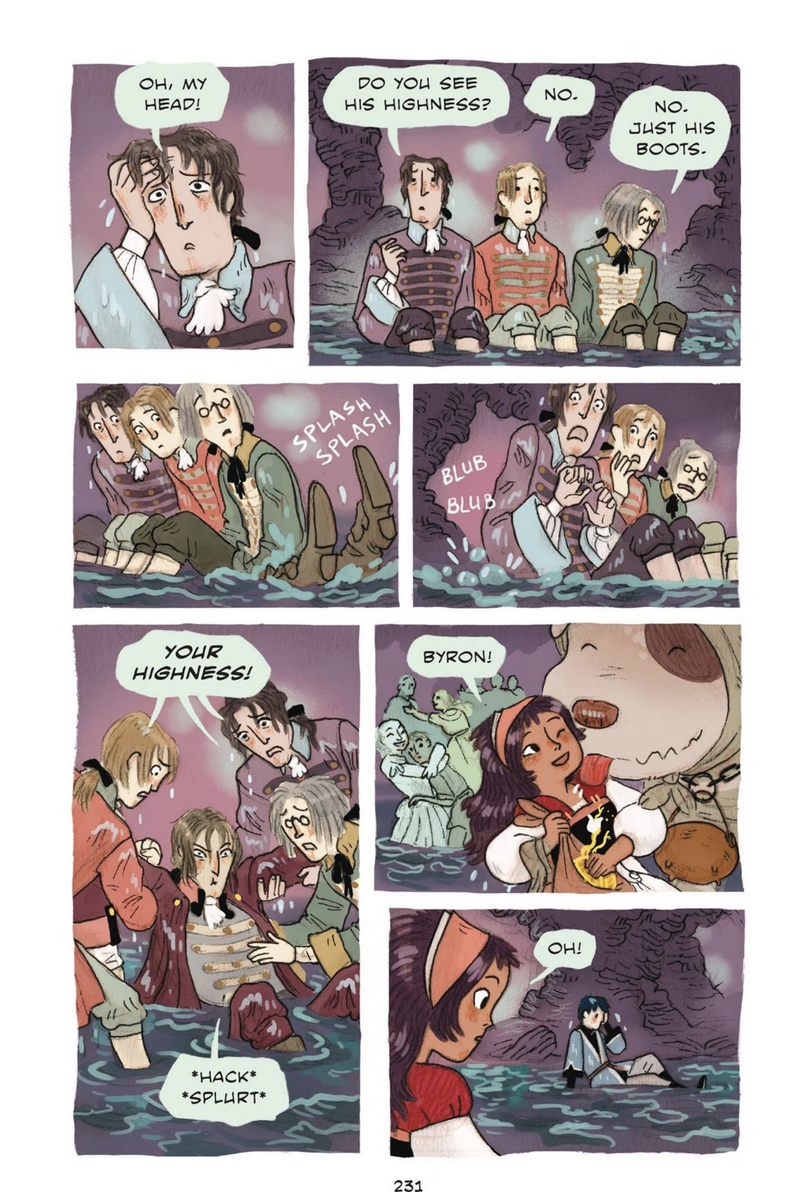
Now Suri is heading to the Monster's Cradle, the land of the giants, to help find a giant for whom her companion Byron, the monster-dog, could be a lap dog. Created by a greedy imp named Caglio, Byron is a lovable but massive dog with few monster tendencies, but he is threatening enough for the prince and his entourage to pursue for monster-hunting sport. But, not only is the trio being followed by the hunters, there are also three caitsiths named Siska, Toska and Mouska who are following them, determined to retrieve the golden twine Mouska had dropped.
From Cat's Cradle: The Mole King's Lair by Jo Rioux
When Suri, Caglio and Byron are confronted with a monster, Byron takes off and Suri and Caglio hide in a mountain cave which Suri believes must belong to the Mole King, according to her monster guidebook. She tries to use the power of her dragon tooth to ward off the Mole King but it's only when Byron reappears, and she feels intensely that it works for her. They soon meet Kolya, a young thief, who had been stealing from the Mole King's treasure room filled with gold coins–this gets Caglio's attention–which explains the Mole King's anger. But when they open Kolya's one bag they realize all he grabbed was a small, three-legged table.
From Cat's Cradle: The Mole King's Lair by Jo Rioux
Suri and her companions now head into the tunnels of the Mole King's lair, but their motives are all a little different. Suri just needs some gold to pay for food as they journey. Caglio just wants money. And Kolya is stealing so that he might redeem himself with the leader of his thieving ring. But Kolya is also drawn to the golden twine he saw in Suri's bag. If he is a caitsith, that golden twine would be handy in disguising his monster-ness. 
 
But going after the treasure is not as simple as finding their way to the treasure room. The prince is still determined to hunt a monster and is now accompanied by Toska, Siska and Mouska as his trackers and by the people of the impoverished town of Tancredi who'd lost many families and friends to the mines of the mountain. It's now a race to the treasure and to capturing a monster while a ball of gold twine draws attention from the caitsiths and Kolya. Who can work together and who cannot will undoubtedly determine the outcome for Suri and others in The Mole King's Lair, and in Book 3, Suri's Dragon.
From Cat's Cradle: The Mole King's Lair by Jo Rioux
Jo Rioux has given us a full range of characters from spunky Suri who wants to be a monster tamer, to the freaky Caglio who is all about himself, the cuddly Byron, the farcical prince and his courtiers, the caitsiths, and new characters like Kolya and his leader Lutrov. There's more coming with hints of a relationship between Lutrov and Toska and someone called Baron Grim. There's a lot of story here and Jo Rioux weaves it together flawlessly, taking us from Suri and her group to the prince and his entourage, from the Mole King's lair to the town and the forests. The story is engaging and will keep middle-grade readers engrossed with who is doing what and why and do they know what the others are up to. Nothing is straightforward except Suri who just wants to be a monster tamer and do the right thing, whatever that might be.
 
Like The Golden Twine, The Mole King's Lair is a delight for graphic-novel fans. It has a little bit of everything, from sweet characters and monsters, and idiots and villains, to dark scenes and humour, and a pursuit or two that keeps the action strong and the adventure compelling. Jo Rioux's artwork gives us all of this with expressive faces that show fear and trepidation, suspicion and affection. Readers will laugh when Byron gobbles up Caglio when he insults the dog, or when Caglio explains his origin–"I congealed in a cauldron of bone soup that spoiled on the fire" (pg. 86)–and cheer when the prince is trampled by Byron. There is so much to engage the young reader and all with a degree of innocence and humanity, even for monsters.

I don't know when Suri's Dragon comes out but, after The Golden Twine and The Mole King's Lair, I know there's lots more story to come and adventures and laughs from Jo Rioux. I'll be cheering for Suri and Byron–not so much Caglio–and hoping that their dreams come true.
 
Cat's Cradle: The Golden Twine (2022)
Cat's Cradle: The Mole King's Lair (2023)
Cat's Cradle: Suri's Dragon (still to come)


July 13, 2023

Monster vs. Boy

Written by Karen Krossing
Charlesbridge
978-1-62354-356-3
240 pp.
Ages 10+
July 2023
 
...people believe the strangest things, especially when they're scared or upset. I think the stories people share are part truth and part not-truth. The hard part is figuring out which is which. (pg. 126)
This is a story about a boy and a monster. Yes, a real monster that lives in his closet. I know you'll say that monsters don't exist but in the town of Morsh (from "monstrous marsh") where 11-year-old Dawz lives with his little sister Jayla with their uncle Pop, there is a history of monster sightings. Problem is that Dawz hasn't really seen the monster because he doesn't go into that large bedroom closet. Still, his fears about it are very real, especially as the kids were abandoned by their mother after she got weird, talking about a monster with yellow feathers and a scorpion tail.

As Karen Krossing tells her story from two perspectives, we know Dawz is right about a monster living there. Mim is small, with purple scales, gray fur, two hearts, several horns, and she can release smoke and ash from her nostrils. She loves the nest she has built among the boxes and bags. Most of all, she loves when the grown-up opens a book and tells a story from it. She thinks it's absolutely magical.
Books were powerful. Wonders dwelled inside them. Wonders that Mim was missing, alone in her dusty closet. (pg. 6)
But Mim didn't understand how something in the book turned into a story told aloud. She had a book in her nest, and nothing happened when she opened it. Her aim was to learn how to make the book work for her.

But Dawz and Mim's status quo is disturbed when Pop decides to clean the closet and excavate some aprons Dawz's mom had made long ago for the annual Baker's Brawl baking contest which she used to enter with her brother and which Dawz now entered with his best friend Atlas. When Mim tries to scare them away, Dawz realizes that only he can see and hear her. With her nest eliminated–"Her world had cracked open... (pg. 41)"– Mim ventures out, grabbing a pillowcase, a sock, and a book, and finds herself pursued by Dawz and company, including Ronny the pest control guy and Officer Rashmi.

As Mim befriends a cat she calls Raar and struggles to find a new nest, deal with her hunger and her surprising growth, Dawz and Thea, one of Atlas's moms, cope with their injuries from encounters with Mim. It takes a while but both Dawz the Horrible, as Mim calls him, and Mim will need to find their way back to each other in order to alleviate their fears, understand their needs, and appreciate the other for whom they are.

While some readers may pick up Monster vs. Boy because of the promise of a horror story, Karen Krossing's latest middle-grade novel is more a reflection of what we see and fear in others before we know them. Dawz has a lot of baggage because of what he remembers of his mother before she abandoned them and, with his nightmares of monsters, he has essentially created one that lives in his closet. On the other hand, Mim knows the comfort of her closet nest and has no interest in the outside except for the opportunity to hear the stories that come from books. When forced out, she tries to make connections, such as with the cat, but finds herself drawn back to the familiar even if it makes her nervous. Because neither understands the other, until the end, they interpret their actions as threatening or horrible and try to prevent further dangers to themselves. There's much learning about themselves and others as the two go from monster vs. boy to monster and boy.

But beyond the conflictual theme of her story, Karen Krossing also reminds us of the magic of books and reading. Whether being a writer who puts words to paper or a listener who has the words read aloud to them, the process of reading is miraculous, taking us from the mundane to the fantastic. Even the text of a recipe, which Dawz reads to Mim, enthralls her. It's the translation of letters to words to meaning that elevates books from paper and ink to the extraordinary, and even a purple-scaled monster knows this. 

So, open your own closet and see what opportunities there are for new learnings and relationships. Taking a chance on the unknown may be trepidatious but the rewards can be so un-horrible.

July 10, 2023

When Rubin Plays

Written and illustrated by Gracey Zhang
Orchard Books (Scholastic)
978-1-338-64826-3
56 pp.
Ages 4-8
July 2023
 
In a small town by a rain forest, there is an orchestra. Rubin's sister Isabel plays in this orchestra, and Rubin would listen through the open windows of their rehearsal space. The music is inspirational and uplifts Rubin. When he asks the maestro if he can play too, Rubin is handed a violin. But the sounds that come out of it when Rubin plays are screechy and howly, and the other young musicians snicker.
From When Rubin Plays by Gracey Zhang
Rubin is instructed by the maestro to practise so that he might be able to play with the rest of the orchestra. First the boy practises quietly at the back of the room. Then, when everyone leaves, he takes himself deep into the forest to practise. Still his violin is "shrill and uneven." But soon he is surrounded by cats who follow his playing, replying to his music with their own howling. 

Back and forth they went, their sounds a leaping crescendo deep into the night.

From When Rubin Plays by Gracey Zhang
When he returns next to the practice room, the young musicians offer Rubin some tips and he continues to play at the back of the room.  But at night, he plays with passion for his feline audience who perform their own music.

When the orchestra gives a concert, Rubin joins them, though he plays "too quietly, too small." But when Isabel encourages him to play, he does so, and an unexpected feline display of sound and dance brings the human audience to their feet. In a musical merger of orchestra, audience, cats and Rubin, harmony and connection are achieved.

From When Rubin Plays by Gracey Zhang
Author-illustrator Gracey Zhang based her story on an image that she had of a boy playing a violin to cats. Learning of a centuries-old history of baroque classical music in small Bolivian towns, Gracey Zhang blended the two into When Rubin Plays. Her story melds the richness that music brings to a child and to a community of both humans and felines while focussing on the passion of a young boy for learning an instrument. Rubin's music might need some refinement but his determination to play, even when only cats are his audience, is paramount. Ultimately, his persistence elevates his playing to connect the boy with the rest of the orchestra and with his audiences, as well as enabling his audiences to connect with each other.

The interactions of child with the music as well as for his listeners is dynamic, and Gracey Zhang's illustrations, primarily ink and paint, lend movement to that dynamism. There's the sounds of the violin playing and the cats' responses to the music that are full of life, but then Gracey Zhang also gives everything the colour of vitality. There is an energy to the musicians, to the people, to the animals that supersedes any skill or lack thereof, and it comes through in the brightness of colours in the clothing and the diversity of felines. When Rubin Plays is a book of life and connection to music and others.

Whether Rubin plays for the cats, with the orchestra, for an audience of people, or for the joy it brings him, there is passion. It's the enthusiasm that comes with finding something that touches you. Rubin's music, whether screechy or melodic, is always full of passion and reminds us all to follow our hearts, even when others may see, or hear, it differently.