April 29, 2022

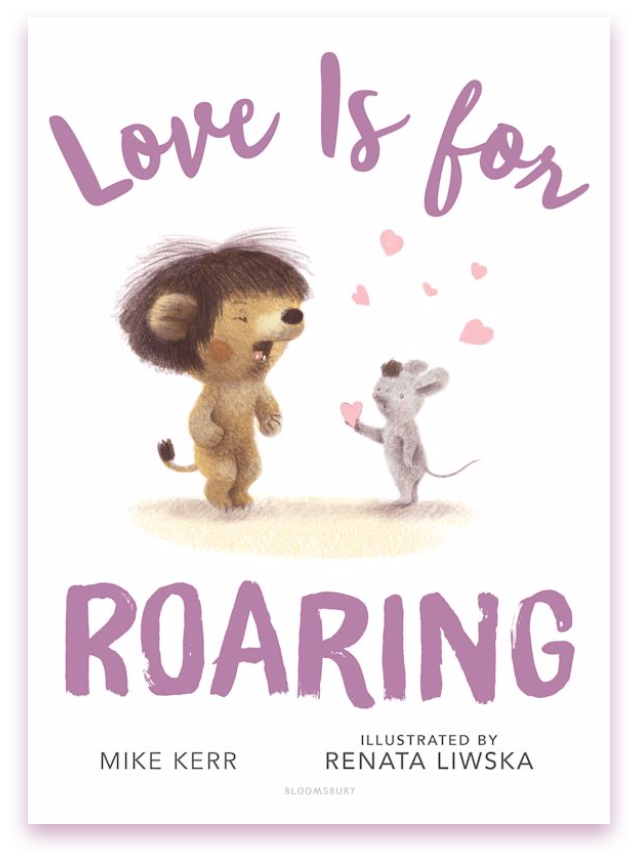
Love is for Roaring

Written by Mike Kerr
Illustrated by Renata Liwska
Bloomsbury
978-1-68119-124-9
32 pp.
Ages 4-8
January 2022

While I probably should have reviewed this lovely picture book in January when it came out so that it would be ready for Valentine's Day, I think that books about love in all its forms are important all year round, don't you think?

From Love is for Roaring by Mike Kerr, illus. by Renata Liwska
At school, the animals are given the assignment of showing their love as a crafty card. But this work distresses Lion who is perplexed by what is required.  Mouse can see the stress this causes Lion and tries to draw out of Lion what he understands love to be and what he might love. But that doesn't go well. Everything Mouse suggests, from hugs and kisses and sweet treats, are negated by Lion whose experiences with or perceptions of those are aggravating.
From Love is for Roaring by Mike Kerr, illus. by Renata Liwska
Finally when Mouse suggests activities like running and playing, roaring and chasing, Lion realizes that there are many things he loves doing, including being and having a friend.
From Love is for Roaring by Mike Kerr, illus. by Renata Liwska
As teachers, we know that understanding any assignment relies on both the teacher's ability to explain it and the student's ability to make connections with it. It's no wonder that Lion, a fearless creature, finds the homework assignment to "Show your Love" to be "impossible, the undoable, the unimaginable" and it causes him much anxiety. Thankfully Mike Kerr gives Lion a friend in Mouse, an animal with infinite wisdom and the patience to help Lion see that love is possible and even familiar. Mike Kerr may be an instructor of illustration at the Alberta University of the Arts but the text of Love is for Roaring suggests that he has the right words to tell a story beyond the artwork. Lion's distress is palpable as is Mouse's concern. And Renata Liwska's illustrations elevate the story with something special. It's a mixture of soft colours, cushioned textures and recognizable body language. From frustration to solemn introspection and playful exertions, Lion and Mouse and their classmates are the children who will read this book and see themselves within the digital artwork. They will know about frustration and wanting to help a friend. They will know distress and confusion and the relief of resolution. Love is for Roaring may be every child's story of uncertainty about school work and finding a connection where one might not have been evident initially.

April 27, 2022

Last Week

Written by Bill Richardson
Illustrated by Emilie Leduc
Afterword by Dr. Stephanie Green
Groundwood Books
978-1-77306-566-3
64 pp.
Ages 9-12
April 2022

Last Week is a sombre little book. It is based on the last week of a child's grandmother, affectionately called Flippa, as she with her family prepare for her death via Medical Assistance in Dying (MAiD). It is sombre because of a child's recognition of time passing swiftly before that death in a week of six hundred four thousand and eight hundred seconds or in the seven chapter days.
From Last Week by Bill Richardson, illus. by Emilie Leduc

This last week begins with Monday and with a child and their father flying across the country to be with the parent's mother during her last week. The child recalls how Flippa used to swim every day in the sea, walking in her wet suit, goggles and flippers the three blocks to the ocean. But no more. Because Flippa always felt it was important to make every second count, the child does that with the seconds they have left with her, chatting while she rests in bed, trying to make her laugh, and more.

From Last Week by Bill Richardson, illus. by Emilie Leduc

Visitors come and bring food and stay to chat and cry and reminisce. When Flippa feels well enough to come out of her room, she recalls being there for the child's birth. Now they will be there for her, "For when I'm set free," she declares. A visit from the green grocer, Mr. Bark, has the two ribbing each other about the tomato plants she'd bought from him having not produced any tomatoes. It's all very low-key with everyone knowing that Flippa's end is near but rarely really discussing it directly. With Flippa's doctor scheduled to come Sunday at 11 a.m. and administer the trio of medicines, the conclusion of that last week is imminent, and the child finds a way to be with Flippa, connect with her and even share a good-bye gift.

From Last Week by Bill Richardson, illus. by Emlie Leduc
Bill Richardson has written a story of such elegance in Last Week. The death of a grandparent can be one of the first significant deaths a child can experience, except for that of a pet, but a scheduled death is a whole different issue. With that last week, the child understands the momentousness of that juncture while preparing for a loss, appreciating every moment and witnessing others' responses. Bill Richardson keeps the story from the child's perspective and what they see, feel, hear, and know. By doing this, it becomes the child's story, not about the death. In fact, Flippa's death is never revealed though readers will know it was impending and unavoidable. That inevitability permeates the story and the child's narration of it but this child does not manifest the same grief as their father or the other visitors. After all, grief for the dying or the dead is different for all. For this child, it's making those seconds count with support and love, easing Flippa through that last week in their own way.
From Last Week by Bill Richardson, illus. by Emilie Leduc
While it is an illustrated chapter book, Last Week is not awash in the colour or boldness of art. Emilie Leduc's illustrations are stark and hushed. The black, grey and white palette keeps the tone of the story soft and quiet. Even though Flippa's last week is busy with visitors and family, those moments are important but fleeting, not unlike the art. Both Bill Richardson and Emilie Leduc can do bright and cheerful, humorous and busy. (Check out Bill Richardson's The Alphabet Thief or Hare B & B and Emilie Leduc's All Year Round.) But they set the tone of the book with their words and art, making Last Week important in its dignity of story message –which includes an Afterword by Dr. Stephanie Green about assisted dying–while taking the opportunity to introduce young people to an important end-of-life discussion.
April 26, 2022

Finding Moose

Written by Sue Farrell Holler
Illustrated by Jennifer Faria
Pajama Press
978-1-77278-244-8
32 pp.
Ages 3-6
April 2022

Sue Farrell Holler and Jennifer Faria first introduced us to this grandfather and grandson in their first picture book collaboration, Raven, Rabbit, Deer (2020). That winter walk, which demonstrated a solid and heartfelt inter-generational relationship, was the means for teaching Ojibwemowin vocabulary related to the natural world and for connecting between people and place. Finding Moose strengthens that mission but now the two companions venture out into the early spring when cold and ice give way to buds and awakenings and they can search for a moose (mooz).
From Finding Moose by Sue Farrell Holler, illus. by Jennifer Faria
As they walk, Grandpa instructs the child to be mindful of the noise he makes, the sounds in the forest, the evidence of life and more. 
Soft footsteps and gentle voices.
Quiet as mice and rabbits and deer.
With patience and attention, Grandpa points out moose droppings and nibbles on branches where the moose ate. As they walk and sit and watch and listen, the two are a study of differences and similarities. Old and young, still and active, teacher and student. And there is much to experience in the woods.
From Finding Moose by Sue Farrell Holler, illus. by Jennifer Faria
The child reasonably connects all that his grandfather points out with his own experiences. The chewings of the beaver (amik) reflect his biting of an apple. The softness of the pussy willows (ziisigobimizhiig) bring to mind kittens. And he notes that they are only finding only boy prints and Grandpa prints, not moose footprints. But after much scrutiny, including the spotting of chipmunks, geese, woodpeckers, tiny purple flowers and rosehips (oginiig), the two head home, accepting that today would not be a day to find moose. Or would it?
From Finding Moose by Sue Farrell Holler, illus. by Jennifer Faria
Finding Moose is as contemplative and instructive as Sue Farrell Holler and Jennifer Faria's earlier picture book. Sue Farrell Holler gives Grandpa the wisdom of age and experience and the boy that of fascination and connection. Together they experience nature fully but perhaps in different ways. A walk in the woods becomes a sensory adventure without the drama and high-octane action that can be tiresome and ephemeral. Instead, the two walk and look. They are one with each other and the world. That patience and calm is carried with Jennifer Faria's illustrations. Her acrylic paintings are often reflective of a Woodland Art style (see the flowers in the illustration above), emphasizing line and shape and keeping the story grounded in tranquility and reality. Even her choice of colour expresses that oneness with nature, playing the browns and blues with occasional flashes of red or a shamrock green.

From endpapers of Finding Moose by Sue Farrell Holler, illus. by Jennifer Faria
For a lovely early spring walk, learning about nature and being introduced to words in Ojibwemowin, join an Anishinaabe grandfather with his grandson to see how forest life reveals itself and search for an elusive mooz.

April 21, 2022

Martin and the River

Written by Jon-Erik Lappano
Illustrated by Josée Bisaillon
Groundwood Books
978-1-77306-444-4
36 pp.
Ages 3-6
March 2022
 
As Earth Day nears, we need to consider that the experiences of young people with the natural world will be quite different depending on where they live. But, if Martin and the River shows us anything, it's that it doesn't have to be that way.
From Martin and the River by Jon-Erik Lappano, illus. by Josée Bisaillon
Martin lives in a rural community where the river and its environs are more than just the landscape of his life: they are his companions. He watches the frogs, great blue herons and crayfish. He knows the behaviour of the otters and osprey. Countless hours are spent at the river that runs through the fields behind his house. Then a new job moves the family to the city.
From Martin and the River by Jon-Erik Lappano, illus. by Josée Bisaillon
As Martin prepares to leave the river and its life force, he seeks a plan to help. But it's not until his parents take him for a visit to the city, with its subway, museum, and its own natural area that Martin finds a way to bring the river to the city with him.
From Martin and the River by Jon-Erik Lappano, illus. by Josée Bisaillon
Story from Jon-Erik Lappano? Art by Josée Bisaillon? I was already sold on Martin and the River. I knew it would be impactful and it is because it touches on big ideas of adapting to change and of our relationships with nature. Every child will experience some change in their lives, especially the leaving behind of the familiar and going to the unknown, whether it be home, family or school. How they deal with that change is important in determining how disquieting the transition will or will not be. Martin may be a resilient child but change is still change and leaving behind his beloved river was going to be hard. Thankfully he and his parents knew enough to help make that transition smoother by finding another river for him to embrace.

Beyond the concept of change, Martin and the River is a big story because of the child's relationship with the river and its elements, hence my choice to review this book for our upcoming Earth Day. For Martin, Earth Day is everyday. It's appreciating the natural world and its plants and animals and water. It's acknowledging how nature sustains us, especially spiritually. He was fortunate to be able to spend time communing with the river and experiencing the life within. But these experiences helped him to bridge a difficult transition because he was able to appreciate that another natural environment had much to offer as well, just different. 

And don't Josée Bisaillon's illustrations, blends of coloured pencil, pastels, gouache and digital art, just burst with the life of that river and the scenes of the city? From the lush greenery, golden fields and busy indoor and outdoor city scapes, Josée Bisaillon has taken us into Martin's busy brain, imagining, appreciating and feeling. Everything is big and bold and wild.

Not every child is fortunate to have a river as a friend, but I hope that every child finds their own natural element, as Martin did with his rivers, to underscore their lives and guide them with reflection, resilience and imagination.

April 19, 2022

A Bend in the Breeze: Book discussion (online)

 Join author Valerie Sherrard
 

for a book discussion to launch 
her newest middle-grade novel
 
A Bend in the Breeze
 Written by Valerie Sherrard
DCB
978-1-77086-647-8
248 pp.
Ages 9-12
April 2022 
 

on April 21, 2022
 
2 - 3 PM (ET)
 
Hosted by Bobbie Henley,

this online event (via Zoom) is free 
and a great opportunity for young readers 
to connect with an award-winning Canadian author 
and hear about her newest book
 
Register at EventBrite here

April 18, 2022

A Bend in the Breeze

 
Written by Valerie Sherrard
DCB
978-1-77086-647-8
248 pp.
Ages 9-12
April 2022 
...there are things in this world that can only be seen by the innocent eyes of youth and by our friends in nature. (pg. 128)
You never know where a bend in the breeze can take you: here or there, away or to. And the bend in the breeze that transports 11-year-old Pascale Chardon to the island of TeJÉ might have done all those things.
 
The small island community of TeJÉ had been established many, many years ago by a twin brother and sister who'd sought a place of peace and happiness. But, as in any community, small discourtesies, some impatiences and ingratitude crept into that goodness. The brother, before his passing, dreamed that a bend in the breeze would bring a stranger who would determine whether the future of the island's people held happiness or misery. So when Pascale, the first ever stranger on TeJÉ appears, they suspect she is the Long Awaited, and anticipate her revelation after the requisite seventeen days on the island.  

Worried about her family and saddened by her predicament, Pascale tries to make the best of her situation. Accompanied by her companion beetle, Inch, Pascale sees much of the goodness of the island. There are her two new friends, Kenta Morningbay and Karuna Cloudwater, and the blind Mrs. Wintercreek with whom Pascale is sheltered. She's delighted with their outdoor school and begins to learn of the island traditions for Union Day (wedding) and addressing concerns to the three Elders at the Place of Matters. Though Pascale is grateful for much, below the surface she is grieving for her situation. This is not unlike the island with its emphasis on harmony but with underlying iniquities that could shatter its future. And then there's the mystery of her boat leaving a hole in the water where it had rested. It would seem there might be another element that will determine the futures of the island and Pascale.
 
TeJÉ may be a small community but it is a microcosm of those who are wise and those who are foolish, those who seek approval and those who seek attention, the kind, the mean, those who cannot see and even those who are blind and see perfectly. It may strive for harmony but, as it is populated by humans, it cannot be perfect. Dropped into this community, Pascale tries to see its goodness, even when unkindness is evident, remembering well what her mother always told her. "No one can be happy until they first learn to be grateful." (pg. 97) But this is a real community of people. And whether she's writing historical fiction like her award-winning The Glory Wind and Rain Shadow, novels in verse like Counting Back from Nine or contemporary stories like Birdspell and Driftwood, Valerie Sherrard always tells of real people who are strong and vulnerable, confused and steadfast, and living with circumstances with which young readers can often relate. Though A Bend in the Breeze takes those readers to a secluded island via a stranded and unaccompanied child, circumstances which undoubtedly none have experienced, Valerie Sherrard does bring them to a relatable story. There's a child who feels alone and wishes to be with her family. There's a community that strives for harmony but includes a veneer of conflict. There is companionship with friends and animals, questioning about self, people and circumstances, and there is uncertainty. This is childhood for many. Thankfully, Valerie Sherrard also resolves Pascale's story. It might be unexpected but it is wrap that readers will appreciate.

Think of A Bend in the Breeze as The Little Prince meets Island of the Blue Dolphins in that a child is stranded on an island, away from family, and learns and imparts lessons about compassion, acceptance, and gratitude. It's also about forgiveness and hope. Big lessons on a small island. That's where A Bend in the Breeze will take young readers.
 
🏝🏝🏝🏝🏝

See my next post about a free online book discussion
 this Thursday, April 21, 2022 
with author Valerie Sherrard about A Bend in the Breeze.

🏝🏝🏝🏝🏝

April 13, 2022

Sing in the Spring!

Written by Sheree Fitch
Art by Deb Plestid
Nimbus Publishing
978-1-77471-039-5
32 pp.
Ages 3-7
March 2022

Though spring officially hit the calendar last month, we know the unpredictability of April, a month in which snowstorms can follow on the heels of mild temperatures and budding snowdrops and croci are challenged with fickle weather. In fact, as I look out my open windows and enjoy a light breeze of 17oC weather, Manitoba and northern Ontario are bracing for a snow storm of epic proportions. So, let's let Sheree Fitch's verses help transition all of us from winter when...
There's a secret hush of magic 
when winter lingers on,
when our garden patch
is still a quilt of white.
And with the real quilts of Deb Plestid's fabric art, the transition to spring and rains and flowers, birds and butterflies is well-serenaded.
From Sing in the Spring! by Sheree Fitch, art by Deb Plestid
While the days are getting longer, a child still enjoys a winter of tracks in the snow and snowshoeing with their father. There may still be storms and power outages, fires and mittens, but they know what is coming. From the roots growing beneath the surface and insects and more resting, perhaps even dreaming, the onset of spring is anticipated.  And then it starts.
The frozen river cracks
and groans
like a giant's belly rumbles
like a thunder god who grumbles
Fee-fi-fo-fum!
From Sing in the Spring! by Sheree Fitch, art by Deb Plestid
The awakening is seen and heard. There's a dance of movement, as asparagus tips push upwards and leaves unfurl, and of song, with dripping rain–Spring rain's garden fairies weeping happy tears–and peepers peeping. The shift from winter to spring is both slow and fast, like a ballad that is both lullaby and swing, soft and cacophonous. And when it has finally arrived, it is...
SPRING!
heart sparkly
gold glittery
glad shimmery
LIGHT
on
EVERYTHING!
Sheree Fitch's words have always sparkled with insight and heart. She feels and she shares, sometimes with humour, sometimes with poignancy. With her words, Sheree Fitch has created music that carries young readers of her free verse along in that transformation from winter season to spring. No matter where they are in our country, children will recognize elements that define the seasons for them, though some may present themselves earlier or later. They'll be looking for plants and insects outdoors but also in the quilted art of Deb Plestid. Her fabric art is astounding. She gives such texture through her choice of fabrics, colours, stitching and patterns. Not only can Deb Plestid depict natural elements authentically, she installs them in rivers that are cold, leaf litter that is expectant, and skies that are alive. As Sheree Fitch brings song into spring with her words, Deb Plestid does so with quilted art.
From Sing in the Spring! by Sheree Fitch, art by Deb Plestid
Whether this month or next, I can surely see Sheree Fitch dancing with her arms raised high as fiddleheads emerge and the hummingbirds arrive and Deb Plestid stitching tableaux of the natural world as she captures each new shift and development. The coming of spring has never been so lyrical and bright.