December 02, 2019

Nutcracker Night

Written by Mireille Messier
Illustrated by Gabrielle Grimard
Pajama Press
978-1-77278-091-8
40 pp.
Ages 3-7
September 2019

At this time of year, many families will be planning their annual excursion to a performance of the Nutcracker, a ballet scored by Tchaikovsky. Whether your child is fortunate enough to attend or perhaps even perform in it or not, Mireille Messier and Gabrielle Grimard's Nutcracker Night will bring the magic of that performance to the page and hence to every young reader.
From Nutcracker Night by Mireille Messier, illus. by Gabrielle Grimard
A young girl delights in being taken to her first performance of the Nutcracker. From the Swoosh! of the cars and the Beep! Beep! of their taxi, their journey to the ballet begins with a subtle sensory burst. Her dress goes Swish! Swish!, her dad's shoes go Clip! Clop! Clip! Clop! and the two enter the  theatre, and get to their seats while the orchestra tunes up with a Pickle-dee! Zing! Boom! Ding!

Before the ballet has even started, the reader will recognize that Mireille Messier has made this event into an onomatopoeic exploration. The sounds of the audience and the orchestra are only the beginning because soon enough Marie (or Clara) is opening her nutcracker gift on stage and her brother Fritz is breaking it. When the clock strikes midnight with a Bong! or seven, Marie envisions the Christmas tree as colossal, and the mice and the soldiers begin their battle. After a welcome intermission, the Sugar Plum Fairy dances en pointe with a Takka-takka-takka, and the flamenco dancers and Mother Ginger and the polichinelles perform, before an ending that has the crowd applauding Bravo! Brava!
From Nutcracker Night by Mireille Messier, illus. by Gabrielle Grimard
Though the story of the Nutcracker, that of a young girl perhaps dreaming of a nutcracker come to life, is the basis for Mireille Messier's picture book, Nutcracker Night goes beyond a retelling of the ballet's premise. Instead it expands the many audible experiences of the performance and encompasses the whole experience from beginning to end of a special father-daughter occasion. There is the travel to the theatre, the audience's reactions and behaviour, an intermission of food, play and chatter, and an affectionate thank-you from a little girl to her father. And throughout, Mireille Messier invites a read-aloud with sound and expression.

Gabrielle Grimard's artwork, created with watercolour, gouache, oil, coloured pencil and digital media, evokes the magic and the affection of the experience for all participants. From the wide-eyed faces of the children to the action of the ballet, Gabrielle Grimard takes the reader into the theatre to watch, to hear and to appreciate the Christmas ballet.

Head to the ballet with Mireille Messier and Gabrielle Grimard's Nutcracker Night for a different kind of audiovisual experience and one that is perfect for the holidays. Like the nutcracker itself, Nutcracker Night opens up a tale for the season.
From Nutcracker Night by Mireille Messier, illus. by Gabrielle Grimard

November 28, 2019

The Mostly True Story of Pudding Tat, Adventuring Cat: Guest blog review

Today's review has been submitted by Grade 6 student Bronte L.

Written by Caroline Adderson
Illustrated by Stacy Innerst
Groundwood Books
978-1-55498-964-5
128 pp.
Ages 8-11
April 2019

In The Mostly True Story of Pudding Tat, Adventuring Cat by Caroline Adderson, Pudding Tat is a blind cat who explores 1900s North America, travelling from Wellington County to Niagara Falls, Buffalo, Atlantic City, the Titanic and the Western Front of World War I, with the help of a needy flea.

When Pudding Tat was a little kitten, living in a barn with his family, he decides he would explore the four corners of the world like his ancestors. Pudding Tat may have been blind but his hearing was exceptional. His family couldn’t hear the drunken conversations of the fleas, but he could. Before Pudding Tat leaves the barn to explore the four corners of the world, a flea decides to jump into his ear. This flea was different from the other crazy drunken fleas in that he had taste, though he was bossy, rude, and constantly complaining.  Yet Pudding Tat never gets rid of him because the flea provides him sight, and it’s nice to have some company while exploring the world. As Pudding Tat travels from location to location, he encounters lots of kind owners who care for him while he gives them joy.

The Mostly True Story of Pudding Tat, Adventure Cat is great for grades 5 to 8. It’s full of adventure and fun as well as including “mostly true” accounts of famous North American events. The Mostly True Story of Pudding Tat, Adventuring Cat has 179 pages, making a great light read, with each chapter a new adventure for Pudding Tat and the flea.

I love the concept of the book and the idea that the same visually-impaired cat was a part of all these events and changed peoples' lives. I also found the way Pudding Tat was able to find his way around using his other senses and the flea was very creative. The descriptions were great while not being wordy and I was able to visualize what was going on clearly. I also loved how Caroline Adderson added songs into her writing. I would give Caroline Adderson’s The Mostly True Story of Pudding Tat, Adventuring Cat  9 out of 10.

~written by Bronte L.

November 27, 2019

Summer North Coming

Written by Dorothy Bentley
Illustrated by Jessica Bartram
Fitzhenry & Whiteside
978-1-55455-465-2
32 pp.
Ages 5-9
November 2019

Though a picture book titled Summer North Coming may seem incongruous for release in November, Dorothy Bentley and Jessica Bartram's book is actually very suitable for this time of year, and just about any, as it examines in verse and art the changing of seasons and activity in the north.

Divided into two parts, Summer North Coming and Winter North Coming, Alberta author Dorothy Bentley takes the reader across muskeg and forests, shores and skies, and inside to experience all with two children.
From Summer North Coming by Dorothy Bentley, illus. by Jessica Bartram
From her first quintain which accompanies the two children paddling through the open water of marshland, Dorothy Bentley immerses us in Alberta's far north.
Fragrant muskeg rose,
tickle my nose
sun climb,
warm shine
summer north coming
Soon the children are picking raspberries in their birch bark baskets, ready for jam-making and spreading on bannock. Then they're swimming in a river and running through rain puddles and dreaming of flight on bats and birds. With the leaves falling and "summer north fading," preparations for winter begin. The family puts on their beaded mukluks and go fishing, and later enjoy a hearty meal.
From Summer North Coming by Dorothy Bentley, illus. by Jessica Bartram
In the later half of the book, winter has set in and the children play in the snow, relish a dog sled run, watch ravens at play, and enjoy some winter camping. Indoors everyone partakes in venison stew and some family games before a final spread which foretells the end of the cold season.
Hills icy sliding,
crash mud landing
sun roams, 
earth moans
winter north melting
Dorothy Bentley makes the seasonal activities of a northern family with some Indigenous roots into a sensory experience. From the berry-stained hands to thunder loud calling and daytime smiles yawning, Summer North Coming is an evocative rendering in words and art of life in northern Canada. Ottawa artist Jessica Bromley Bartram provides the visual for Dorothy Bentley's expressive free verse, giving the illustrations a folksy feel of family who enjoy the outdoors and live with the seasons. The art, which appears to be a blend of watercolour, gouache and pencil crayon, is surprisingly detailed–the trees in the forest are easily identifiable–yet organic in its rounded edges and softness of energy.

Summer may have passed for now and winter is here and not, but Summer North Coming will take young readers through all the seasons as they advance and retreat in the subarctic environment of northern Canada.
From Summer North Coming by Dorothy Bentley, illus. by Jessica Bartram

November 25, 2019

Brady Brady: Teammate Turnaround

Written by Mary Shaw
Illustrated by Chuck Temple
Scholastic Canada
978-1-4431-6373-6
32 pp.
Ages 4-8
September 2019

Brady is called Brady, Brady because he needs to be called multiple times to get his attention. That is, except for hockey. The anticipation of his team, the Icehogs, starting their season has the boy and his buddy Chester excited and practising enthusiastically. But after tryouts for the season, Chester is placed on another team and is ready to give up on hockey. Can Brady help his friend see that playing the game is the fun part and that they'll always be best buddies?
From Brady Brady: Teammate Turnaround by Mary Shaw, illus. by Chuck Temple
After Chester learns that he has been placed on another team, he dumps all his goalie equipment at the front of the arena with a note, "Free equipment. No longer needed." While the two wait in Chester's dad's car, Brady reminds him that "We're gonna win the Stanley Cup together one day" and "We can still play hockey together. On my backyard rink, in my basement, on my driveway." But when the boys rush back into the arena to retrieve Chester's equipment, it's already gone. 
From Brady Brady: Teammate Turnaround by Mary Shaw, illus. by Chuck Temple
So begins a search for the missing goalie pads, stick and bag. They enlist the help of a group of kids hanging out in the lobby to search the change rooms, the washroom, the concession stand and finally the lost and found room. High up on a shelf, the equipment sits. But reaching it becomes a problem for the children. Together, working as team, they construct a human pyramid to retrieve Chester's equipment, before he realizes that these kids are the Rink Rattlers, the team to which he has been assigned.
From Brady Brady: Teammate Turnaround by Mary Shaw, illus. by Chuck Temple
Chuck Temple's diverse kids with the quirky smiles and palpable enthusiasm for hockey are the right composite of cartoon and lifelikeness, quirky and real to keep the story fun, funny and truthful. So many kids love playing sports but dread playing with kids they don't know. We all love the familiar to some degree, especially in new situations. By making Chester's story about finding friends to help him out, before even heading onto the ice, Mary Shaw upholds the quote (attribution vague) that "There are no strangers, just friends you haven't yet met." It's no surprise that Chester feels comfortable playing with the Rink Rattlers now that he knows who they are and that his friendship with Brady is not at stake. 

Ultimately, Chester "knew it didn't matter what uniform he was wearing as long as he was playing the sport he loved." With their overwhelming enthusiasm for hockey, these kids would make any team, whether Icehogs or Rattlers or something else, remarkable because they knew how to work together to accomplish something great.

••••••••••••••••

A number of Brady Brady stories have been published, including 3 collections and several French-language versions. Check them out at Scholastic Canada or at the Brady Brady website.

November 21, 2019

One Wild Christmas

Written and illustrated by Nicholas Oldland
Kids Can Press
978-1-5253-0203-9
32 pp.
Ages 3-7
September 2019 

Nicholas Oldland's animal friends from his Life in the Wild series of picture books are back and this time the trio of friends are anticipating their favourite time of year and preparing for the finest celebration.
From One Wild Christmas by Nicholas Oldland
A beaver, a moose and a bear have their traditions which many children will recognize. There's the cooking of the food–check out the moose's apron that reads "I ❤️ X-Moose"– hanging the stockings, putting up lights, wrapping presents and getting a Christmas tree. Finding the right tree is not easy but they finally locate a beautiful pine. However, "the bear loved all living things, especially trees" and he was not going to let the beaver chop it down. When it becomes evident that moose and beaver are determined to have that perfect tree–there is quite a tussle!– the bear finds a solution, as suggested by a little cardinal, that allows the trio to celebrate the holiday without harming a living tree.
From One Wild Christmas by Nicholas Oldland
At this time of year, many families fortunate enough to have the opportunity to celebrate Christmas with a tree must be considering their options. The choices would seem to be endless: fake or real, spruce or fir or pine, green or silver, cut or potted. Even within families, the discussions, nay arguments, can seem endless. Fortunately Nicholas Oldland's characters who are a family of their own find a way to enjoy a beautiful tree by taking their celebration to the wild, hence One Wild Christmas
From One Wild Christmas by Nicholas Oldland
The message about conservation and the natural world is charming, as are Nicholas Oldland's characters and whimsical settings. (Readers may recognize the artwork from the Hatley and Little Blue House apparel companies which are run by Nicholas Oldland and his brothers.) Simple in line and shape and even colour, his artwork, rendered in Photoshop, is uncluttered but natural and inviting while rustic, not unlike the pine the trio of friends discover. In the basic outdoorsy colours of brown, black and green with blue for the sky, Nicholas Oldland's setting reminds us that we are outside in the wild. Still, the only bird and a sled and Christmas accessories bring in the bright reds and colour to offset the organic world and bring a celebration of friendship, family and environment to life.

🌲🌲🌲🌲🌲🌲🌲🌲

Read about all the books in the Life in the Wild series at Kids Can Press here.
Life in the Wild series by Nicholas Oldland

November 20, 2019

King of the Mole People (Book 1)

Written and illustrated by Paul Gilligan
Henry Holt & Co.
978-1-25017-134-4
272 pp.
Ages 8-12
August 2019

...I was never aiming for popular. All I wanted was to somehow claw my way up the ladder to a comfortable middle rung. (pg. 116)

Doug accepts that he's weird but he hates it, especially when bullies like Ed and Ted and popular girl Becky and her Binkettes call him so. But what makes him weird?  He lives in Dreadsville Manor adjacent to a graveyard. His father's prime cooking ingredient is eels. And he's been crowned King of the Mole People after King Zog (there are actually 16 O's in his name) disappears. It's no wonder he craves normalcy. So he makes a plan to participate in school activities, crush on a girl, get a friend, learn to tell jokes and even just eat regular sandwiches for lunch. Unfortunately his good efforts continue to be thwarted.
From King of the Mole People by Paul Gilligan
His friend Simon is becoming less friendly. His efforts at school participation at the rocket club, the school play and at soccer club are epic fails. And he keeps getting summoned to the underworld of the Mole People–crowns etched in the dirt or with mud–where the Royal Advisor, Croogoolooth, both manipulates and disrespects Doug. Fortunately his Royal Guard, a trio of Mole People, support his efforts and continue with the last king's positive attitude about the Up-worlders.
From King of the Mole People by Paul Gilligan
But things above ground and below are getting more weird. Kids are disappearing into holes, at least temporarily, and Doug is welcomed into groups that had rejected him earlier. Below ground, the Mole People have been helping themselves to Up-stuff and clogging their world below with everything from bicycles to fencing, stage lights and water jugs. Keeping his two worlds separate becomes harder and harder, especially with classmate Magda spying on him and with the Underworld in danger of attack by Mega-worms. Worse still, Doug is compelled to help those who trusted him, even if he has to negotiate with the Slug People, the Mushroom Folk, and the Stone Goons to achieve cooperation.
From King of the Mole People by Paul Gilligan
With the right blend of humour, irreverence and weird fantasy, Paul Gilligan will get middle-graders rolling on the floor with belly laughs for his story and his illustrations. His characters are goofy, their circumstances bizarre and his plot lines both ludicrous and entertaining. It's impossible not to laugh at a dad who makes eel pudding or a society where O's in your name denote status or where a king's throne is a painfully pointy rock. Yet in all this absurdity there is an ordinary that most children will understand. Most children just want to fit in. So with a message of self-acceptance, whether it be for a human or a Mole Person, King of the Mole People speaks to many children who will understand when Doug is eventually pleased to return to his "regular level of unpopularity" and accept his differences as normal.

November 15, 2019

The Clothesline

Written and illustrated by Orbie
Translated by Karen Li
Owlkids Books
978-1-77147-390-3
64 pp.
Ages 5-8
October 2019

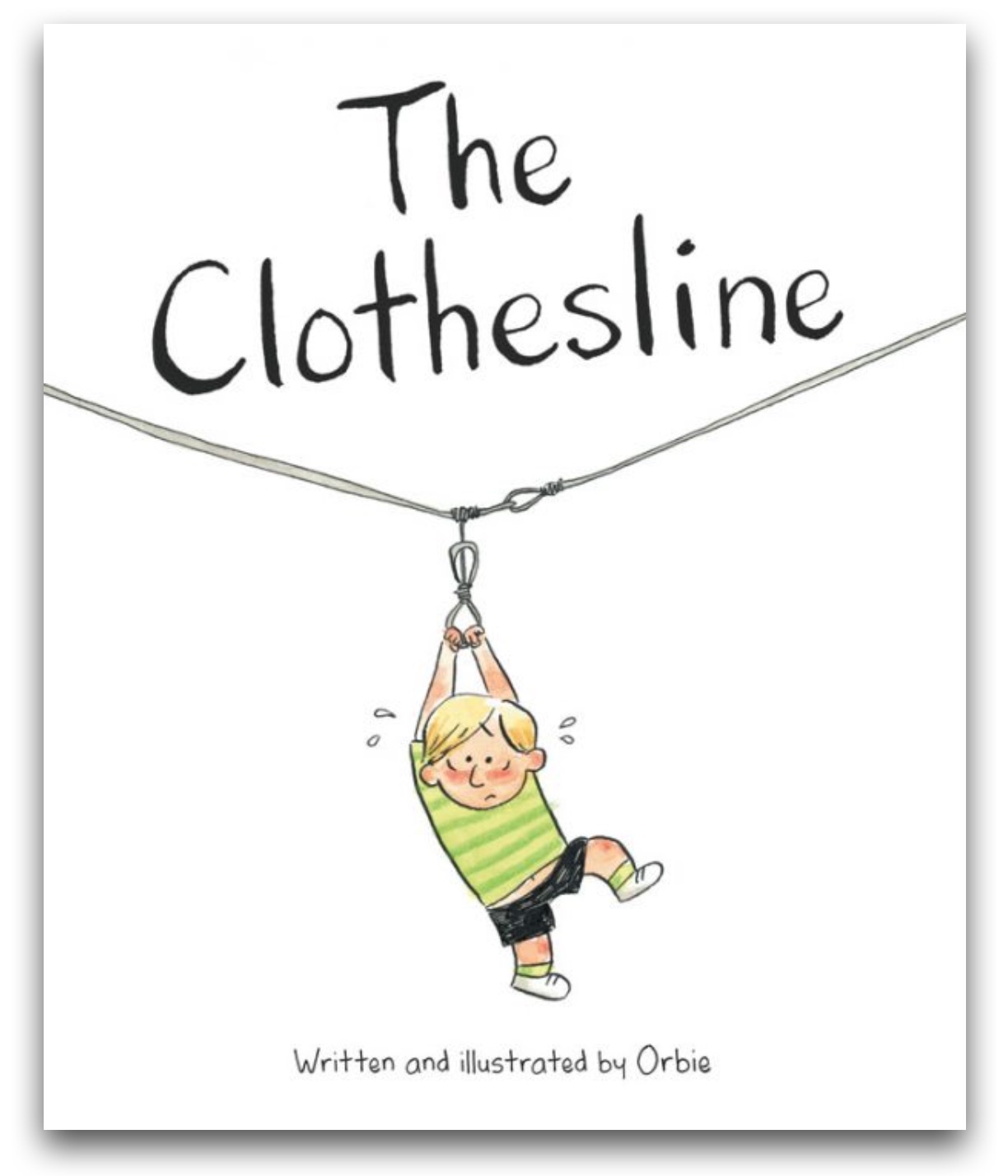
From The Clothesline by Orbie
Reggie is five and lives in an apartment above a corner store. When he gets his allowance for doing chores, he races down the outside stairs heading to the store, always yanking on a knot that hangs from the adjacent clothesline.  The sound it makes–ftoiiing–is something he enjoys.

From The Clothesline by Orbie
But one day, coins in hand destined for a candy purchase, Reggie races down faster than ever, yanks at that knot but loses his footing and, grabbing at the knot, is propelled halfway across the clothesline. And there he hangs.
My name is Reggie.
I'm five years old.
And I'm stuck in the
middle of a clothesline.
From The Clothesline by Orbie
He knows this is a dilemma. He cannot use his right hand since it grasps his coins. His left hand is hurting and he knows he cannot hold his weight indefinitely. He's scared that he will fall. So Reggie hangs from the clothesline, looking down, up, across and wonders what to do. Of course he shouts for help but his mother does not hear. He tries to move himself along so he might climb down the pole but to no avail. So he waits. Only the cat comes, though it's focused on washing itself.

In the end, Reggie gets down by accident, and with a few scrapes and tears, and learns to avoid getting himself in trouble again while still enjoying the "ftoiiing" he'd always loved.

Originally published in French as La corde à ligne by Quebec illustrator Orbie, The Clothesline translates easily into English. The story is universal after all in that all children "try" things that look like fun but may get them into a spot of trouble. And though he tries to find a solution to his dilemma, thinking through the possibilities and the consequences, thereby giving children an opportunity to see how problem-solving can happen, Reggie must finally accept his fate. Thankfully he is not badly injured and Orbie's lightness of illustration with pen and ink and watercolour conveys that same impression. Ultimately Reggie finds a way to learn and compromise his need for daring with safety, all courtesy of an old-fashioned clothesline.