January 29, 2014

Albertan YoungCanLit Author Trio: Author Event (Edmonton)

Mark February 8th on your calendar
if you live in the Edmonton area 

because
you're fortunate to have
not one,
not two,
but
three youngCanLit authors
 
Karen Bass, Marty Chan, and Karen Spafford-Fitz

visiting

Chapters at West Edmonton Mall
from 12 p. m. to 4 p. m.


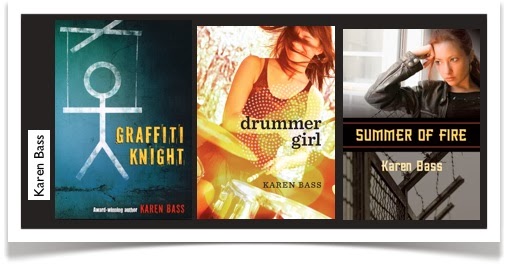
Check out some of their books below, including their latest (always far left book cover).

 
Karen Bass
  • Graffiti Knight (Pajama Press)
  • Drummer Girl (Coteau)
  • Summer of Fire (Coteau)

Marty Chan
  • The Ehrich Weisz Chronicles: Demon Gate (Fitzhenry & Whiteside)
  • Barnabas Bigfoot: Bone Eater (Thistledown Press)
  • The Mystery of the Cyber Bully (Thistledown Press)

Karen Spafford-Fitz
 
  • Vanish (Orca Book Publishers)
  • Dog Walker (Orca Book Publishers)


Further details about the event can be found here.

January 27, 2014

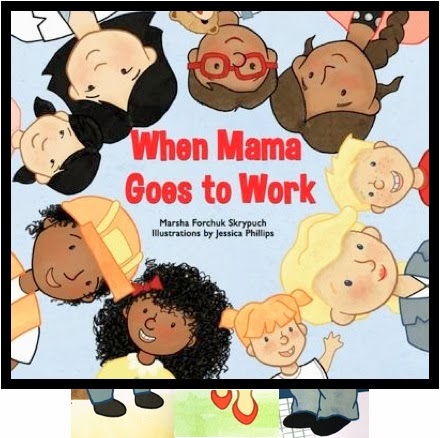
When Mama Goes to Work

by Marsha Forchuk Skrypuch
Illustrated by Jessica Phillips
Fitzhenry & Whiteside
978-1-55455-34-3
32 pp.
Ages 1-5
October 2013

We know that, in these days of economic instability, many children are part of households in which parents are out of the house at work each day.  It doesn't matter whether it is a single-parent household, one with both father and mother, or even one with two mothers–bills must be paid, careers to be realized and passions to be developed, and contributions to be made outside of the home.  As adults, we understand why we go to work, but do children always understand this? 

In When Mama Goes to Work, Marsha Forchuk Skrypuch ensures that they do understand, specifically that the days of working mothers and children are not that dissimilar.  Their days start the same, in preparation for the day: dressing appropriately, making lunches, tidying themselves, and packing their bags.  At work and school, the similarities continue, as they do when Mama and child are reunited.  Regardless of their day's activities, Mama and child know that they are each in the other's thoughts and hearts, and that when the "work" day is over, they will again be together.

This positive and reassuring message, which also communicates the variety of roles mothers may play within the community e.g., construction worker, medical professional, business person and care giver, is enhanced by illustrator Jessica Phillips' cheerful round-faced children and mothers.  All children will see themselves in her characters who range in their skin and hair colours, in gender, nationality, and activities.  When Mama Goes to Work is an inclusive story of everyday routines that may be unfamiliar and may seem mysterious but are reassuringly comparable and interconnected.

January 26, 2014

Grandmother Ptarmigan

by Qaunaq Mikkigak and Joanne Schwartz
Illustrated by Qin Leng
Inhabit Media
978-1-927095-52-2
24 pp.
Ages 0-4
2013

While a grandmother ptarmigan seeks to get a little one to sleep, Grandmother Ptarmigan is actually a traditional Inuit origin tale that explains why ptarmigans cry, "Nauk, Nauk" and why baby ptarmigans fly so young.

Just as many human parents try a variety of strategies to help their young ones go to sleep, a little ptarmigan's grandma sings to him, tells him to close his eyes, and tucks him in, but he continues to demand a story.  Well, she tells him a story, obviously a little more feather-raising than she intended, though it does end with affectionate tickles. Unfortunately, the little ptarmigan is so frightened that his reaction is to fly away, much to the distress of his grandmother.

Qaunaq Mikkigak, an elder from Cape Dorset, Nunavut, shares a traditional Inuit origin tale in Grandmother Ptarmigan, written in collaboration with children's author Joanne Schwartz.   I applaud the successful efforts of these authors in divulging an origin tale from the Aboriginal Peoples of our own continent.  In addition to reaffirming the Inuit culture for young people, Grandmother Ptarmigan reminds us that origin tales do not all stem from Africa or lands with which youngCanLit readers are unfamiliar.  Along with Qin Leng's deceptively simple but effective illustrations, Qaunaq Mikkigak and Joanne Schwartz bring the origin tale to roost appropriately amidst the rich stories told by the Aboriginal Peoples of North America, here courtesy of Inhabit Media. Thank you.

January 25, 2014

2014 CBC Bookies are on!

Time's running out for the CBC Bookie Awards of 2014. These are the readers' choice awards organized by CBC Books in eleven categories:
  • Best Canadian Fiction
  • Best Canadian Non-Fiction
  • Best Canadian Book Cover
  • Best Canadian Poetry
  • Best Canadian Thriller, Mystery or Crime
  • Best Canadian Science Fiction, Fantasy or Speculative Fiction
  • Best Canadian Young Adult
  • Best Canadian Graphic Novel or Comic Book
  • Best Canadian Short Story Collection
  • Best International Fiction
  • Best International Non-Fiction
The nominated titles for the Best Canadian Young Adult book are:


The Unlikely Hero of Room 13B
by Teresa Toten
Doubleday Canada/Random House of Canada

Sorrow's Knot 
by Erin Bow
Scholastic Canada

Not Your Ordinary Wolf Girl
by Emily Pohl-Weary
Razorbill

Homeland 
by Cory Doctorow
Tor Books

September 17: A Novel
by Amanda West Lewis 
Red Deer Press

***********************************

Go to CBC Bookies 2014 web page  and support great Canadian YACanLit by voting before Wednesday, February 5, 2014 at 11:59 p.m.

Winners will be announced Thursday, February 6, 2014.

January 21, 2014

Marsha Skrypuch: Author Event (Toronto)

YoungCanLit Author Marsha Skrypuch
 
 
presents her Silver Birch Fiction Award-winning novel
and 
2014 Kobzar Literary Award nominee

Making Bombs for Hitler
by Marsha Forchuk Skrypuch
Scholastic Canada
978-1-4431-0730-3
186 pp.
Ages 8-12
2012
   
and 

its new companion book

 Underground Soldier
by Marsha Forchuk Skrypuch
Scholastic Canada
978-1-4431-2437-9
208 pp.
Ages 8-12
January 1, 2014

on
 
Wednesday January 29, 2014

 at 7 p.m.

St. Vladimir Centre
620 Spadina Avenue (below Bloor St.)
Toronto, ON

This presentation is part of A Series of Readings with the 2014 Kobzar Literary Award Nominees


In addition to a presentation about her books and launching Underground Soldier, books will be available for sale and autographing.

January 20, 2014

#CanLitChoices for "The Birchbark House"

The Birchbark House
by Louise Erdrich
Hyperion Books
244 pp.
Age 8-12
RL 4.9
1999
This novel, winner of countless book awards including the National Book Award, is a favourite novel used in the middle grades as an example of historical fiction with the focus on Aboriginal Peoples. Written at a reading level at 4.9 (this means a child should be able to read this at the ninth month of Grade 4), The Birchbark House provides teachers with an emphasis on historical fiction and the following themes:
  • community
  • family
  • Aboriginal Peoples
  • culture conflict
  • death
≤≥≤≥≤≥≤≥≤≥≤≥≤≥≤≥≤≥≤≥≤≤≥
While all of these themes are not present in each of the following youngCanLit, these eight titles provide a variety of options, at different reading levels, for historical fiction that has an emphasis on the Aboriginal Peoples of Canada.  I encourage teachers to delve into these titles to provide your young readers with Canadian alternatives to The Birchbark House.

Blood Red Ochre
by Kevin Major
Delacorte Press
160 pp.
Ages 11-14
1989

When a Newfoundland boy, David, travels to Red Ochre Island, to help with a school project on the Beothuk, he learns of the Beothuk way of life from Dauoodaset, one of the last of tribe, before it goes extinct.


Broken Circle
by Christopher Dinsdale
Napoleon Publishing
98 pp.
Ages 8-12
2004

When twelve-year-old Jesse meet his late father's Wendat relatives for the very first time, he is transformed into a deer during an unexpected vision quest, and finds himself experiencing the Wendat history of the mid-17th century.  That historical period has Iroquois invading Wendat territory and the French fort at Ste. Marie seeming to be possible shelter. By presenting himself as a spirit guide, Jesse finds a way to help his Wendat ancestors.


Counting on Hope
by Sylvia Olsen
Sono Nis
299 pp.
Ages 10-14
2009

Though twelve-year-olds Hope (whose family moved from England to an island off the coast of British Columbia) and Letia (whose tribe, the Lamalcha, make their summer home on the island) become secret friends, there is much suspicion and conflict between the settlers and the First Nations in the early 1860s on Wallace Island.


The Dream Carvers
by Joan Clark
Puffin Canada
240 pp.
Ages 11-14
1995

A Norse boy from 11th century Greenland is captured by the Beothuk and struggles with retaining his own identity until he adjusts to their world and their ways.


Outcasts of River Falls
by Jacqueline Guest
Coteau Books
242 pp.
Ages 9-13
2012

After her father dies, Kathryn must leave her upper class life in Toronto to live with her Aunt Belle in River Falls, Alberta. There, in the community of shacks, she learns of her Métis identity and the life of the Métis, including the grave injustices they endure.


Sister to the Wolf
by Maxine Trottier
Kids Can Press
348 pp.
Ages 10-14
2004

In 1703, French Canadian Cécile Chesne rescues Lesharo, a Pawnee, from brutal slavery but learns more about prejudice when they travel to Fort Detroit.


Sky
by Pamela Porter
Illustrated by by Mary Jane Gerber
Groundwood Books
104 pp.
Ages 9-11
2004

The life of the Métis living with the Blackfoot is told through the voice and eyes of a young girl, emphasizing the poverty and discrimination as well as historic events in 1960s Montana.


Sweetgrass
by Jan Hudson
Puffin
168 pp.
Ages 11-15
1999

Life on the early 19th century Canadian prairie is not easy for Sweetgrass, a fifteen-year-old Blackfoot, especially with starvation and smallpox forcing her to break a tribal taboo for which she must endure the consequences.


≤≥≤≥≤≥≤≥≤≥≤≥≤≥≤≥≤≥≤≥≤≤≥

Leave comments if you have any other suggestions for alternatives or to select an age-old novel that needs refreshing with #CanLitChoices.

January 19, 2014

Rebel Spring

by Morgan Rhodes
A Falling Kingdoms Book, Book 2
Razorbill
978-1-59514-593-2
400 pp.
Ages 12+
December, 2013


Warning: 
If you have not read Falling Kingdoms, the first book in this series, don't deny yourself that pleasure and the full story needed to appreciate Rebel Spring better. Moreover, some details in my review of Rebel Spring will undoubtedly be spoilers to your reading of Falling Kingdoms. So, stop, read Falling Kingdoms, then come back and read this review before your own reading of Rebel Spring. But not any sooner.


Morgan Rhodes (author of Falling Kingdoms and Rebel Spring) and Maureen Fergus (author of A Gypsy King and A Fool's Errand) must have both attended the elevate-your-readers-with-staggering-plots-but-knock-them-down-with-shocking-endings school of writing (though I suspect both have inherent talent that schooling could not supplant). Here I had been so smug about finishing Falling Kingdoms (reviewing it here just three days ago) knowing that Rebel Spring was patiently waiting on my desk to be read and appease me of any unsettled feelings I had with its prequel's startling ending. Yeah, right. More rich story lines, another unforeseen ending.

With King Corvin and Chief Basilius now dead, King Gaius has taken over the golden palace in Auranos as his primary residence and the base for ruling over the reunited kingdom of Mytica (once Auranos, Paelsia, and Limeros). To further his domination over the land and his subjects, Gaius is publicly executing captured rebels and making plans to build a road from the temple of Cleiona in Auranos, through the Wildlands into Paelsia, through the Forbidden Mountains and finally across Limeros to end at the temple of their goddess Valoria. Unbeknownst to most, however, King Gaius is attacking Paelsian villages, murdering many and enslaving the hardier men to work on the road. Paelsian teens Lysandra and her brother Gregor witness such an attack on their own village. Lysandra escapes and joins Jonas Agallon and Brion Radenos's rebel group, determined to make things right. Though Brion is smitten with Lysandra, Jonas has issues with her passionate, demanding nature.

To further his plans, King Gaius announces the betrothal of his son, Magnus, to the true heir to the Auranian throne, Princess Cleiona. But Jonas kidnaps Cleiona, hoping to force the King's hand; instead Cleiona and Jonas hatch a plan for a rebel attack at her scheduled wedding to Magnus.

Surprisingly, the true object of Magnus' affection, his "sister" Lucia, has been unconscious since the attack on the palace in Falling Kingdoms. In this state, she occasionally enters a dreamscape where she meets with Alexius, the Watcher, and learns more about the magic and the role she will play in recovering it. Unlike his wife, King Gaius sees Lucia as the great sorceress she is prophesized to be and now, with the covert intervention and advice of the powerful Watcher elder Melenia, Gaius anticipates ruling well beyond the borders of Mytica.

These are just a few of the subplots that diverge and coalesce into richer roads leading to the finding of the Kindred, the source of the four elements of magic. With different parties seeking its power and few knowing the details of its provenance and dangers, the Kindred is both a charm and an atrocity, and how its nature will manifest itself remains in Morgan Rhodes' pen. In the meanwhile, her many characters, good and evil and in-between, carry the story as their motivations and passions change with new knowledge and experiences (OK, not King Gaius–he’s just evil). As the three kingdoms transform into a Mytica destined to be united by a road, so do the characters transform Rebel Spring from “just” a sequel to Falling Kingdoms into a book with its own bounty.

†††††††††††††††††††††††††††††††††††
The title and cover of Book 3 in the Falling Kingdom series have yet to be revealed although its release has been scheduled for December 9, 2014.  The Falling Kingdoms' Facebook page (https://www.facebook.com/FallingKingdoms) by Morgan Rhodes hints that the title, cover and blurb will be released in February.