March 02, 2022

Step

Written by Deborah Ellis
Groundwood Books
978-1-77306-815-2
150 pp.
Ages 8-12
March 2022

For many of us, our days are spent stepping out and stepping in and stepping around. These are our everyday lives of going to school or work, dealing with peers and family, and returning home. But there are milestone days. For many children, those days include their birthdays. And, for the children of Deborah Ellis's ten stories in Step, the milestone day of an 11th birthday brings with it a new opportunity to step. 
 
Each of the ten stories within Step is titled with a single and powerful word.  They are Smash, Alone, Rock, Rubber, Shoes, Ride, Laundry, Free, Nails, and Supper. Some take place in familiar North American settings, like Smash in which Connor takes his sister's rejected and fearful dog for a walk and both see and become something different. Or Ride, in which Aislyn is taken to the county fair by her older sister and deserted to spend time with her boyfriend. But there are other stories that take us to the unfamiliar. In Rubber, Oma and her family are escaping on a rubber raft for Europe, and in Free, a child and her mother and sister leave the gangs and deaths of their homeland to walk days into the land of the free. Perhaps the most disparate in setting is Laundry in which Masud shares a cell with twenty-one men at a prison-like Libyan detention facility. Their cell is a community of unrelated persons who have come together to work as family for everyone. Most unusual is the story of Rock. While its setting will be familiar to young readers, Rock is wholly different in that it includes a supernatural element that links our world with another to highlight a social injustice halfway around the world.
 
From the pen of Deborah Ellis always comes brilliant writing but also profound attention to social justice and the courage of children to step up. This is the same in Step. From neo-Nazis, an inhumane detention center, gang violence, poverty, bullying and those seeking refuge, Deborah Ellis lets young readers see from the perspective of eleven-year-olds who are leaving their childhoods behind and looking at people and places with fresh eyes. For many, that one day of transition from 10 to 11 has given them clarity for flawed family members, for right and wrong, and for their own place.

I love that there has been a resurgence of short story collections, especially themed ones such as Deborah Ellis's latest collection, a companion book to her earlier Sit (2017). In Step, eleven-year-olds are stepping into, stepping up and stepping away. And sometimes doing what is actually another, like Lazlo in Shoes who by stepping away is actually stepping up. These children from around the world are dealing with big issues in their own homes, in their communities and in foreign lands. They must deal with their families, with their peers, with strangers, and with authorities. And each time they must decide what they will do in their steps. They could step back or around. They could do what they might have done at age ten and taken the familiar course. Ah, but they have all just turned eleven. That milestone moves them forward to step differently. These children have come of age, some in common circumstances and some in horrific struggles. Each has stepped into their new maturity in their own way, thinking beyond themselves and instead of others and the greater good. They have attained the wisdom that many of their elders have not.

February 28, 2022

I Can See You

Written by Rosemarie Avrana Meyok
Illustrated by Michelle Simpson
Inhabit Media
978-1-77227-420-2
28 pp.
Ages 0-4
February 2022
 
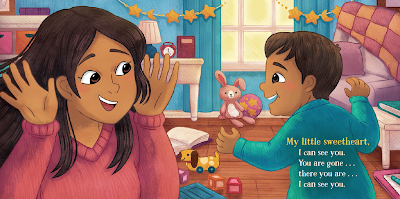
Concepts books, i.e., those that teach concepts such as the alphabet, colours and numbers, are always valuable resources for parents and teachers. These books introduce young children to early learning but, if handled well, will entertain while that learning is happening. With bright illustrations, a simple rhythm of repetition and a unique cultural foundation for that learning, I Can See You will teach, delight and enlighten.

From I Can See You by Rosemarie Avrana Meyok, illus. by Michelle Simpson
In I Can See You, mothers and grandmothers endearingly play with babies, based on the senses of seeing, hearing, smelling, feeling and even tasting. Embraced with obvious adoration, a baby, always called "my little sweetheart" is experienced fully by the parent or caregiver.
 
From I Can See You by Rosemarie Avrana Meyok, illus. by Michelle Simpson
From playing peek-a-boo to giggles, hugs and kisses and cuddles, each baby is well-loved and the basis for readers, and undoubtedly young listeners, to understand how the five senses can be the vectors for that love.

From I Can See You by Rosemarie Avrana Meyok, illus. by Michelle Simpson  
Born in NWT and residing in Nunavut, author Rosemarie Avrana Meyok speaks from experience both of people and place. As a great-grandmother, she has undoubtedly done her fair share of baby cuddling and nurturing. Her words are simple, as appropriate for a concept book, but never shallow. Rosemarie Avrana Meyok gives depth of feeling to those words but also experience with their message. From the baby in an amautik (parka with a hood for a baby) receiving kunik (nose kisses) from her mother to an Arctic landscape of cottongrass and saxifrage or northern lights–depending on the season– I Can See You takes young readers to the far north. In her joyful artwork, Niagara Falls illustrator Michelle Simpson brings that landscape to life, in its people and its place. The vegetation is distinctly that of the tundra, the stilted houses are raised above the permafrost, the stuffies include walrus, narwhal and snowy owls, and there are earrings that are beaded or resemble the ulu. Everything speaks to an Arctic community and an Inuit culture at its heart. And more at its heart is the love of mother or grandmother, perhaps aunt or sister, for babies who are seen, heard, touched, tasted and smelled with tenderness, knowing all the love that every child deserves.

February 25, 2022

Funny Pages Festival: April 22 (Halifax and Online)


It's time to get kids laughing again by celebrating books that crack them up with the hope "to laugh low literacy rates right out of existence." 
This brainchild of author Vicki Grant is the aim of Canada's first and only festival dedicated to children's books of humour.


For parents, teachers and kids interested in participating here are some of the details:

Date:                 Friday, April 22, 2022

Participants:     Kids of Grades 4 to 8

Events:             Author presentations, writing workshops, book signings and online fun. Plus there will be the awarding of the first Funny Pages Readers' Choice Awards.

Presenters    This year's presenters will include Kate Beaton, Sheree Fitch and Angela Misri

Location:         Halifax Central Library (public health guidelines permitting) and Online
 
Tickets           Available to schools at www.funnypages.ca on March 1st, with only 25  tickets per school. As per public health guidelines, 250 free tickets will be available through Eventbrite.  (If public health guidelines permit, more tickets will become available closer to the event.  Also, several tickets have been set aside for marginalized groups and home-schooled students.)


Full details about the Festival, the presenters, tickets and more are posted at the Funny Pages Festival website.

February 23, 2022

The Chandler Legacies

Written by Abdi Nazemian
Balzer & Bray (HarperCollins)
978-1-06-303932-2
336 pp.
Ages 13+
February 2022
 
Through the voices of fourth-formers (sophomores) Beth Kramer, Sarah Brunson and Ramin Golafshar and sixth-formers (seniors) Amanda Spencer and Freddy Bello, readers will enter Chandler Academy in Connecticut, a microcosm of concentrated reality. All the good and bad of the outside world is focalized in that elite boarding school and readers are invited to view it from the multi-faceted perspectives of the story's protagonists.

The year is 1999 and Ramin is entering Chandler for his first time. He may have left behind his great love and the danger of being gay in Iran but he is now subjected to a new kind of homophobia and bullying. However, he finds a place of belonging within the Circle, an exclusive writing group under the guidance of Professor Hattie Douglas. Also invited into this group are Brunson, a driven young woman who writes for the newspaper, the Chandler Legacy; Beth, Brunson's former roommate, who is dealing with anxiety; wealthy, popular, and beautiful actor Spence; and athlete Freddy. Through their writing and Circle meetings, the five become friends and establish a support system that they may not have realized they needed. Their writing may allow them to explore who they are...
 
...even fiction is non-fiction, because it reflects the author's truth. (pg. 76)
 
...but it reveals what the others have been experiencing. And some of that is not good. In fact, some of it is abusive.
 
How these five young people, amidst their peers, teachers and families–good, bad and innocuous–grow into the extraordinary people of Abdi Nazemian's prologue and epilogue of 2008 is the legacy of their time together as Circle members at Chandler. Their legacy is what they learned, what they achieved and what they conquered. They are the Chandler legacies and these are legacies of which they should be enormously proud.

Author Abdi Nazemian jumped on the YA CanLit scene with Like a Love Story (2019), garnering much attention, including a White Pine nomination and selection as a Stonewall Honor Book. With The Chandler Legacies, he has again given voice to a diverse group of young people and exposed their vulnerabilities and strengths in dealing with the challenges of coming of age, including their sexualities, mental health, bullying, friendship, family and self-expression. Beth, Spence, Freddy, Brunson and Ramin each have their own stories, yet they come together to share one as students at Chandler and as young people who are trying to find their ways in a world that is not always just or easy. While there is an introductory comment from the author that some aspects of the story may be triggering–resources are provided if the reader chooses to seek outside help–Abdi Nazemian writes with sensitivity and without the motive of shocking readers. In fact, beyond sensitivity, he addresses the challenges the students are experiencing with compassion, leading them and the reader to understanding and grace.
 
There is a rawness to The Chandler Legacies which is not unlike the experiences endured by Ramin, Beth, Brunson, Spence and Freddy. They struggle with becoming the people they are destined to become, as they question, argue, learn and care. And still they thrive in their world within Chandler so that their legacy is one of hope and courage to do what's right for themselves and others.

February 17, 2022

DC Canada: One Story A Day Writing Contest

For teachers and parents who would like to get kids writing purposefully, here is a contest for children in Grades 1 through 6.
 

The Contest
• Submit a short story. (One submission per person.)
  • Grades 1-2: 50 to 100 words
  • Grades 3-4: 150 to 250 words
  • Grades 5-6: 250 to 350 words
Eligible Participants
• Students who are in Grades 1 through 6 and reside in Canada

Submission deadline
• 12 PM (EST) March 31, 2022
 
Judging:
• A panel of judges will evaluate each story based:
    • Creativity (uniqueness of ideas, topics, objective of story)
    • Writing style (narration, word choice, description, figurative language, text organization/logic), and
    • Grammar (spelling, punctuation, sentence fluency).

Prizes:
• The top 3 winners in each category will receive a cash prize and be published in an illustrated storybook. 
• The school with the most participants will also win a prize pack of DC books!
• Approximately 30 stories will be published in the illustrated book.

Details:
Details about the contest including rules and regulations and how to submit are posted at https://www.dc-canada.ca/story-writing-contest-2022/

February 16, 2022

CBC Books: The First Page 2022 Student Writing Challenge


Get your students in Grades 7 to 12 writing with
CBC Books'

2022

THE FIRST PAGE
STUDENT WRITING CHALLENGE

The Challenge:  
• Write the first page of a speculative fiction novel set 150 years after 2022 exploring how a modern day current affairs event or trend has played out.
• Submission should be between 300 and 400 words. (It must not exceed 400 words.) Be sure to give your "book" a title.

Eligible Participants:
• All Canadian residents who are full time students enrolled in Gr. 7 to 12 may enter.

Timeline:
• Submit here between 9 AM (ET) February 1, 2022 and 9 PM (ET) February 28, 2022

Selection:
• A team of Canadian middle grade and YA writers will help curate the two shortlists, based on:  creativity, critical thinking, and quality of writing.

• The final judge, author Sarah Raughley, will determine the winners of the two categories.

Prizes:
• One year subscription to OwlCrate, a monthly delivery of a box of books (winners will choose from MG or YA packages).
• The school library of each winner will also receive a donation of 50 books.

Full details of this writing challenge are provided at CBC Books with rules and regulations available here.

February 14, 2022

Muinji'j Asks Why: The Story of the Mi'kmaq and the Shubenacadie Residential School

Told by Muinji'j and Shanika MacEachern
Art by Zeta Paul
Nimbus Publishing
978-1-77471-047-0
40 pp.
Ages 5+
January 2022 

Though the horrors of the residential schools has long been known, recent discoveries and revelations have brought shock and questions from more of us. Now imagine being a child whose family's history includes those residential schools. There would be questions, many questions. Hence, Muinji'j Asks Why.

Muinji'j, one of this book's storytellers, is a seven-year-old child who returns from school distraught that that day's schooling included discussions about residential schools that differed from what she'd been told by her Mi'kmaq grandparents, Nana and Papa. They decide it is time to tell her the history of her people.
From Muinji'j Asks Why by Muinji'j and Shanika MacEachern, illus. by Zeta Paul
From the beginnings when the Mi'kmaq were the one people present, Nana and Papa tell of a life born of Mother Earth. They tell of a way of life in which children were taught from their Elders and became knowledge keepers. Then, other people arrived to explore Mi'kma'ki and, what had begun as a relationship of cooperation and sharing, soon became one of control and assimilation. The Mi'kmaq may have been moved to reservations and unable to live their traditional ways but they still held onto their language and beliefs, no matter how much this angered the men who had all the power. And so, in a final push to convert the Mi'kmaq to their ways, they built schools to teach the Canadian way of life. 
From Muinji'j Asks Why by Muinji'j and Shanika MacEachern, illus. by Zeta Paul
The children were taken away by force and in Mi'kma'ki–today's Nova Scotia, New Brunswick and Prince Edward Island–they went to the Shubenacadie Residential School. There children had their hair, their clothing, their beliefs and their language taken and eventually they started to think the same as the others. They'd been taught to be ashamed of their heritage, and returning home caused them even more confusion, not fitting in as they once did. 

When little Muinji'j asks about the children who died at residential schools, Papa tells her with great sadness of the deaths of children from sicknesses and cruelties, and the overwhelming losses to families who rarely knew of the tragedies until long past.
From Muinji'j Asks Why by Muinji'j and Shanika MacEachern, illus. by Zeta Paul
Finally Nana shares with Muinji'j that, though the schools have closed, the hurts from the suffering have not gone away.
It is hard to heal from suffering that last lifetimes. It is hard to heal when so much was taken away and so much harm was done. But our people work together to heal and to be well. 

Still, by Muinji'j now knowing the stories, the truth can be shared. And with Muinji'j Asks Why, the sharing can continue.

Children hear and want to learn. They want to know the truth but the truth may not always be available or it is provided by a secondary source who doesn't know the reality of that truth. By asking her grandparents, Muinji'j opened herself to learning the truth of their histories and experiences, and with the help of her mother, Shanika MacEachern, Muinji'j (who also goes by Breighlynn) MacEachern passes that story on. That story is inclusive in its breadth of storytelling and in its compassionate approach to a history that is both far-reaching, rich and troubling. With Mi'kmaw artist Zeta Paul's illustrations, the reality and starkness of that story comes to light. Her art is clear and defined, and conveys the pride of culture, the sadness of a people forced to assimilate, the darkness of the residential school experience, and the promise that the stories won't be lost. 

With this picture book and an obligation to work towards healing–Nana is right when she tells Muinji'j that "It is time now for all of Canada to help us heal"–the darkness may allow more light to shine in and from the culture and people of the Mi'kmaq.