November 07, 2016

Timo's Party

by Victoria Allenby
Illustrated by Dean Griffiths
Pajama Press
978-1-77278-008-6
48 pp.
Ages 5-8
October, 2016

Bunny rabbit Timo Vega learned in last year’s Timo’s Garden (Pajama Press, 2015) that he needed to spend a little bit more time tending to his friendships rather than obsessing about his garden and he’s learned that lesson well.  With food critic Madame LaPointe coming to Toadstool Corners as part of her search for the best small towns to visit, Timo agrees to host an apple festival in his orchard so that his friend Hedgewick Stump, the hedgehog, can show off his culinary skills.  But as soon as he’s made the offer, the crowd-averse rabbit is regretting his decision.
From Timo's Party 
by Victoria Allenby
illus. by Dean Griffiths

Organizing his tasks into a list of three things–invitations, decorations and games–Timo begins to feel that the Toadstsool Corners Apple Festival might be manageable after all. Though Hedgewick sees the attributes that will make Timo a great host–he is organized, generous and thoughtful–Timo’s other friends, knowing how much he hates big parties, advise him how to be confident and comfortable around lots of people.

With the help of his many friends, Timo is able to pull off a great party, and Hedgewick, with only a small cooking mishap, caters an impressive apple festival.  Like the very different apples and bananas in the recipe at the conclusion of Timo’s Party, Timo and Hedgewick come together spectacularly. Each brings their own strengths to their endeavour and are successful in supporting the other when needed.
From Timo's Party
by Victoria Allenby
illus. by Dean Griffiths
Timo’s Party is an exceptional early reader for imparting an engaging life lesson. But author Victoria Allenby never preaches or instructs the reader how to live life well, or be a good friend or be brave.  Instead, she swathes that message in Timo’s daily experiences, taking advantage of a true story-telling opportunity.  It’s easy to see beyond the anthropomorphized animals–with their clothes, speech, and human endeavours–as just a bunch of friends whose lives the reader is pleased to share.  Though not a fully-illustrated book, Dean Griffiths's artwork helps take the reader into the friendly world of Toadstool Corners.  From the plaid jacketed Timo with his subtle smile and relaxed ears, to the rose-toqued badger Rae and the bustling Hedgewick, Dean Griffiths gives life to the animals in Timo’s Party, taking them from characters to neighbours.  And, let me say, we are all pleased to have been invited to this party, and look forward to more good times in Timo’s neighbourhood.
From Timo's Party 
by Victoria Allenby
illus. by Dean Griffiths

November 03, 2016

On Our Way to Oyster Bay: Mother Jones and her March for Children’s Rights (A CitizenKid Book)

by Monica Kulling
Illustrated by Felicita Sala
Kids Can Press
978-1-77138-325-7
32 pp.
Ages 6-9
September 2016

Kids Can Press’ newest title in its CitizenKid series of books that promote children’s global citizenship has at its core the fight for those very rights.  Monica Kulling, who excels at sharing biographies of key individuals from science, engineering, the arts and social justice by partnering with illustrators to convey those stories, focuses this time on a pivotal moment in child labour activism.

From On Our Way to Oyster Bay
by Monica Kulling, illus. by Felicita Sala
Eight-year-olds Aidan and Gussie are fictionalized cotton mill workers in 1903 but they could be any child of the time: working twelve hour days, six days a week to help their families with much-needed earnings, yet yearning to be able to go to school.  The matronly Mother Jones, a labour activist who had helped organize picket lines and strikes and fought for better wages and working conditions, saw a new challenge in ending child labour.  Her plan was to get the message out to President Theodore Roosevelt that child labour was unacceptable and that children should be taken out of the work force and given the opportunity to attend school.  Her plan was to march with a contingent of adults and children from Kensington, Pennsylvania to the President's summer home in Oyster Bay, over a hundred miles away.

The July 1903 march required long days of walking in hot temperatures and camping out at night.  Not surprising that some marchers quit along the way, though Monica Kulling's fictionalized characters Gussie and Aidan stick by Mother Jones to the end.  Even with a partial train ride and local townspeople offering their support with food and shelter, the march took weeks.  Banned by the major of New York City from speaking at Madison Square Gardens and from holding a public parade, Mother Jones still found a way to spread her message and give the remaining thirty marchers the treat of a day at Coney Island.  But, when they finally arrived in Oyster Bay, the President refused to speak with Mother Jones.

Many might feel that Mother Jones and her march for children's rights had been a failure, but not Mother Jones, and she shares this with Gussie and Aidan on the train ride back home.  She had drawn attention to the problem of child labour in their country and that small step would become a massive step in getting children out of the mills and factories and into schools.

The story of Mother Jones a.k.a. Mary Harris Jones is an important one in the fight for children's rights and, though her march for children's rights took place in the United States, her cause was a just and global one, still being fought in some countries today.  Not only does Monica Kulling help readers understand the daunting task that Mother Jones took upon herself, she encourages them to take action themselves, providing references of current organizations fighting against child labour, and background information about child labour today and the work of other activists like Craig Kielburger and Kailash Satyarthi.

Though Monica Kulling does provide valuable information about the fight against child labour in her story text and afterword, On Our Way to Oyster Bay: Mother Jones and her March for Children's Rights is still at its heart a picture book, and Australian-born Felicita Sala's bold illustrations support both a lightness and the importance to the story.  Felicita Sala's artwork, which appears to be a mixture of pencil, ink and watercolours, shows the strength of Mother Jones and her supporters' commitment while balancing that against the Herculean nature of their task.  Bold outlined characters and placards give way to expansive landscapes in which the marchers seem insignificant.
From On Our Way to Oyster Bay 
by Monica Kulling, illus. by Felicita Sala
On Our Way to Oyster Bay: Mother Jones and her March for Children's Rights illustrates in text and pictures an important historical event in labour activism while bringing that event into the 21st century and inspiring children to think about what they can do to support children's rights. Mother Jones would be proud.

November 02, 2016

What is Peace?: Book launch (Toronto)

Another Story Bookshop 

and 

the Toronto Public Library

present

award-winning author and illustrator
of

Wallace Edwards

for the launch of his newest book

What is Peace?
Text and illustrations by Wallace Edwards
North Winds Press/Scholastic Canada
978-1-4431-4843-6
32 pp.
Ages 4-10
November 2016

on 
Saturday, November 5, 2016

at 2 p.m.

at

Lillian H. Smith Library
(branch of the Toronto Public Library)
239 College Street
Toronto, ON


November 01, 2016

What is Peace?

Text and illustrations by Wallace Edwards
North Winds Press/Scholastic Canada
978-1-4431-4843-6
32 pp.
Ages 4-10
November 2016

If you’re seeing the red felt poppy pins on coats, you’ll be starting to think about Remembrance Day and war and peace.  The concept of peace is a prodigious one.  Imagine attemping to encompass all aspects of peace in a single book, especially a picture book?  Fortunately, with Wallace Edwards at the helm of that undertaking, and the use of his glorious illustrations and a multitude of questions to guide this reflective discussion of peace, enlightenment is on the horizon.

Each double spread has one page of text–a series of questions, culminating with a final line “What is peace?”–and a full page illustration.  From a bird on a cherry blossom branch with accompanying questions on the temporal and spatial nature of peace–old, new, near, far– there follows a range of quiet and evocative illustrations and questions about peace’s inclusivity, its study, its sensory nature, as well as expressions and attributes of peace.  Wallace Edwards covers all nature of peace without ever defining what it is, relating to this in the appending text titled “What Do You See?” (pg. 30), in which he admits that there are no right or wrong answers.

From What is Peace? by Wallace Edwards

In the preface to the book, Wallace Edwards discusses how, after being asked to do a series of paintings on the theme of peace, he found it himself meditating on the question that is the title.  And after recognizing how big a question it is, Wallace Edwards hopes that the book “inspires you to think and talk and maybe draw or write or sing about what peace means to you and the other creatures who share this world.” (pg. 3) Ever thoughtful, Wallace Edwards inspires with his words and artwork of all nature of creature and substance: mandrill, luna moth, zebra, crumbling wall, rhinos, and the ubiquitous white bird evident on every illustration.

By recognizing the distinctiveness of peace and a commonality to it as well, Wallace Edwards has shown us the way that is peace without actually driving his own definition of it onto the reader.  What is Peace? is an eloquent discussion starter and contemplative tome for a month of remembrance and loss and hope.

From What is Peace? by Wallace Edwards

Look for my post tomorrow about the book launch for What is Peace? in Toronto this weekend.

October 31, 2016

Bera the One-Headed Troll

by Eric Orchard
First Second / Roaring Brook Press
978-1-626721067
128 pp.
Ages 7-14 
August 2016


With today being Halloween and Bera the One-Headed Troll being filled with pumpkins and trolls and witches, it seems only fitting to review this graphic novel today.  Written and illustrated by Eric Orchard, the illustrator of the recently reviewed If I Were a Zombie (Kate Inglis, Nimbus, 2016) –am I sensing a monstrous theme here?–Bera the One-Headed Troll is atmospherically perfect for a fun but teensy bit scary read.

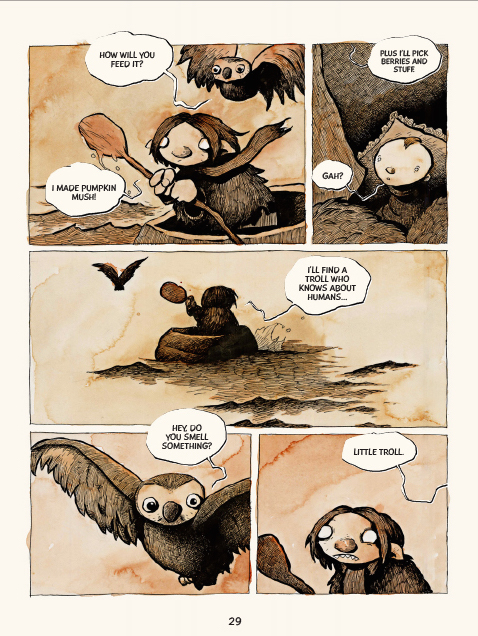
Bera, who lives on an isolated island with her owl companion Winslowe, is the official pumpkin gardener of the Troll King. (There’s the pumpkin connection for Halloween,  and, except for the cover and an occasional candle burning yellow, it’s the colour scheme of all the book’s graphics.)  When Bera rescues a human baby from three evil mermaids (they are not of the lean and lovely variety), she takes upon herself the task of returning the baby to its humans.  But that is contrary to the wishes of the malevolent Cloote, former  head witch of the Troll King, who wishes to use the baby to return to the good graces of the Troll King.
From Bera the One-Headed Troll 
by Eric Orchard
Bera who feels unprepared for dealing with the baby decides to seek a hero from her books, specifically choosing Wulf the Dragon Masher.  On their journey, Bera and the baby, with Winslowe scouting from above, encounter the mermaids again, as well as the Guardian, a sea monster as big as an island, and a bunch of hedgehog wizards.  Thankfully this last group whose mandate it is to protect the creatures of the wood already know firsthand of Cloote’s destruction and offer to steer Bera to Wulf’s tower.  Wulf, a troll of epic proportions and light-spirit (“Hey, is that a baby?”, “Well, look at that” and “Imagine that!”; pg. 52), has not been on an adventure in a very long time and, though willing of spirit, he succumbs to his epic sleepiness.

So Bera goes in search of another hero, finding both Duke Otig, the two-headed troll hero of the troll-giant war, and then the three-headed Nanna the Great.  But the reader will soon realize that heroes are not just those who undertake adventures and engage in battles.  Heroes are also those who make extraordinary sacrifices to do ordinary things, making their own quests in the spirit of goodwill, not glory.
From Bera the One-Headed Troll 
by Eric Orchard
Bera the One-Headed Troll is a offbeat graphic novel filled with trolls (one-, two- and three-headed varieties), goblins, witches, and rats (Vince is particularly helpful) and positive messages about offering assistance to those in need.  With only her want to do the right thing, Bera takes herself out of her comfortable pumpkin patch island and discovers new strengths and instincts, while making some new friends and good karma in the process.  I thought Bera the One-Headed Troll was going to be a dark, dark tale for a Halloween night, and its graphics would’ve supported that notion.  Eric Orchard’s trolls and witches and other creatures could be seen as darkly unnerving, as are the settings of straggly trees and murky swamps and stone edifices.  But Bera the One-Headed Troll is neither dark nor frightening.  It is a positive message wrapped in a dark cloak festooned with pumpkins.  Read it for Halloween but take its guidance beyond the day.

October 28, 2016

Mouse Vacation

by Philip Roy
Illustrated by Andrea Torrey Balsara
Ronsdale Press
978-1-55380-479-6
32 pp.
Ages 4-8
October 2016

Compromise is tough enough between humans.  Imagine trying to compromise with an adorable mouse who has great imagination and wanderlust but no sense of distance or costs.  Happy the Pocket Mouse has decided the solution to a case of the boredom blues is for him and his human, John, to go some where.

For John, though, going somewhere usually means someplace close to home, like the store or the park.  But Happy has other ideas, and he has lots of them.  So, John recommends that they each make a list of places they’d like to go.  John is thinking the woods and the river, but Happy’s thinking the Taj Mahal and New Zealand.

Finally John introduces the idea of compromise, a meeting in the middle, which Happy jumps on, proposing meeting in Egypt, or Paris or even New York City, all of which John nixes based on cost.  John’s suggestion about an overnight bus ride to the nearest city to see the Tall Ships finally grabs Happy’s attention, especially John’s description of them as “ghosts from the past” (pg. 23).  Still, finally settling down for the night, the excited little mouse checks with John about one potential stop on the way home!
From Mouse Vacation 
by Philip Roy, illus. by Andrea Torrey Balsara
I’ve reviewed every Happy the Pocket Mouse story that Philip Roy and Andrea Torrey Balsara have created: Mouse Tales (Ronsdale, 2014); Jellybean Mouse (Ronsdale, 2014); and Mouse Pet (Ronsdale, 2015).  The foundation of each picture book is the endearing relationship between John and Happy.  John is like the laid-back best friend/dad who radiates subtle wisdom and empathy while Happy is this adorable, adorable innocent whose heart is filled with love and mind brims with imagination.  (I love the sweetness of his response to John’s suggestions: “That’s okay, John, we’ll just go somewhere else”; pg. 5) By having John and Happy working out what it means to take a vacation and finding a way to compromise, Philip Roy has again produced a charming life lesson in a story book.  And Andrea Torrey Balsara flawlessly brings the story to visual completion, ensuring John looks like the man who is wise and caring and Happy is effusive with sweetness and virtue.  But, this time, Philip Roy’s story allows Andrea Torrey Balsara to create wild backgrounds for Happy: on a cow at the Taj Mahal, roasting a marshmallow over a candle while camping, riding a camel in Egypt, or sporting an “I ❤︎ NY” T-shirt.  Still, the magic is in the collaboration, between the text and illustration and between John and Happy.  That's what makes the story, and Philip Roy and Andrea Torrey Balsara have done it again, blending the two into a story of adventure for the mind, the heart and the soul.

From Mouse Vacation 
by Philip Roy, illus. by Andrea Torrey Balsara

October 26, 2016

The Story of Canada (new updated edition)

by Janet Lunn and Christopher Moore
Illustrated by Alan Daniel
Scholastic Canada
978-1-4431-1954-2
344 pp.
Ages 9+
September 2016

The Story of Canada was an important book when first published in 1992 by Lester Publishing and Key Porter Books.  It’s still an important book but even more so now with an additional twenty-five or so years of Canadian history to make the story of Canada more complete.  Students and teachers of history and Canadians, new and indigenous, will appreciate the completeness of this newest edition as a true compendium of Canada’s history.

The Story of Canada takes a journey through eleven chapters and an epilogue, with obligatory index, photo credits, and acknowledgements, as well as chronology. The table of contents, now neatly organized onto a single page, lists the following chapters:

  1. A Hundred Centuries
  2. Strangers on the Coast
  3. Habitants and Voyageurs
  4. The Colonists
  5. The Great Northwest
  6. Mountains and Oceans
  7. Confederation Days
  8. Sunny Ways
  9. Stormy Times 
  10. The Flying Years 
  11. New Millennium
  12. Epilogue: Northern Voyagers

Photo of spread from The Story of Canada 
by Janet Lunn and Christopher Moore,
illus. by Alan Daniel

Thought the initial note To the Reader from The Authors at the beginning of the book is not included, The Story of Canada is essentially the same, as would be expected, except for amendments to the formerly-last chapter, The Flying Years, and the addition of an eleventh chapter, New Millennium.  Discussions of First Peoples, the Vikings, New France, exploration, Confederation, the gold rush, immigration, two world wars, the Great Depression, and the 1950s-1970s are essentially unchanged.  But now there are greater discussions about the free trade agreement and what it meant for Canada’s economy and the controversy that was the Meech Lake Accord, as well as conflicts in the global village.  The New Millennium chapter delves more into technological achievements and more milestones for Canada such as Chris Hadfield’s command of the International Space Station, the growing diversity of our populations, and the appropriately-increasing role of women in government and culture.  Sadly this chapter also examines life in the aftermath of September 11, 2000 and the growing reach of terrorism, as  well as the Great Recession, the refugee crisis, environmental disasters and the need for Truth and Reconciliation for our indigenous people.  Though this chapter is hardly one of a contented country, it is not unlike our history in general:  busy with conflict, evolution and achievement, not all of which we should be proud.  But, as is said, it is what it is.  Finally, the epilogue, titled Northern Voyagers, goes beyond the adventures and legendary songs of the Northwest Passage, now emphasizing the discovery of Franklin’s Erebus, ending with the prophetic words of Journey of Nishiyuu leader David Kawapit:
This land, the earth, the rivers, the winds, the mountains, the clouds and all of the creation, we are the true keepers and will continue to do so until time on earth is over. (pg. 313)
As more time passes, The Story of Canada will become the keeper of more and more of our history (the chronology appending the book now extends beyond 1992 to 2016, including Blue Jays’ victories, the establishment of Nunavut, the SARS epidemic and the Vancouver Olympics).  As with the telling of any history, there will be those that disagree with the emphases or perspectives of the authors but I believe that Janet Lunn and Christopher Moore have prepared a fair and comprehensive and up-to-date history of Canada in The Story of Canada, giving voice to all peoples, all centuries, all blemishes and glories, in an effort to recount and enlighten.  Enhanced by numerous photographs and Alan Daniel’s illustrations, includng many double-spread, for which he did exhaustive research at various archives and art collections, The Story of Canada has learned from its own history to become more inclusive and truly more Canadian, reaching beyond what we have been and into the future of what we are to become.