March 30, 2013

World Autism Awareness Day, April 2: Book List

 
(updated June 2017)

According to Autism Society Canada, Autism Spectrum Disorder (ASD) is a neurological disorder that affects the way the brain processes information, resulting in developmental disability.  Communication, social interactions and behaviours are affected to different degrees in individuals with ASD.

To encourage education and awareness of ASDs, April 2nd has been designated as World Autism Awareness Day. To support that mandate, I'd like to present this short list of youngCanLit book titles that includes fiction with characters that display ASDs or that aim to educate readers about Autism Spectrum Disorder. Share this reading with others and help extend those who have a better understanding of this neurological disorder.

PICTURE BOOKS

Dinosaur Diego: The World's Smartest Dude: Asperger's Syndrome (Autism)
by Jill Bobula and Katherine Bobula
Illustrated by Rob Hall
Wildberry Productions
36 pp.
Ages 5-9
2008
Diego may know everything about dinosaurs but his daily life isn't as clear cut as he tells readers about his Asperger's.


FICTION


Burn
by Alma Fullerton
Dancing Cats Books/Cormorant
255 pp.
Ages 10-13
2010
After her mom takes off, Casey must deal with her autistic sister Ginny, taunts from friends and bullies, and her mom's partner's despair and despondency.  


Don't Tell, Don't Tell, Don't Tell
by Liane Shaw
Second Story Press
272 pp.
Ages 12-16
2016
Teen Frederick is taken outside his comfort zone of routines when he helps a friend.
Reviewed here


The Encyclopedia of Me
by Karen Rivers
Arthur A. Levine Books/Scholastic Canada
251 pp.
Ages 10-13
2012
In the encyclopedia of her life that she writes while grounded, Tink deals with all events and issues, including living with her autistic older brother Seb.


Everyday Hero
by Kathleen Cherry
Orca Book Publishers
168 pp.
Ages 8-11
2016
Thirteen-year-old Alice may be initially helped by goth-inspired Megan but it's Alice who ends up being the hero to her new friend.
Reviewed here


Fragile Bones: Harrison and Anna  
by Lorna Schultz Nicholson 
Clockwise, Press 
217 pp.
Ages 13+ 
2015
Hugh-functioning autistic teen Harrison teams up with Anna in the Best Buddies program at their high school.
Reviewed here


Gemini Summer 
by Iain Lawrence 
Delacorte Press / Random House Canada
261 pp.
Ages 10-13
2006
It's 1965 and the summer of the Apollo Gemini mission. In Canada, the tragic death of Beau River, the younger brother of the protagonist Danny, is initially blamed on Dopey, a boy who ostensibly has a developmental disorder such as ASD.


Looking for X
by Deborah Ellis
Groundwood Books
132 pp.
Ages 11-13
1999
Eleven-year-old Khyber who lives with her mom and autistic twin brothers in Toronto's Regent Park befriends a homeless woman, X.


Seeing Red

by Ann Louise MacDonald
Kids Can Press
220 pp.
Ages 9-13
2009
Frankie, who has disturbing dreams with unclear messages, volunteers at a therapeutic horse ranch where he works with a young autistic boy.


Shimmerdogs
by Dianne Linden
Thistledown Press
134 pp.
Ages 9-13
2008
When his mother joins a peacekeeping mission in Bosnia, Mike becomes fixated on death, finding solace with unusual companions both real and otherwise. 


Shooter 
by Caroline Pignat 
Razorbill
320 pp.
Ages 12+
2016
Five teens barricaded in a school washroom during lockdown include a girl and her older autistic brother.
Reviewed here


The Space Between
by Don Aker
HarperCollins Canada
245 pp.
Ages 14+
2007
Eighteen-year-old Jace deals with middle-child syndrome, between his wildly successful older brother Stephan, now dead, and Lucas, his younger brother whose autism garners him much needed special attention.
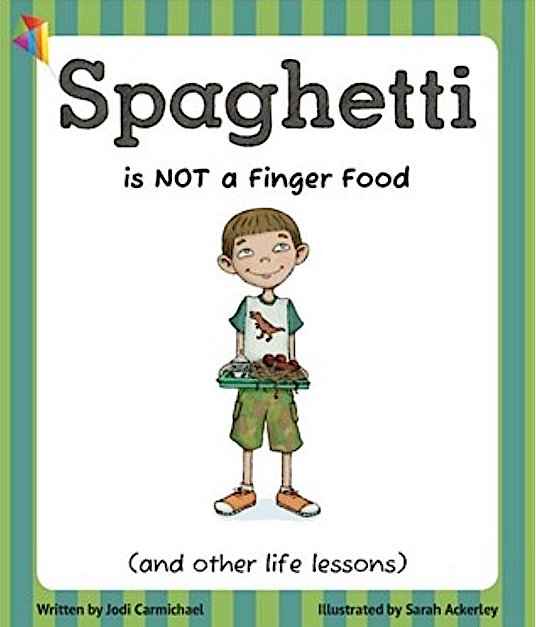


Spaghetti is NOT a Finger Food (And other life lessons)
by Jodi Carmichael 
Illus. by Sarah Ackerley
Little Pickle Press/Sourcebooks Jabberwocky
152 pp.
Ages 7-10
2013
Gr. 3 student Connor shares life lessons from a single day at school in which his ASD helps define his routines, likes and dislikes and interactions with others.


Waiting For No One
by Beverley Brenna 
Red Deer Press
187 pp.
Ages 13+
2010
Taylor (from Wild Orchid, 2005) is becoming more independent after her summer of change. She is taking a university course, working at a bookstore and learning how to keep herself out of the "red zone" where she speaks and acts inappropriately.


Wild Orchid
by Beverley Brenna
Red Deer Press
156 pp.
Ages 12+
2005
Eighteen-year-old Taylor, who has Asperger's, graduates from high school and pursues her goals to get a job, make a couple of friends and find a boyfriend.


You Can't Take Micky!
by Sonia Craddock
Scholastic Canada
137 pp.
Ages 9-11
1986
Siblings Claire (13) and Adam (11) run away with their four-year-old autistic cousin Micky when they fear he will be placed in an institution.

March 28, 2013

The Way We Fall

Written by Megan Crewe
Hyperion Disney Group
978-1-4231-4616-2
308 pp.
Ages 12+
2011

There are many ways to fall.  You can fall down, fall in love, fall apart, fall asleep, fall at someone's feet, fall back, fall away, fall behind, fall flat on your face, fall short, fall afoul. And in Megan Crewe's first book in her YA Fallen World Trilogy, The Way We Fall, someone at sometime has demonstrated each type of falling.  On an island that succumbs to the wrath of an infectious virus, "falling" becomes the norm.

Through the journal entries of sixteen-year-old Kaelyn, ostensibly to her former best friend Leo who is going to school off the island, the reader is taken on a harrowing trek from health to illness to fear and death, with valiant efforts throughout to manage, if not eradicate, a contagion.  When the infection first hits, it is hard to differentiate it from a cold, with the typical coughing and sneezing.  However, when relentless scratching is evident, followed by displays of extreme expression of affection, distrust and hysteria, coupled with delusions, hospitalization is required. As the microbiologist on the island, Kaelyn's father becomes a central figure in the investigation of the virus, and Kaelyn, her older brother Drew, and Mom, an islander who manages the local café at the local service station, are among the first to wear masks and keep themselves home to avoid contact with others.

With the spread of the illness and deaths recorded from it, some islanders find their way off the island, though some, like Kaelyn's Uncle Emmett and her seven-year-old cousin, Meredith, are encouraged to wait until the mainland has secured a site to process them.  But, when the island is quarantined, the residents become reliant on the mainland government for food and medical and other supplies, a position that many protest, with consequences.  The reactions of the islanders as well as the mainlanders, including soldiers sent to offer protection, to the quarantine could warrant a study in fear.

While Kaelyn volunteers to notify residents of the quarantine and help get ill residents to hospital, Leo's girlfriend Tessa is recruited to help grow plants that may offer hope for treatment (a passionate gardener, Tessa has her own greenhouse).   A young man, Gav, who'd organized a group of guys into a Fight Club, had them "looting" from the grocery store and storing goods in a warehouse, arranging deliveries to those who couldn't get out, were ill, or had no support systems.  Through a series of interactions, including Gav coming by to teach them some self-defense, he and Kaelyn grow closer, offering each other support and affection in a troubling situation.

While I have shared very little about the sequence of events that lead to the story's end, probably because the plot and subplots are complex (but elegant), the reader will not be given much reprise from action and chaos of a community faced with more than a contagion; the mentality of those quarantined presents as much turmoil as the fatal infection itself.  The psychological responses of the residents to living with a contagious illness and in a quarantined situation vary from heroic and charitable to egocentric and even mercenary.  With a complex menagerie of characters, coupled with Megan Crewe's plotting and organizational style i.e., Kaelyn's short, dated journal entries addressed to Leo, The Way We Fall successfully keep readers interested throughout, appropriately earning it a nomination for this year's Forest of Reading®'s White Pine Award.  While the book offers some hope in its conclusion, don't expect everything to be resolved by the time the ferry finally approaches the island again; after all that falling, it will take a lot to help everything right itself ("in love" exempted).

Luckily, The Lives We Lost, Book 2 in the Fallen World Trilogy, came out just last month, and the title of the third book, The World We Make, has been announced for release in the winter of 2014. Megan Crewe can be assured that this reviewer will be pursuing those titles promptly, determined to learn more about Leo, Drew, Aunt Lillian, the underlying hostility between Drew and Gav, and the only positive fall - Kaelyn and Gav in love.

March 25, 2013

Mister Dash and the Cupcake Calamity

by Monica Kulling
Illustrated by Esperança Melo
Tundra Books
978-1-77049-396-4
32 pp.
Ages 3-6
March 12, 2013

Mister Dash is back!  The well-mannered pooch from Monica Kulling's Merci Mister Dash! (Tundra, 2011) is still sharing his life with Madame Croissant who has started Cupcakes à Go-Go and using her well-bred (I mean polite; I'm not sure 5 different breeds in one dog would be considered successful breeding) canine for delivery.  And, just as in his first book, Mister Dash must contend with the lovely lady's hurricane of a granddaughter, Daphne.

In Mister Dash and the Cupcake Calamity, Madame Croissant is extending her cupcake baking enterprise into North America.  Using a well-used van and custom-made paniers for Mister Dash, the lusciously-decorated cupcake treats would be delivered très rapide! Though he's not thrilled to be in his new outfit, Mister Dash is nothing but accommodating and loyal, helping his mistress as he can (although when the van breaks down, he holds some hope for a reprise).

But Mister Dash cannot evade the enthusiastic flurry of Daphne, Madame's granddaughter, though he does try to slip out in a very clever disguise.  Sadly, even Madame cannot keep Daphne from creating havoc in the kitchen, while baking, and even on delivery.  But Mister Dash, the ever clever companion, comes to the rescue when the delivery of five hundred cupcakes to the mayor's house is in danger of being trashed.

Monica Kulling gives such sweet voice to Mister Dash who questions, ponders and evaluates before springing to action as needed. He is responsible, faithful, and has a flair for picking up the pieces (as well as flour, dough and cupcakes) after things go awry.  He is the embodiment of chivalry, albeit in a canine form, made all the softer for Esperança Melo's warm acrylic paintings.  Daphne may be a smiling bull in a china shop, and Madame Croissant the Julia Child of the fashionable baking set but Mister Dash is Sir Galahad:  courageous (you'd have to be to ride in the van driven by Madame Croissant), gentle and polite. The story is smooth, sweet and sparkles with goodness, not unlike Madame Croissant's cupcakes. A tasty treat, to be sure.

March 21, 2013

Assured Destruction

Written by Michael F. Stewart
978-0-981269948
183 pp.
Ages 13+
March 22, 2013

Tomorrow Michael F. Stewart's first book Assured Destruction hits the market and, with its savvy plotting and tech focus, it's sure to be the start of a successful series.  And there's even a little romance going on.

Assured Destruction may normally refer to a principle of military strategy but here it refers to the Ottawa service that Janus, 16, and her mother run with the mandate of destroying and recycling hard drives and other electronics.  Except for Fenwick, their forklift operator and general works employee, Janus does a lot to keep the business running, as her mother has multiple sclerosis and generally works on the administrative needs of Assured Destruction. But Janus has a little secret cache of hard-drives that she keeps back from destruction by their metal shredder, affectionately known as Chop-Chop, so that she can poke around for secrets.
Secrets are power. (pg.7)
In fact, the story begins with Janus taking the hard drive of a classmate of her's, Jonny Shaftsbury, after being dropped off by his mother. Though it is slated to be destroyed, Janus is intrigued because Jonny has seemed interested in her. So, along with her other Shadownet terminals, for which she has created different personas and Twitter accounts, Janus adds Jonny's which becomes Paradise57. 

When Janus realizes that two individuals from whom she held back HDs have been targeted, one by robbery and the other with allegedly posting pornography, and the police come by about leaked names from other computers dropped off at Assured Destruction, Janus knows something wicked is unfolding but she can't admit her involvement for fear of making the business liable.  But things go from bad to worse when Janus sets up a trojan to learn who has set up a site where she appears to be the administrator.  Instead, all of Janus' networked computers and server go down, and she is suspended from school, grounded at home and questioned by the police.

Soon Janus realizes that her Shadownet of virtual people does not provide the solace it once had.
...I'm not sure I care as much about these people anymore, they don't seem as real as they once had. (pg.120)
In fact, Janus is finding herself attracted to Jonny and another classmate, Karl, who both show an interest in her, but her precarious status has her questioning everyone's trustworthiness, including her mom's new boyfriend, Peter.  While Janus is very tech savvy, she had never anticipated someone hacking her and putting the life that she and her mom have in jeopardy.

While I would consider myself familiar with the use of technology, the programming and hacking exploits of Janus and others would have left me confused if not for Michael F. Stewart's ability to explain without explaining.  Janus' reactions and valiant efforts to stay the consequences of the cyber attacks provide clarity enough to know when something is working or not working. Keeping the hard drives may seem reprehensible but for a girl who is working hours upon hours at the family business (since her dad took off), her Shadownet people are her friends.  She has no time for others.  Maybe she shouldn't have saved them from Assured Destruction but what has been done to her and those whose hard drives she has "borrowed" is far beyond justifiable.  The hacker's actions are not there to incite better behaviour; they are completely selfish.  And Michael F. Stewart has no problem convincing the reader that the world of the Shadownet and hacking is a dark and dangerous one, not a strategy game for all ages.  While there were a few instances where I felt that the writing could have been tighter to ensure clarity and impact, Assured Destruction's fast pace, intricate plotting and atmosphere of unease has me looking forward to Michael F. Stewart's next instalment. 


Just as I was preparing this review, I learned of this trailer for the book and thought readers might be interested.

ASSURED DESTRUCTION: Trailer
Uploaded by Michael Stewart on March 20, 2013 to YouTube.

March 19, 2013

M in the Abstract

by Douglas Davey
Red Deer Press
978-0-88995-487-8
216 pp.
Ages 14+
March, 2013

We all have voices in our heads directing our actions.  They may be the voices of our parents who reminded us what to do or not do; our consciences lacing our decision-making with guilt or clarity; our inner children begging to be heard; or even our own voices silently repeating a mantra for living a better life.  Most of us can tell the source of those voices and heed them accordingly.  But what if you couldn't discern the source of the voices?  Or they're so loud and insistent that they're impossible to ignore?  Or what if they seem to be accompanied by dark wispy shadows that torment and tantalize?  How do you make sense of your voices then?

This is Mary's reality (or maybe not).  For Mary, whose real name is Mariposa (though her mother always calls her Posey), the voices are persistent, often warning her against interactions with others and arguing with her choices or suppositions.
This is not a place for you (pg. 38)
Remember the last one seemed friendly (pg. 60)
Stop this before you get in over your head (pg. 63)
But with a move from the suburbs to town, Mary is exposed to new people at school and elsewhere.  Her mom may want Mary to change her look, to make new friends and to wipe away all memory of her dad (who'd inexplicably left ten years earlier), but these stresses continue to bring forth the voices and the dark shadows that drift around her.

Mary tries to appease her mother and even thinks about making herself happy, considering having a boyfriend after two different boys show an interest in her.  But her lack of experience interacting with others have her reconsidering every decision she makes, sometimes overreacting and confusing others.  As Mary tries to navigate successfully into new relationships, she begins to consider what the voices and shadows truly mean.

Douglas Davey presents Mary's situation in haunting colours of loneliness, confusion, dismal weather, and wispy shadows.  Even as Mary meets new people and experiences positive interactions, Douglas Davey does not allow the reader to forget the trepidation that accompanies each new encounter.  Sadly even as she enjoys moments of camaraderie and fleeting affection, they're sabotaged.  But the source of the sabotage is unclear.  When I began reading, I wondered whether M in the Abstract was speculative fiction and the voices fantastic elements of a new world. (In my defense, I try not to read too much about any book before I read it to ensure my review is truly my own.)  I realized soon enough that I was wrong. As the title suggests, Mary is an enigma, unsure of herself. When she signs the class register, she signs it as M, not Mariposa, not Mary.   The book M in the Abstract is as abstract as its protagonist in that it is a complex examination of a girl with legitimate worries and in transition.  How she interprets and deals with those concerns is profound, as is how the story resolves itself.  To its very end, the story is abstruse, just as it would undoubtedly be in reality.

March 17, 2013

Vanish: Book Launch Invitation (Edmonton)

Join

author Karen Spafford-Fitz
with Orca Book Publishers

on

Sunday, April 14, 2013

at

2:00 pm 

Audrey's Books
10702 Jasper Ave NW, Edmonton, Alberta

for the launch of her newest middle-grade novel, 
part of the Orca Currents series


Vanish
written by Karen Spafford-Fitz
Orca Book Publishers
978-1-45980-349-7 (pbk)
131 pp.
Ages 10-14
March, 2013

A story about an important friendship between a teen at a new high school and a kindergartener with secrets in her background.

 
ENJOY
  • a brief author discussion
  • readings from Vanish
  • a book signing, and 
  • refreshments

The official invitation (below) is posted on Karen Spafford-Fitz's FaceBook page.


March 15, 2013

Mäko

by Julien Béziat
Translated by Evan Jones
Fitzhenry & Whiteside
978-1-55455-275-7
36 pp.
Ages 5+
January, 2013

Don't let anyone tell you differently but art is sustenance.  Without art, there is no life.  Perhaps that seems like an over-the-top statement but in Julien Béziat's Mäko, translated by Fitzhenry & Whiteside editor Evan Jones, we learn that this is a reality.

Mäko is a walrus who, like most animals, spends much of his time searching for his food.  But after fishing, Mäko returns to the giant ice floe on which he and other animals live and uses his tusks to carve amazing ice sculptures.  

His sculptures are more than just a joyful hobby for Mäko - they provide key information to the locations of the fish that the animals need to survive.  When the giant ice floe breaks apart and all his ice maps are destroyed, so too do the fish disappear.  It's up to Mäko to find a way to help everyone survive.  But how?

The simplicity of Julien Béziat's story, whose integrity is maintained by Evan Jones' thoughtful translation, speaks of art, appreciation, global warming, responsibility and logic.  Why does the ice floe break apart?  Where have the fish gone?  Why does Mäko bother sculpting ice?  Do the other animals appreciate Mäko's efforts and artistry?  What sculpture could result in the reappearance of enough fish to feed everyone? Most important, the question that is answered so simply but eloquently is: what is the value of art?

The text is sparse, the illustrations are pen and ink with watercolour, and the story is succinct.  For any age, Mäko teaches that art is integral to life.